
MINNEAPOLIS — Target Corporation disclosed another period of falling revenues and earnings as the retail giant works to reconnect with shoppers who are grappling with elevated costs in nearly every sector.
However, the Minneapolis-based retailer delivered on Tuesday a promising yearly earnings forecast that surpassed what Wall Street analysts had anticipated. The company also expressed confidence that revenue will increase each quarter throughout this year.
Target additionally reported that same-store sales showed improvement at the beginning of the current quarter.
Stock prices surged over 4% in pre-market trading.
The retailer generated $2.30 per share, totaling $1.05 billion, during the three-month span ending January 31. This represents a decrease from $2.41 per share, or $1.10 billion, in the corresponding period last year. Modified earnings per share reached $2.44 for the latest quarter.
Revenue dropped 1.5% to $30.45 billion in the recent period. Annual sales declined nearly 2% to $104.78 billion.
Wall Street experts had projected $2.16 per share with revenue of $30.46 billion, based on FactSet polling data.
Same-store sales — revenue from existing locations and digital platforms — decreased 2.5%, following a 2.7% decline in the previous fiscal quarter. This latest number represents the 11th quarter out of the last 13 where Target recorded either decreases or minimal growth in this key metric.
Target’s results highlight the difficulties confronting new Chief Executive Michael Fiddelke, a two-decade company employee who replaced long-serving CEO Brian Cornell last month.
Fiddelke is scheduled to outline his turnaround strategy on Tuesday at the company’s annual shareholder meeting in Minneapolis. Investors are eager for Target to reclaim its previous reputation for stylish yet affordable merchandise that once earned it the playful moniker “Tarzhay.”
Fiddelke assumes leadership as Target’s Minneapolis headquarters finds itself at the center of President Donald Trump’s efforts to combat illegal immigration. Several company locations have become focal points in resistance to U.S. Immigration and Customs Enforcement operations. The corporation has faced demands to publicly oppose the immigration enforcement measures.
Prior to immigration-related tensions, Target had already encountered protests and consumer boycotts following its choice to scale back diversity, equity and inclusion programs. Opponents view this as abandoning Target’s charitable commitment to addressing racial inequality and supporting progressive causes in liberal Minneapolis and other markets.
These challenges exist alongside an unpredictable economic and political climate intensified by aggressive trade policies under Trump. The administration currently pursues a 15% global tariff after the U.S. Supreme Court invalidated many extensive import taxes imposed over the past year.
Although inflation rates have moderated, consumer costs have risen approximately 25% during the last five years. American corporations face uncertain prospects with struggling households, while the Trump administration attempts to circumvent the Supreme Court decision to maintain its tariff policies.
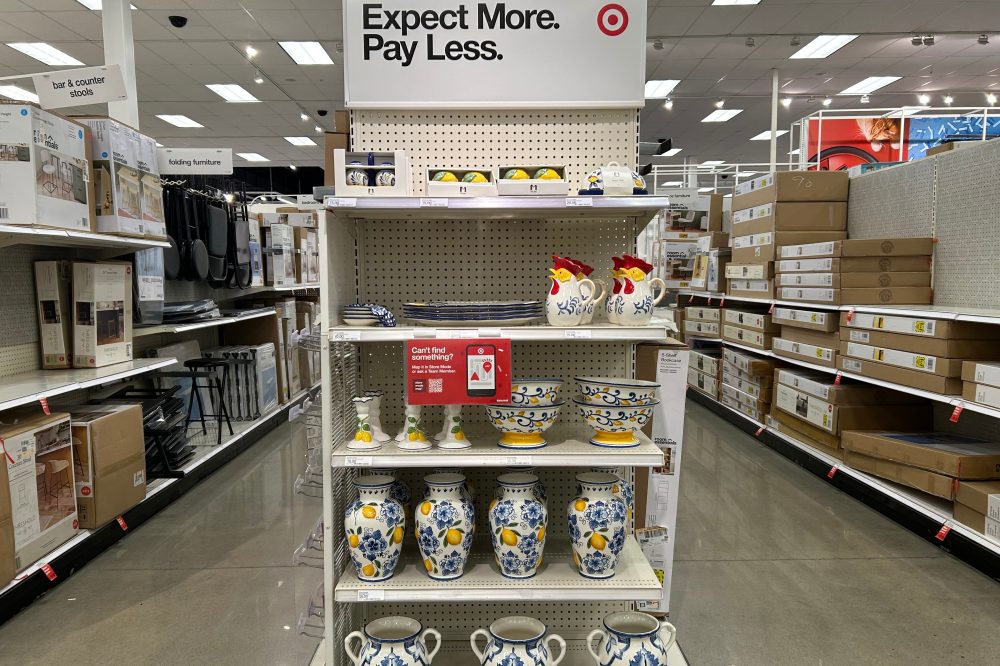
Target shoppers have grown dissatisfied with what they perceive as poorly maintained and disorganized stores featuring subpar products.
As the company’s roughly 2,000 locations have transformed into fulfillment centers for online orders, customers report that in-store shopping experiences have deteriorated with employees prioritizing digital order completion over store maintenance.
Target also confronts intensified rivalry from Walmart, which has enhanced its emphasis on fashion and other merchandise categories. As numerous Americans seek lower-priced alternatives due to inflation, Walmart has captured market share, especially among families earning more than $100,000 annually.
Joe Feldman, senior managing director and assistant research director at Telsey Advisory Group, believes consumer boycotts related to DEI policy changes and inadequate opposition to ICE operations have impacted sales. Nevertheless, he noted that Fiddelke appears committed to implementing operational improvements.
Fiddelke has already reorganized Target’s executive team, increased investment in store staffing, and reduced positions at distribution centers and regional headquarters, according to an employee memo distributed in February.
The company is also revamping its private label merchandise including the Threshold home goods line and announced a partnership with Roller Rabbit, recognized for 1960s-inspired designs and vibrant patterns. This limited-time collection of apparel, sleepwear and accessories is set to launch at Target stores this month.
Tuesday’s financial report provided encouraging indicators for the business. Target noted that sales and shopper visits gained momentum during the quarter’s final two months. The company also recorded revenue growth in food and beverages, beauty products and toys for the latest quarter.
Target projects annual net sales will grow by 2%, suggesting revenue could reach $106.88 billion. This slightly exceeds analyst predictions of $106.7 billion. Target also forecasts earnings per share between $7.50 and $8.50. Analysts expect $7.30 per share for the year, according to FactSet surveys.