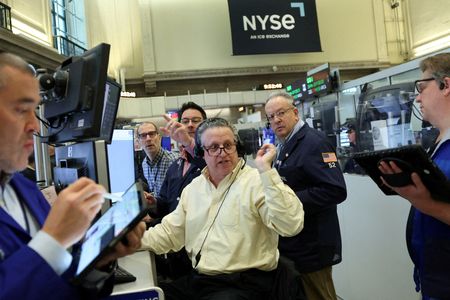

Technology companies are turning to massive stock buyback programs in an effort to halt a prolonged slide in share prices, but market analysts question whether these moves will be sufficient to restore investor confidence.
Software stocks have been in freefall since autumn, with the S&P 500 software index plummeting 28% from its late October peak. The decline stems from growing anxiety that artificial intelligence breakthroughs could fundamentally reshape competition within the historically high-valued software industry.
The downturn intensified in January when AI firm Anthropic unveiled new products that heightened concerns about the rapid pace of AI advancement and its potential impact on traditional software companies’ future earnings potential.
From January 12 onward, software companies traded on U.S. exchanges have approved $70.5 billion worth of share repurchase programs – nearly quadruple the amount authorized during the comparable timeframe last year, data from EPFR shows. Salesforce led the charge by adding $30 billion to its existing buyback initiative, while ServiceNow greenlit an additional $5 billion in repurchases beyond the $1.4 billion already available, including a $2 billion accelerated program.
Across the broader technology sector, buyback authorizations jumped approximately 63% to $110.1 billion compared to $67.6 billion in the previous year’s equivalent period.
“When a company announces a buyback after their stock has been hit hard, I think that is an attempt to stop the decline,” explained Andrew Slimmon, senior portfolio manager at Morgan Stanley Investment Management. He noted his preference for companies that execute share repurchases during periods of solid fundamentals and upward price movement.
Share buybacks typically appeal to investors because they inflate quarterly earnings per share by reducing the total number of outstanding shares, while also demonstrating management’s belief in the company’s prospects.
However, some investment professionals remain unconvinced that repurchase programs alone can revitalize the beleaguered software sector.
“I don’t think the buybacks are enough,” stated Peter Tuz, president of Chase Investment Counsel in Charlottesville, Virginia. “There needs to be demonstrated evidence that AI isn’t going to fundamentally hurt the business of a specific software company. That just takes time.”
Tuz revealed his firm increased its position in Paychex, a human resources software provider, after the company reaffirmed its annual financial projections in December and subsequently unveiled a $1 billion buyback program on January 16, replacing a smaller $400 million repurchase plan scheduled for 2024.
Despite these moves, Paychex shares have dropped 15% since the buyback announcement, closing Monday at $94.25 – more than 40% below its June 2025 peak. Tuz predicted it may require “several quarters of hitting and hopefully exceeding revenue and earnings targets before the stock probably rises.”
While companies executing buybacks have historically outperformed broader market indices, recent performance has been mixed. The S&P buyback index has surpassed the S&P 500 over the past two decades, though it has trailed the benchmark for the last three years. Share repurchases reached a record $1.38 trillion in 2025, up from $1.34 trillion the previous year, according to EPFR data.
Daniel Morgan, portfolio manager at Synovus Trust in Atlanta, Georgia, expressed skepticism that buybacks would significantly improve software stock performance “as investors will focus more on the long-term fundamental outlook.”
That fundamental outlook is undergoing substantial revision. By late February, the S&P software and services index was trading at 22 times projected earnings for the next 12 months, a sharp decline from the 32 multiple seen in October.