
FENGLIN, Taiwan — In the small Taiwanese community of Fenglin, residents have discovered an unusual solution to boost tourism following a devastating earthquake: racing snails.
This town of approximately 10,000 people has built its reputation around unhurried living, and rather than fighting this characteristic, locals have decided to celebrate it. The community has organized snail racing competitions to showcase its commitment to a leisurely, sustainable way of life that emphasizes wellness, long life spans, and strong community bonds.
The unique events also serve a practical purpose — drawing visitors back to the region after a powerful earthquake in April 2024 significantly reduced tourism. The disaster claimed 19 lives and left over 1,100 people injured, creating lasting concerns among potential travelers.
“The earthquake two years ago had a relatively big impact on tourism because people are worried an earthquake may happen again,” explained Hsu Lu, a 32-year-old local resident. “Many people have left Hualien because of earthquakes,” Hsu noted, referencing the broader county known for frequent seismic activity.
The connection between Fenglin and snails began in 2014 when the town became part of Cittaslow, a global movement of smaller communities dedicated to improving quality of life and promoting locally grown food. The organization’s emblem features a snail with various structures on its shell.
This slow-living philosophy fits naturally with Fenglin’s character. The community’s population has decreased by two-thirds over recent decades, and today it represents Taiwan’s aging demographic challenge, with over 20% of residents being 65 or older.
Following the April 2024 disaster, community members launched their first snail competition the next month as a way to help restore local tourism, according to event coordinator Cheng Jen-shou.
“We thought that our event could attract people, and that would be a small help,” he explained.
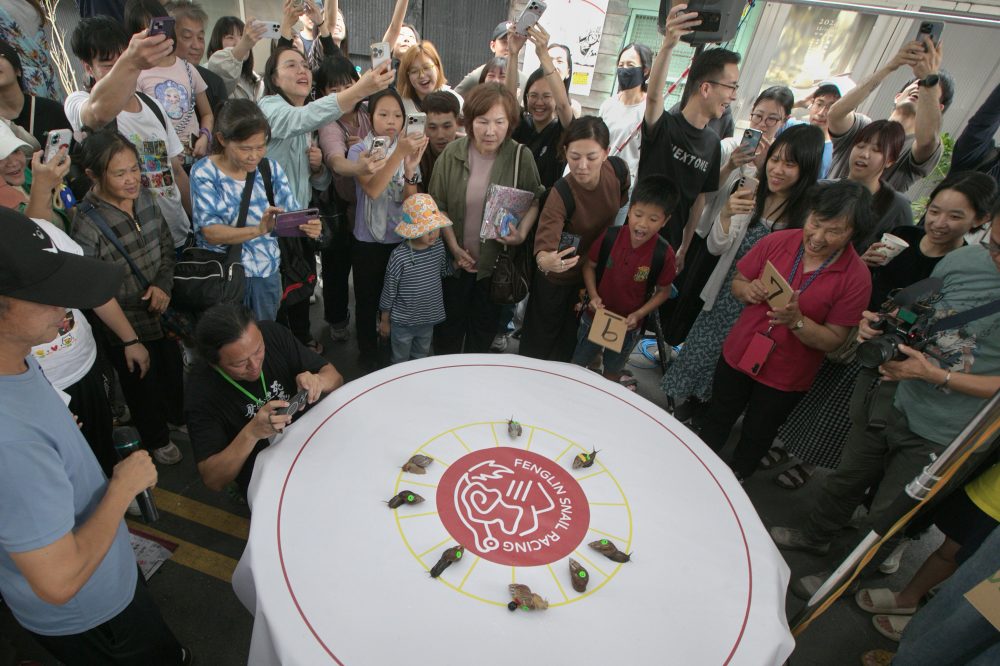
The town recently completed its third annual competition during the May Day holiday weekend. Dozens of excited locals and visitors gathered for the festivities, which included six separate races spread across two days. Race winners advanced to a championship round, but not before being ceremoniously transported on wooden boards across green carpeting while supporters applauded.
Among the participants was Li Cheng-wen, a 70-year-old retired resident who brought several competitors he had discovered eating vegetables in his garden. Rather than eliminating them as many farmers might, he chose to care for them as companions, providing daily water and feeding them fruit slices and plant leaves.
“As to the criteria for choosing snails for the race, I usually select those that are very active and pleasing to the eye,” Li shared.
Kelvin Hong and Tiara Lin made an especially long journey for the event, driving approximately five hours from the southern metropolis of Kaohsiung with their 2-year-old daughter Murphy and their giant African snail named Aquaman. The family had originally planned to participate in 2024, but Lin’s unexpected labor prevented their attendance. This year, they finally got their chance to support their unusual athlete.
Despite Aquaman’s size advantage over locally gathered competitors, the imported snail proved disappointingly sluggish during competition.
The racing format involves placing ten snails at the center of a circular table covered with vinyl sheeting. Victory goes to whichever mollusk reaches the table’s edge first.
This year’s overall champion was Guage, nicknamed Brother Snail, owned by 39-year-old Tanya Lin from Hualien. She has cared for the winning snail since 2024, when it also claimed victory in one race.
Brother Snail completed the 33-centimeter course in exactly 3 minutes and 3 seconds, earning placement on a miniature podium and a prize of organic sweet potato greens.
Beyond snail racing, local officials have developed additional tourism attractions including guided electric bicycle tours that visit historical tobacco storage buildings, structures from the Japanese colonial period, and a museum dedicated to Hakka minority culture.
The appeal of unhurried living drew university students Annette Lin and Tanya Liu, who traveled roughly 30 minutes by train from Hualien on Saturday to experience both the snail competition and Fenglin’s relaxed atmosphere.
While the friends appreciated the unusual contest and enjoyed the town’s peaceful environment, they viewed it primarily as a temporary escape from urban pressures.
“I think for travel or a trip, it’s a great choice,” Liu observed. “But maybe living here would not really be my dream choice.”