
Taiwan’s leader offered a detailed explanation Sunday of what his administration means when discussing the island’s independence from mainland China’s control.
President Lai Ching-te clarified that references to “Taiwan independence” indicate the island operates outside Beijing’s authority and that Taiwan’s residents alone should determine their political destiny. His remarks came during a speech in Taipei.
The president’s statements follow recent high-level discussions between President Donald Trump and Chinese leader Xi Jinping in Beijing, which sparked uncertainty in Taiwan about continued American support.
Following those talks, Trump commented to Fox News: “We’re not looking to have somebody say, ‘Let’s go independent because the United States is backing us’.”
Beijing considers Taiwan part of its territory and maintains it could use military action to enforce control, particularly if it believes the island is pursuing formal separation.
During his address, Lai referenced a 1999 resolution from his Democratic Progressive Party that remains current policy, declaring Taiwan already functions as an independent nation known as the Republic of China.
He emphasized that Taiwan’s self-governance cannot be compromised or taken away, and its political direction must be chosen by its citizens.
“Everyone can clearly understand that the meaning of the term ‘Taiwan independence’ actually refers to Taiwan not being part of the People’s Republic of China,” Lai stated at an event commemorating the DPP’s 40th anniversary.
“It refers to the Republic of China and the People’s Republic of China not being subordinate to each other,” he continued.
Beijing’s Taiwan Affairs Office had not issued a response to requests for comment.
The current Republic of China administration relocated to Taiwan in 1949 following defeat in a civil conflict against Mao Zedong’s communist forces, who established the People’s Republic.
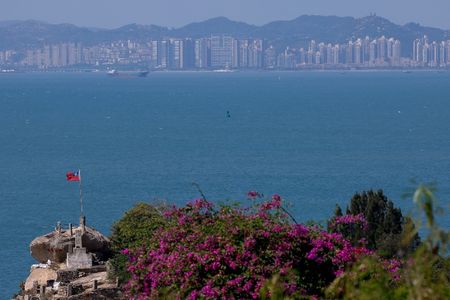
Lai noted that Taiwan’s existence is essential to the Republic of China, whose boundaries encompass the Penghu islands in the Taiwan Strait plus Kinmen and Matsu islands near the Chinese mainland.
“So it is very clear: the Republic of China has been in Taiwan for 70 or 80 years and has already become integrated with Taiwan as one,” he explained.
“Whether we call it the Republic of China, the Republic of China, Taiwan, or Taiwan — basically, no matter what we are called internationally, it refers to us: the 23 million people of Taiwan, Penghu, Kinmen and Matsu.”
The president did not mention Trump during his remarks and declined to respond to reporters’ questions afterward.
Although the U.S. has historically served as Taiwan’s primary international supporter, Trump indicated during his return flight from Beijing that he hasn’t made decisions regarding additional weapons sales to Taiwan, which are mandated under the 1979 Taiwan Relations Act.