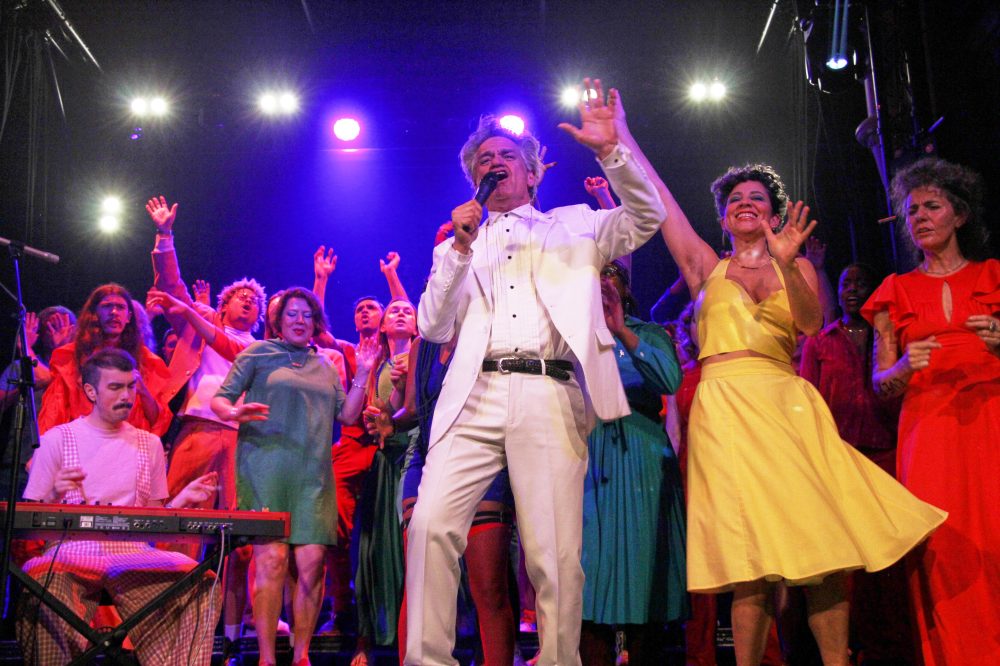

LOS ANGELES (AP) — Indie musician Alex Cameron has built a reputation on pushing boundaries with his lyrics. So when he launched into a heartfelt song about Jesus during a performance in a trendy Los Angeles neighborhood, the audience wasn’t quite sure whether to laugh or bow their heads.
“Jesus never had no porno / Jesus never had cocaine / Jesus never had Ibiza / He never even went to Spain,” the Australian singer-songwriter sang, drawing scattered laughter from the crowd.
That tension between the absurd and the earnest reflects a growing artistic trend — one that resonates especially with people who have drifted away from organized religion. Scholars have begun calling it “reverent irreverence.”
As Cameron moved into the chorus, the laughter faded. “But every time he spoke / The people gathered round / When he washed their feet / The demons all came out / So when’s he gonna come again?” he sang over a melancholy electric guitar.
Whether funny, offensive, or somewhere in between, there’s an unmistakable genuineness to “Jesus Never Had No Porno” and other Cameron songs that wade into similar territory.
“You’ve been disarmed with laughter. Now you’re kind of open to anything. You’re open to profound sadness or hope,” Cameron told the Associated Press ahead of his album, “Late to Set,” due out July 24. “That’s my entire life. It’s serious, but it’s funny.”
Scholars are beginning to interpret this blending of irony and sincerity as a way for younger generations to wrestle with questions of ritual, meaning, and authenticity — even as involvement in organized religion across the United States has declined sharply over recent decades.
“Religion is understood as a source of power, whether or not you believe in it,” said Kathryn Lofton, who studies religion and pop culture at Yale University.
As the world feels more chaotic and morally unmoored, Lofton has noticed more skeptics gravitating toward sacred spaces in search of community and transcendence.
Despite the surge of Americans with no religious affiliation — often called “nones” — faith remains a powerful creative reference point. Its staying power as a shared cultural language reaches the highest levels of pop culture, from Beyoncé’s exploration of Yorùbá religion and African diasporic spirituality to Rosalía’s 2025 concept album “Lux,” which draws on Catholicism, female saints, and mysticism.
These themes aren’t confined to explicitly Christian outlets like contemporary Christian radio. But when comedians or artists known for humor invoke religion, it can carry a unique appeal — especially for those who consider themselves immune to the cultural or political baggage tied to traditional faiths.
“Someone who is playing with it, is humorous about it, has a sense of irony — it’s a way for them to engage these kinds of questions and at the same time retain plausible deniability that they really are interested in religion,” said Leigh Eric Schmidt, a professor at Washington University in St. Louis.
Religion threads its way throughout Nathan Fielder’s HBO docuseries “The Rehearsal,” where he examines interfaith relationships, antisemitism, forgiveness, and numerology.
“I was raised Jewish and I still do all the holidays and stuff,” Fielder narrates in one episode, adding he “hadn’t been to synagogue in years because it’s so boring.”
For many fans, that ambiguity is exactly the draw. “You never know if he’s serious or not,” said Shelah Marie, a 41-year-old wellness influencer from Atlanta.
“There’s an increasing level of disassociation that we have to feel in order to maintain sanity. It is psychotic, the amount of information that we receive,” she said. “Maybe being absurd is our protection.”
Cameron Winter, the front man of the rock band Geese, plays with these same blurred lines on his debut solo album “Heavy Metal.” “God is real, God is real / I’m not kidding, God is actually real,” he declares.
While claiming “I’m not kidding” might seem to invite doubt, the sheer force of his delivery makes it difficult to write off as pure sarcasm.
“It’s a fine line,” said Schmidt, who helped organize a 2024 lecture series titled “Reverent Irreverence: Parody, Religion, and Contemporary Politics.” “You’re not going to convince people that you’re not just making fun of them sometimes.”
One of those lectures focused on The Church of Stop Shopping, led by director Savitri D and the character of the Reverend Billy, portrayed by actor and playwright William Talen. The anti-consumerist collective satirizes tropes from conservative Protestant traditions, yet “irony gives way to an articulation of communal values that are sincerely held,” according to sociologist George González, who authored a book about the group.
As evidence of that sincerity, Neil Young invited the Stop Shopping Choir to open for him on his 2024 tour.
“We’re an adopted church for lots of post-religious people,” said Talen, reflecting on what it means to be “seriously full of God at the same time that you’re seriously full of bull(asterisk)(asterisk)(asterisk)(asterisk).”
Christian theologian Harvey Cox wrote in the 1960s about how humor can draw people toward spiritual questions, noting that when society’s familiar symbols are used “to say something different in an ironical manner, we heap nuance upon nuance and combine satire, hope and playfulness.”
Today’s artists are exploring that same relationship between humor and faith with audiences grappling with the rapid rise of artificial intelligence and its effect on creativity.
“We can no longer tell surface from depth and treasure from knockoff,” González said. “Is my art real or did an algorithm produce it?”
Cameron is keenly aware of this anxiety, joking that humans are headed toward a future where they exist purely in service of technology companies. “Aren’t we all just eventually going to be in gestating pods where they fill up every orifice with a way to extract experience out of us?”
Yet that unease has also fueled a personal search for something deeper. Though Cameron didn’t grow up attending church, he has made an effort to go as an adult.
“Just to try and ground myself in something ritualistic,” he said. “Magic is real and God is real, and you know those things are pretty widely accepted, I think.”