
Eight sources with inside knowledge of Venezuela’s disaster response have told Reuters that delayed commands from senior military leaders, a shortage of basic equipment, and widespread confusion crippled the country’s ability to mobilize troops in the critical first days following two massive earthquakes that struck its coastline last month.
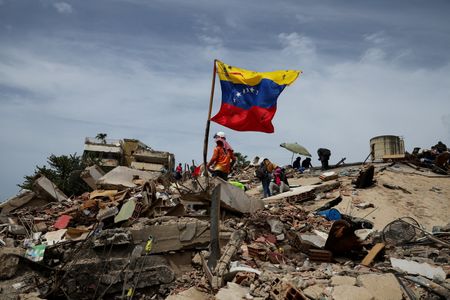
The two quakes, measuring 7.2 and 7.5 in magnitude, claimed approximately 5,000 lives according to government figures — though experts, including the United States Geological Survey, have estimated the final death toll could reach nearly double that number. The hardest-hit area was La Guaira state, which is home to the country’s primary airport, a major port, and hundreds of high-rise residential buildings, many of which collapsed entirely or partially.
Acting President Delcy Rodriguez, who has the backing of U.S. President Donald Trump, has forcefully defended her administration’s handling of the disaster in the face of widespread criticism that military personnel and government officials arrived too late and provided little meaningful assistance to survivors, including those trapped beneath rubble.
While Rodriguez stated that 4,000 officials were deployed immediately following the quakes, residents, Reuters journalists on the ground, and multiple sources familiar with the situation said military and police were barely visible in the early hours after the disaster struck.
Ordinary civilians took the lead in rescue efforts — particularly during the first two days — bringing food and using basic tools to pull survivors and victims from the wreckage. International rescue teams, firefighters, civil protection workers, and a small number of Venezuelan soldiers eventually joined the effort. Those soldiers told Reuters they had volunteered for the often-grim work rather than being formally ordered to participate.
Active and retired military officers, along with diplomatic community sources, attributed the thin security presence to late deployment orders, uncertainty about who held authority over the crisis, and a lack of proper equipment.
“We don’t act on our own; we receive direct orders,” said one active-duty officer who spoke anonymously. “I can’t tell my unit, ‘Let’s go help in La Guaira,’ if I haven’t been ordered to do so. We didn’t have a plan like the ones that exist for defending the nation. There was no plan for dealing with something like this.”
Soldiers from that officer’s unit traveled to La Guaira the day after the June 24 earthquakes, following orders to reinforce personnel already there.
“We weren’t going to leave without preparation or logistics because obviously nobody is prepared for something like this,” the officer said. “The troops in Caracas should at least have been sent to provide security and help however they could.”
A source familiar with diplomatic circles described the overall situation as one of confusion. “There was no plan and the chain of command was weak; many people simply didn’t know what to do,” the source said. That same source noted that delays in issuing orders also held back international rescue teams who had arrived within the first 48 hours, squandering precious time during which more lives might have been saved.
“Everyone looks upward waiting for an order. They would rather do nothing than act and risk being reprimanded,” the source said, referring to delays in assigning search zones to rescue teams. “The loss of those hours was enormously frustrating.”
“The Marine Infantry Brigade was ready to move but never received instructions to do so,” said one source with knowledge of military affairs.
A separate military source said their unit lacked enough vehicles to transport personnel to the disaster zone. Three additional sources said units were missing equipment ranging from hammers and pickaxes to helicopters fitted with night vision capability. Another source said the vice minister responsible for disaster response arrived in La Guaira around midnight on the night of the quake without the communications equipment necessary to report the full scale of the devastation.
Venezuela’s Communications Ministry did not respond to a request for comment. Rodriguez, however, has been vocal in defending her government’s actions. When pressed by reporters on July 2 about who had issued orders to the military, she claimed that “media laboratories” had manufactured a false impression of chaos — though she offered no supporting evidence. Days later, at a public event, she declared: “I gave the order, and I take responsibility for our Bolivarian National Armed Force.”
Rodriguez designated National Guard commander Juan Sulbaran Quintero as the “single authority” overseeing the disaster response, while simultaneously issuing a decree granting authority to Interior Minister Diosdado Cabello. Four sources said that overlapping command structure generated confusion over who was actually directing military and police operations, including disagreements over whether to deploy military police or the national police force.
Sources noted that years of economic hardship have eroded military readiness, with budgets prioritizing payroll over equipment maintenance and upgrades. By contrast, when La Guaira was devastated by a massive mudslide in 1999, the military launched a full-scale response using boats and helicopters to rescue and evacuate survivors.
“The armed forces have a concept known as operational readiness — the capacity to respond to threats and emergencies — but that readiness is limited,” said one source with knowledge of military matters.
The earthquakes struck on Army Day, a national holiday during which many military personnel were off duty and away from their assigned posts. “When the earthquakes hit, the strategic operational commander and the regional commander should have ordered an immediate recall of military personnel. That order never came,” the source said.
“The earthquake was the moment for the military to distinguish itself,” the active-duty officer said. “They should have been there at dawn with armored vehicles and cables pulling people out. The psychological impact would have been enormous — people seeing the troops helping. But we didn’t have a plan.”