
BEIRUT (AP) — For more than ten years, Ahed Badawi made her home in Bahrain, a tiny Gulf nation that offered peace and stability unlike her war-torn homeland of Syria.
The small country served as sanctuary for Badawi, her sister, and their aging mother throughout Syria’s devastating 14-year civil conflict.
“Nothing at all ever happened there,” she explained. “I mean, the Bahrainis don’t even know what war is.”
However, when the United States and Israel launched attacks against Iran, triggering a broader regional conflict, Bahrain and other Gulf nations suddenly became targets in Iran’s retaliation. The family made the surprising decision to return to their home in Aleppo, once a battleground of Syria’s bloodiest fighting but now offering unexpected safety.
The conflict-scarred nation has emerged as an unusual pocket of stability during the region’s current crisis. Syrian leadership has been working to repair diplomatic ties with Arab and Western nations that had isolated Syria during Bashar Assad’s rule, before rebels removed him from power in December 2024 and established new leadership.
Following the start of the U.S.-Israeli conflict with Iran and Iran’s blockade of the Strait of Hormuz, Damascus has capitalized on this chance to strengthen international relationships by maintaining neutrality.
Syria has “presented itself as the solution to strategic crises in the region,” explained Obayda Ghadban, a Syrian Foreign Ministry representative.
Following the U.S.-Israeli strikes, Iran launched missiles not just at Israel but also targeted Gulf nations that house American military installations. In Lebanon, fighting resumed between Israel and Hezbollah, the Iran-supported militant organization. Iraq, hosting both Iranian-backed militias and U.S. military bases, became caught between opposing forces.
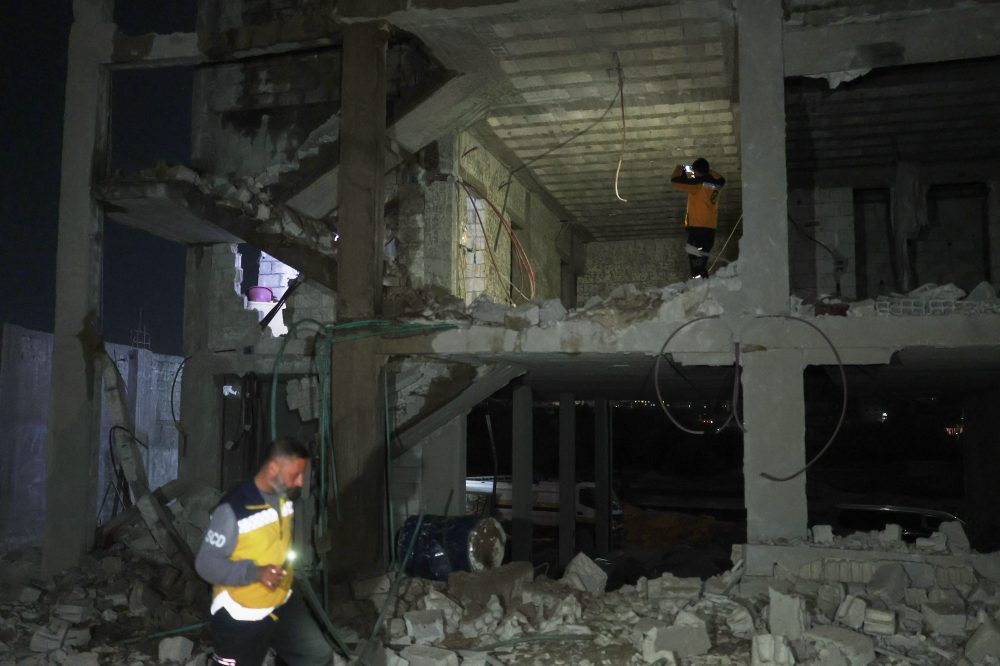
Even with missiles crossing Syrian airspace and occasionally landing within its borders, Syria successfully remained uninvolved while establishing itself as an alternate shipping route for oil that can no longer pass through the blocked strait.
“Syria, which was once an arena for others’ conflicts, has today chosen, through the will of its people and institutions, to be a bridge to security and a fundamental pillar of the solution,” interim Syrian President Ahmad al-Sharaa declared during a recent gathering of European officials in Cyprus.
He promoted his nation as “the alternative and secure artery connecting Central Asia and the Gulf to the heart of the European continent.”
With Iran controlling access to the strait, oil shipments now travel by truck from Iraq into Syria before being transported to European customers through Syria’s Baniyas port, avoiding the Hormuz passage. A crucial border crossing linking northern Iraq and Syria resumed operations last month after more than a decade of closure, with authorities promoting it as another pathway for energy shipments.
This land-based route costs more and operates less efficiently than maritime transport through the strait, but it offers a viable alternative while Iran maintains control over the waterway.
Ghadban emphasized that his nation had no desire to align with either warring faction.
“The parties participating in it are strategic enemies of Syria, whether we talk about Iran and its affiliates, or if we talk about Israel and its aggressive expansionist policy in Syria,” he stated. “Both parties have an interest in weakening Syria.”
Iran served as Assad’s crucial supporter during the civil war, alongside Hezbollah and allied Iraqi militias. This alliance put them at odds with the groups currently governing Damascus.
Israel has maintained suspicion and sometimes open hostility toward Syria’s new Islamist leadership. Following Assad’s removal, Israeli forces took control of a UN-monitored buffer zone in southern Syria and continue their occupation.
During the initial phase of the U.S.-Israeli war with Iran, some observers predicted Syria might enter the conflict to retaliate against Hezbollah.
Instead, Syrian military forces remained inactive, while al-Sharaa and other officials emphasized their lack of interest in Lebanese involvement.
Noah Bonsey, who serves as senior adviser on Syria with the International Crisis Group, noted that while “Damascus was really clear from the beginning that it wanted no part of this war and signaled to everyone accordingly,” its successful neutrality resulted partly from favorable circumstances.
American troops had maintained bases in eastern Syria for years, but the U.S. had reduced its military presence before the Iranian conflict began.
When clashes erupted between Syria’s central government forces and the Kurdish-led Syrian Democratic Forces in the northeast during January, U.S. military personnel relocated thousands of detained Islamic State suspects from Syrian facilities to Iraq. The military also reduced its Syrian presence, where preventing IS resurgence had been the primary objective.
“Because the withdrawal had gone so far by the time the war (with Iran) started, there were very few U.S. assets and personnel still in the country” that might have attracted Iranian attacks, Bonsey observed.
While Syria may have gained diplomatic advantages through its neutral stance, the nation will still face economic consequences from the regional conflict, according to Bonsey.
Damascus had anticipated that Syria’s post-conflict reconstruction would attract investment from prosperous Gulf Arab nations previously recognized for their commercial centers and modern architecture.
However, these countries will now have reduced resources and “less bandwidth to spare for lower-priority issues” as they concentrate on “shoring up their own defense and getting their own economies back up to speed” following the war, Bonsey explained.
Although Syria might eventually benefit from infrastructure developments like proposed railway connections and gas pipelines linking the Gulf to Turkey and European markets, such projects would require years to complete, if they materialize at all.
Currently, Syria’s new administration confronts growing public dissatisfaction over the nation’s struggling economy.
Despite these challenges, Badawi remains content with her decision to return home.
“There’s nothing like being in your own country,” she reflected. “When you’re in your own country, you feel a different kind of security.”