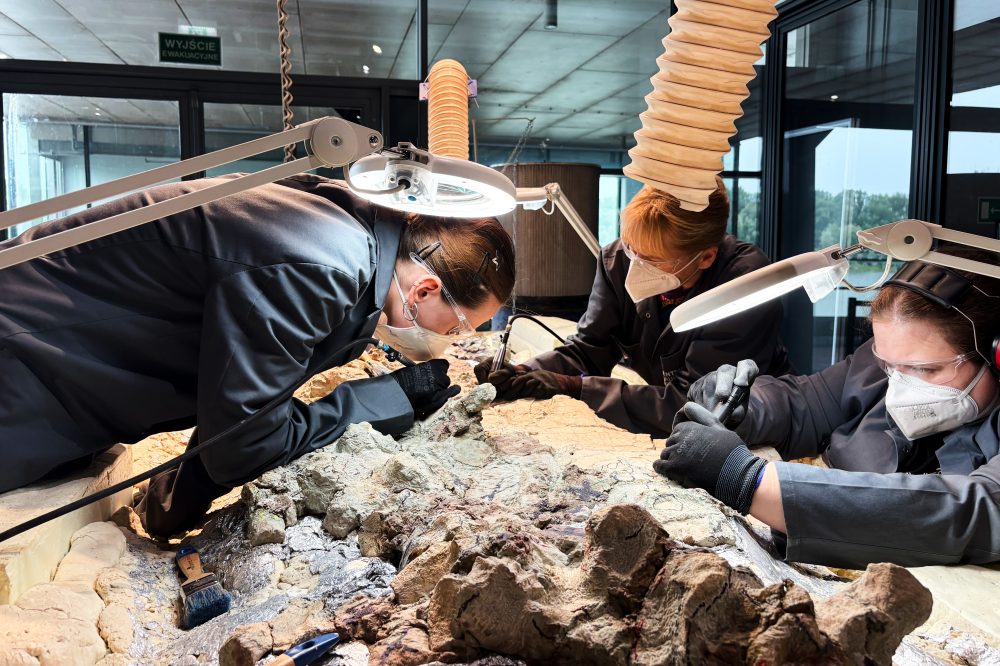

Inside a glass-walled laboratory at Warsaw’s Copernicus Science Centre in Poland, volunteers armed with chisels, brushes, and protective goggles carefully chip away at the rock surrounding the bones of an enormous prehistoric creature — while curious visitors watch from just a few feet away.
The project involves more than 2,000 volunteers helping Polish scientists restore the skeleton of a Mastodonsaurus, a fearsome aquatic predator that roamed Earth’s waters around 240 million years ago — roughly at the dawn of the dinosaur age. The nearly six-meter (20-foot) skeleton weighs 1,300 kilograms, or about 2,865 pounds.
The process is extraordinarily precise. Volunteers use a pneumatic chisel to separate bone from rock millimeter by millimeter, while ultraviolet light helps distinguish where the bone ends and the surrounding stone begins.
The volunteers come from all walks of life — managers, cleaners, tattoo artists — none of them trained geologists or paleontologists. Each person receives special training and protective equipment before beginning supervised, two-hour chiseling sessions.
“I imagine that those bones were lying underground for 240 million years and I am the first human on earth to touch them,” said Tatyana Kozyk, who coordinates the volunteer teams. “I’m still trying to wrap my head around this experience.”
The Mastodonsaurus was one of the largest amphibians ever to live on Earth. It thrived during the Middle Triassic period, at a time when the earliest dinosaurs were just beginning to emerge. An underwater ambush hunter, it fed primarily on fish and smaller amphibians. The creature had a wide, flat head, elongated jaws, and sharp, cone-shaped teeth — giving it an appearance similar to a crocodile, though it belonged to an entirely different branch of the vertebrate family tree.
Paleontologist and professor Tomasz Sulej, from the Institute of Paleobiology at the Polish Academy of Sciences, says that once restored, this skeleton will be the largest Mastodonsaurus ever put on public display anywhere in the world. Sulej and his colleague Wojciech Pawlak, from the Faculty of Geology at Warsaw University, discovered the skeleton in southern Poland in 2023 and developed the idea of involving volunteers in the restoration.
“The structure of the body is different from what we knew so far,” Sulej said. “This is information that is completely new to the scientific world.”
While other Mastodonsaurus skeletons have been found in places like Germany and Russia, Sulej noted that those specimens are only about two to three meters — or roughly six and a half to ten feet — in length, far smaller than the Warsaw find.
Dorota Serafin, a 51-year-old manager from Warsaw, described volunteering on the project as both “relaxing and philosophical, even mystical.” She said she plans to return for more sessions and hopes to bring her family to see the finished skeleton when it goes on display, which is expected to happen in October or November.
Beyond the remarkable experience of touching the remains of a creature that lived hundreds of millions of years ago, those involved in the project say working with the Mastodonsaurus also invites reflection on the future. The amphibian survived in the aftermath of Earth’s largest known mass extinction, just before the age of dinosaurs began.
For Sulej, that history carries a message of hope as the world grapples with the threat of climate change. “The Mastodonsaurus lived after the great extinction, which shows one thing, that nature always manages,” he said. “It’s not true that humans can destroy life on this planet. Nature and life always find ways to survive.”