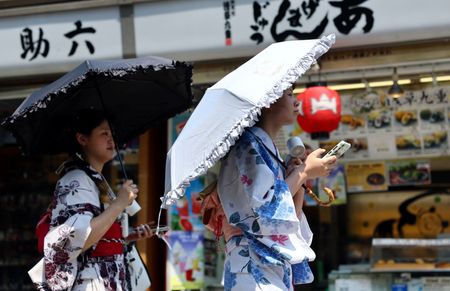

Japan is in the grip of a dangerous heat wave, with temperatures threatening to hit 40 degrees Celsius — that’s 104 degrees Fahrenheit — in several cities, marking what the government is now officially calling a “brutally hot day.”
The country’s weather agency issued heat stroke warnings across much of Japan on Wednesday, forecasting back-to-back days of what is termed “kokushobi” — a Japanese phrase that translates literally to “brutally hot day.” Forecasters said temperatures could reach 40 C in Kumagaya, a city north of Tokyo, as well as in Nagoya, located in central Japan.
Officials are urging the public to crank up their air conditioning, drink plenty of fluids, and stay out of the heat as much as possible.
This week’s extreme conditions are part of a troubling trend. Japan has seen increasingly intense summers in recent years, and last year the country set an all-time temperature record of 41.8 degrees Celsius.
Even before the current heat wave took hold, the toll was already significant. Between July 6 and July 12, some 4,580 people were rushed to hospitals for heat-related illness, and seven of those individuals later died, according to the most recent figures from the Fire and Disaster Management Agency.
The “kokushobi” classification was introduced this year by the weather agency to formally identify days when temperatures hit 40 C or above — a recognition of just how frequently such extreme heat is now occurring. Government data shows that more than 100,000 people have been hospitalized for heatstroke so far during the 2025 summer season.