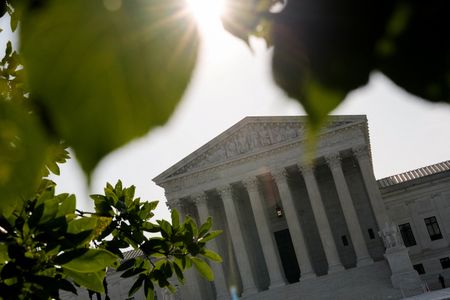

A recent U.S. Supreme Court ruling shielding the Federal Reserve from political interference did more than block President Donald Trump from removing one of the central bank’s governors — it also put a spotlight on a growing rift among the justices over their use of the court’s emergency docket.
Three of the four conservative justices who voted against Monday’s ruling involving the Fed’s Lisa Cook also took aim at the five-justice majority for handling such a weighty legal matter through emergency procedures — a process that bypasses lower courts and their deliberations.
That criticism drew a direct response from Chief Justice John Roberts, who authored the 5-4 ruling alongside fellow conservative Justice Brett Kavanaugh and the court’s three liberal members. Roberts defended the approach as a matter of “prudence” on which reasonable people can disagree.
For years, critics have voiced concern about the court’s growing readiness to settle major legal questions through what’s known as the “shadow docket” or “interim docket.” The criticism centers on the lack of transparency, the speed at which decisions are made, and the limited explanation typically provided to the public.
Unlike the court’s standard process — which involves detailed written arguments, oral hearings, months of deliberation, and thorough written opinions — the emergency docket allows justices to rule quickly, often without any explanation at all, and before lower courts have had a chance to weigh in.
Now a new worry is taking shape: as emergency rulings increasingly reshape the law and even overturn the court’s own past decisions, the justices appear to be at odds over just how much power this process should carry.
The justices wrapped up their latest nine-month term on Tuesday and have begun their summer break, with the next term set to open in October.
Bradley University law professor Taraleigh Davis, who specializes in the emergency docket, said Roberts’ decision to address the criticism head-on was itself significant.
“What I find really telling is that Roberts felt he had to respond to it. He didn’t have to. The opinion could have just decided the case,” Davis said. “He felt the pressure of the complaint enough to put a principle on paper for the first time. And the principle he lands on, that it’s a matter of prudence, is, honestly, pretty honest about the fact that there is no rule. There is no formula.”
Once a rarely used tool, the emergency docket has grown into a major force in American legal and political life, particularly since Trump returned to the White House in January 2025. The court’s 6-3 conservative majority has repeatedly sided with Trump through emergency orders, allowing him to push forward with contested policies while legal challenges continued in lower courts.
Through these emergency rulings, Trump was permitted to dismiss federal workers, take control of independent agencies, bar transgender individuals from military service, carry out aggressive immigration enforcement, and deport migrants to countries where they have no prior ties, among other actions.
Among the emergency decisions from the most recent term that legal observers say changed existing law: the court allowed states to redraw U.S. House district boundaries in ways that could benefit Republicans, and it weighed in on the rights of parents of transgender children.
The court also used the emergency docket last September to strengthen Trump’s ability to remove independent federal regulators, permitting him to oust Democratic Federal Trade Commission member Rebecca Slaughter. Similar actions involving other agency officials were allowed during the prior term as well.
Liberal Justice Elena Kagan dissented in several of those cases, arguing that a 1935 court precedent protecting federal regulators from being fired at will by a president should have prevented Trump’s moves. Kagan contended that the emergency docket should not be a vehicle for overturning precedent or rewriting existing law.
On Monday, the court formally struck down that 1935 precedent in a 6-3 ruling, expanding presidential authority and affirming the legality of Trump’s firing of Slaughter.
The same day, the court ruled on the Cook case involving the Federal Reserve. The justices turned down Trump’s emergency request to block lower court rulings that had prevented him from removing Cook, who faces unproven mortgage fraud allegations she denies. However, the court left open the possibility that Trump could still succeed in removing her once those allegations are examined more thoroughly.
No president since the Federal Reserve was established in 1913 had ever attempted to remove one of its officials. Trump’s effort raised alarms about the central bank’s long-standing independence.
Justice Samuel Alito, joined by Justice Neil Gorsuch, wrote in dissent that the court should not have issued such a sweeping ruling in the Cook case, given that the litigation was still in its early stages and involved unsettled legal questions. Alito pointed out that the case reached the Supreme Court on the emergency docket just 21 days after it was first filed.
Those circumstances “counseled in favor of a light touch by this court,” Alito wrote.
Justice Amy Coney Barrett echoed that concern in her own dissent: “While a modest approach would have been appropriate, the court chooses to go big. Its opinion sets precedent on a series of important issues, with implications that extend well beyond this case.”
Roberts fired back, writing: “How much to say on our interim docket … is not reducible to any mechanical formula; it is ultimately a matter of prudence, upon which reasonable minds can (and often do) disagree.”
Liberal Justice Ketanji Brown Jackson noted that unlike many other high-stakes emergency docket cases, this one received more deliberation and even included the rare step of oral arguments.
Similar complaints surfaced in another emergency docket case from March, known as Mirabelli v. Bonta. In that case, the court blocked a set of California laws that restricted schools from sharing information about a student’s gender identity with parents without the child’s consent, ruling in favor of Christian parents who challenged the protections.
The ruling expanded parental rights under the 14th Amendment’s due process clause, recognizing the right of parents to receive such information. “These policies likely violate parents’ rights to direct the upbringing and education of their children,” the ruling stated.
Kagan, joined by Jackson, criticized what she called a “terse, tonally dismissive ruling designed to conclusively resolve the dispute.” She wrote that the decision would be interpreted as a final judgment on the legal merits rather than a temporary order, producing a sweeping change in American law on a deeply contested issue.
“Today’s decision shows, not for the first time, how our emergency docket can malfunction,” Kagan wrote.
Yale Law School professor Douglas NeJaime said the Mirabelli case illustrates wider problems with the court’s approach. “Parties are denied the opportunity to fully brief and argue a case, lower courts are denied the opportunity to fully consider the merits in the first instance, and the law changes in ways that are not always clear and that leave state actors, lower courts, and ordinary Americans with an insufficient basis on which to move forward,” NeJaime said.
Barrett, who was part of the majority in Mirabelli, defended the decision to offer legal reasoning, writing: “Interim applications routinely require the court to balance the lock-in risk of saying too much against the transparency cost of saying too little.”
George Mason University law professor Ilya Somin said the disagreements among the justices are understandable. “It’s not surprising there are internal disagreements on this, as it’s a hard issue. It can be problematic to both say too much or to say too little,” Somin said.
He added that there is no easy fix. “I would lean towards giving more explanation for decisions rather than less, and only using the shadow docket in cases where there is a very compelling reason,” Somin said. “Of course, what counts as a compelling reason is likely to divide people with different ideologies and judicial philosophies.”