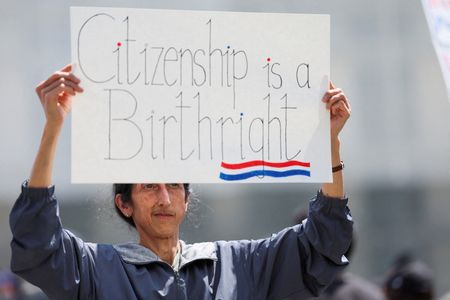

The nation’s highest court will examine Wednesday whether President Donald Trump can legally end automatic citizenship for certain children born on American soil, in a case that could fundamentally alter how the Constitution has been understood for more than a century.
The nine justices will review the administration’s challenge to a federal court ruling that halted Trump’s executive order. That directive instructed government agencies to stop recognizing citizenship for newborns whose parents are neither U.S. citizens nor permanent residents with green cards.
Trump is scheduled to attend the oral arguments personally, according to his public calendar.
A federal judge previously determined that Trump’s policy conflicts with citizenship provisions in the Constitution’s 14th Amendment and existing federal statutes that establish birthright citizenship. The ruling came in response to a class-action case filed by families whose children’s citizenship status would be jeopardized under the new policy.
Restricting automatic citizenship has become a central goal for the Republican leader, who signed the executive order during his first day back in the White House last year as part of broader immigration enforcement measures. Opposition groups have characterized his immigration agenda as discriminatory based on race and religion.
For generations, the 14th Amendment has been understood to guarantee citizenship for all babies born within U.S. borders, with very limited exceptions like children of foreign diplomats or enemy forces during wartime.
The constitutional language in question, called the Citizenship Clause, reads: “All persons born or naturalized in the United States, and subject to the jurisdiction thereof, are citizens of the United States and of the state wherein they reside.”
Trump’s legal team argues that the phrase “subject to the jurisdiction thereof” requires more than simply being born on American soil for citizenship eligibility. They contend it excludes babies born to immigrants without legal status or those with temporary legal presence, such as international students or workers on temporary visas.
According to the administration’s interpretation, citizenship should only apply to children whose parents demonstrate “primary allegiance” to America, meaning citizens and permanent residents. This allegiance would be proven through “lawful domicile,” which administration attorneys describe as “lawful, permanent residence within a nation, with intent to remain.”
The government has claimed that providing citizenship to nearly everyone born within U.S. boundaries encourages illegal border crossings and promotes “birth tourism,” where foreign nationals specifically travel to America to deliver babies and obtain citizenship for them.
Should the Supreme Court side with the administration’s position, experts estimate the ruling could impact the legal standing of approximately 250,000 infants born annually, while forcing millions of additional families to document their newborns’ citizenship eligibility.
The 14th Amendment became part of the Constitution in 1868 following the Civil War that abolished slavery from 1861-1865, specifically overturning an infamous 1857 Supreme Court ruling that declared people of African heritage could never become American citizens.
U.S. District Judge Joseph Laplante in Concord, New Hampshire, granted class-action status to the lawsuit challenging Trump’s directive last July, enabling a nationwide block of the policy.
Those opposing the order point to an 1898 Supreme Court decision, United States v. Wong Kim Ark, which they say definitively established that the 14th Amendment provides citizenship through birth on American territory, including for children of foreign parents.
The administration maintains that the 1898 ruling actually supports Trump’s position, arguing that the court’s decision noted Wong Kim Ark’s parents maintained permanent residence and domicile in the United States when he was born.
A final decision from the Supreme Court is anticipated by late June.
The court previously handed Trump a partial win on birthright citizenship issues by limiting federal judges’ authority to impose nationwide restrictions on presidential policies. However, that earlier ruling did not address whether Trump’s directive violates the Constitution.
The court’s current 6-3 conservative majority has generally supported Trump’s immigration initiatives since his return to office. It has allowed expanded deportation operations to proceed temporarily while legal challenges continue, including ending humanitarian protections for migrants and permitting deportations to nations where individuals have no connections.