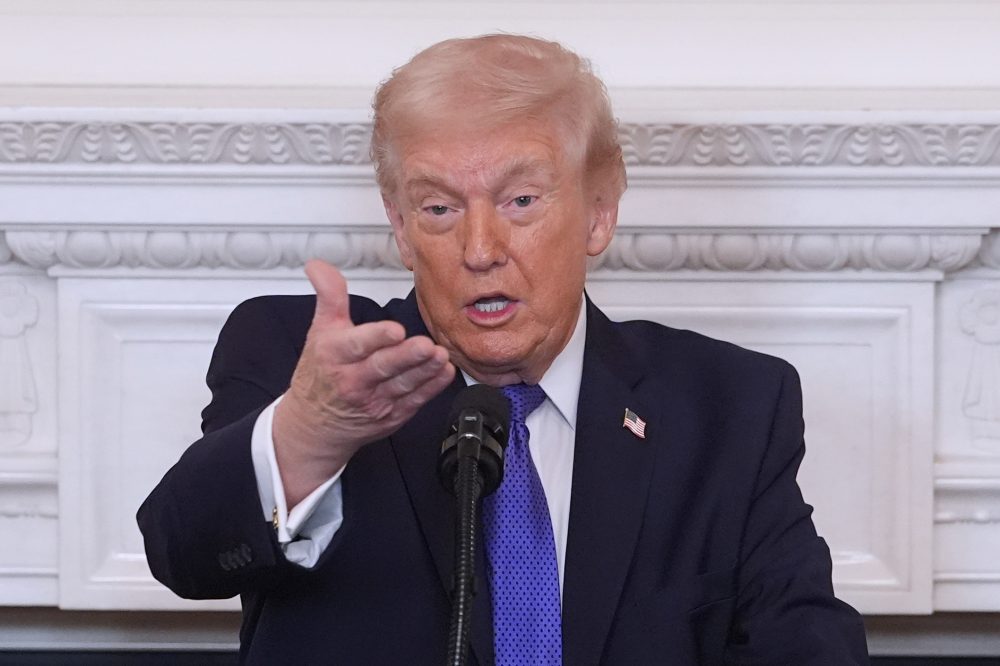

WASHINGTON — The Supreme Court dealt a major setback to President Donald Trump’s trade strategy Friday, issuing an uncommon rebuke by determining he overstepped his authority in declaring an economic emergency to impose extensive import taxes.
Trade tariffs have become the cornerstone of Trump’s economic message to voters ahead of the midterm elections, with the president once calling tariffs his “favorite word in the dictionary.” He pledged that manufacturing plants would return from abroad bringing employment opportunities, while cautioning that eliminating tariffs might trigger a severe economic downturn.
However, Friday’s Supreme Court decision will likely extend political and economic uncertainty surrounding international commerce throughout the election cycle.
According to two individuals familiar with the president’s response who requested anonymity, Trump labeled the ruling “a disgrace” when he received word of the Supreme Court’s decision during a private gathering with multiple governors. A third person briefed on the discussion revealed that Trump stated he has “to do something about these courts.”
The governors’ meeting concluded shortly after Trump was informed of the ruling.
The president is anticipated to make public remarks about the decision during an afternoon news conference.
Republican political consultant Doug Heye noted it was immediately apparent that the president “is not going to be happy” regarding the decision.
“We’re starting to hear about how this is a massive blow, a massive repudiation,” he stated.
Nevertheless, Heye indicated Trump would likely seek alternative methods to advance his trade policies.
“Are they going to be able to figure out how to use this as an opportunity or not?” he questioned. “There are too many questions.”
The administration intends to utilize different legal authorities to maintain his tariff program, though these approaches will only extend the controversy and sustain an issue that remains largely unpopular among voters.
Approximately 60% of Americans believed Trump had overreached in implementing new tariffs on foreign nations, based on an AP-NORC survey from January.
Even more concerning for a president who campaigned on addressing Americans’ affordability worries, 76% indicated in an April poll that Trump’s tariff strategies would raise consumer prices domestically.
Trump’s assertive tariff implementation had created discomfort among numerous Republican legislators, both publicly and privately, compelling them to justify what amounted to tax hikes on American citizens and enterprises.
Throughout Trump’s second presidential term, no fewer than seven GOP senators have expressed their objections. This month, six House Republicans aligned with Democrats to support a measure opposing Trump’s tariffs on Canada.
Free trade had historically represented a fundamental principle of the Republican Party prior to Trump’s political emergence.
Former Vice President Mike Pence, who served during Trump’s initial term, celebrated the Supreme Court decision as a win for citizens, constitutional separation of powers, and free trade principles.
“American families and American businesses pay American tariffs — not foreign countries,” Pence posted on social media. “With this decision, American families and businesses can breathe a sigh of relief.”
Democrats quickly capitalized on the opportunity presented by the Supreme Court, with Rep. Suzan DelBene, D-Wash., declaring that Trump “is not a king” and his “tariffs were always illegal.”
“Republicans in Congress could have easily ended this economic crisis by standing up for their communities,” stated DelBene, who chairs the Democratic Congressional Campaign Committee. “Instead, they chose to bend the knee to Trump while families, small businesses, and farmers suffered from higher prices.”
The decision effectively enables Trump’s opponents to argue he violated the law while middle-class families bore the consequences.
Yet Trump has maintained that his tariffs prevented national economic collapse, a message he delivered Thursday evening to voters in the battleground state of Georgia.
During Thursday’s address at Coosa Steel, a Georgia steel manufacturer, the president mentioned “tariff” 28 times, with the company attributing the import taxes to making their products more competitive against Chinese goods.
“Without tariffs, this country would be in such trouble right now,” Trump declared.
Trump also expressed frustration about having to defend his tariff authority before the Supreme Court.
“I have to wait for this decision. I’ve been waiting forever, forever, and the language is clear that I have the right to do it as president,” he said. “I have the right to put tariffs on for national security purposes, countries that have been ripping us off for years.” The high court disagreed by a 6-3 margin.
The president has repeatedly provided misleading information about his tariffs, asserting contrary to evidence that foreign governments would bear the cost and that the revenue would be adequate to reduce the national debt and provide taxpayer dividends.
Fresh analysis from a major American bank released Thursday showed that tariff payments by medium-sized U.S. companies increased threefold during the past year.
The additional tax burden has forced companies employing a total of 48 million Americans — the type of businesses Trump promised to strengthen — to manage the new costs by raising customer prices, reducing their workforce, or accepting diminished profits.
Trump’s tariffs — not entirely eliminated by the ruling — were projected to produce $3 trillion in revenue over a decade, according to Congressional Budget Office estimates. While substantial, this amount would fall short of covering anticipated deficit spending.
The Supreme Court has not addressed how any potential refund mechanism would operate.