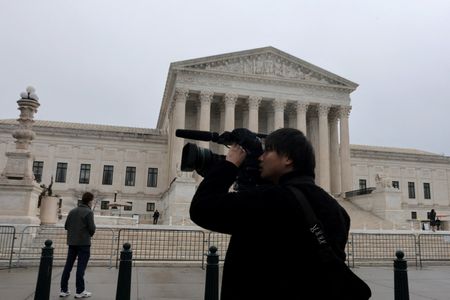

WASHINGTON — The U.S. Supreme Court handed down a major gun rights ruling on Thursday, striking down a Hawaii law that prohibited people from carrying handguns onto private property open to the public — such as most businesses — without the property owner’s explicit permission.
The court’s six conservative justices voted together to overturn a lower court decision that had found Hawaii’s Democratic-backed law was likely in compliance with the Second Amendment. The Trump administration had supported the legal challenge to the law before the Supreme Court.
Hawaii’s law required gun owners to obtain “express authorization” from a property owner before bringing a handgun onto that property, even when the property was open to the general public.
Conservative Justice Samuel Alito, who wrote the majority opinion, was sharply critical of the Hawaii measure. “This regime hobbles what the Second Amendment protects: the right of Americans to carry arms for self-defense as they go about their daily lives,” he wrote. “We hold that the law is unconstitutional.”
The three liberal justices on the court dissented from the ruling.
Legal experts note that several other states have enacted similar laws, and those measures may now face serious constitutional challenges in light of Thursday’s decision.
The lawsuit was brought by three Hawaii residents who held concealed-carry licenses, along with a Honolulu-based gun rights organization. They filed their challenge just weeks after Democratic Governor Josh Green signed the law in 2023. Hawaii officials had argued the law appropriately balanced Second Amendment rights against property owners’ rights to keep firearms off their premises.
The Supreme Court has repeatedly sided with an expansive interpretation of Second Amendment protections, including landmark rulings in 2008, 2010, and 2022 — all decided against a backdrop of ongoing national debate over gun violence and mass shootings.
The challengers in the Hawaii case leaned heavily on the court’s 2022 ruling in New York State Rifle & Pistol Association v. Bruen, which established that the Second Amendment protects an individual’s right to carry a handgun outside the home for self-defense. That ruling struck down New York’s restrictions on carrying concealed handguns in public and set a new legal standard: firearms laws must be consistent with the country’s historical tradition of gun regulation, rather than simply serving a government interest.
A federal judge had initially blocked Hawaii’s law from taking effect. However, the San Francisco-based 9th U.S. Circuit Court of Appeals largely sided with Hawaii, which led the challengers to appeal to the Supreme Court.
Notably, the Supreme Court did not address a separate part of the legal challenge concerning the law’s ban on carrying handguns at beaches, bars, and other designated sensitive locations.
This was not the only significant gun rights case the court decided this term. On June 18, the justices limited the reach of a longstanding federal law that bans firearms possession by certain drug users, rejecting the Trump administration’s broader interpretation that would have threatened the gun rights of millions of marijuana users who also own firearms.
Earlier, the court upheld a federal rule targeting so-called “ghost guns” — firearms that are typically bought online, assembled at home, and lack serial numbers used to trace weapons. That ruling was based on federal statute, not the Second Amendment.