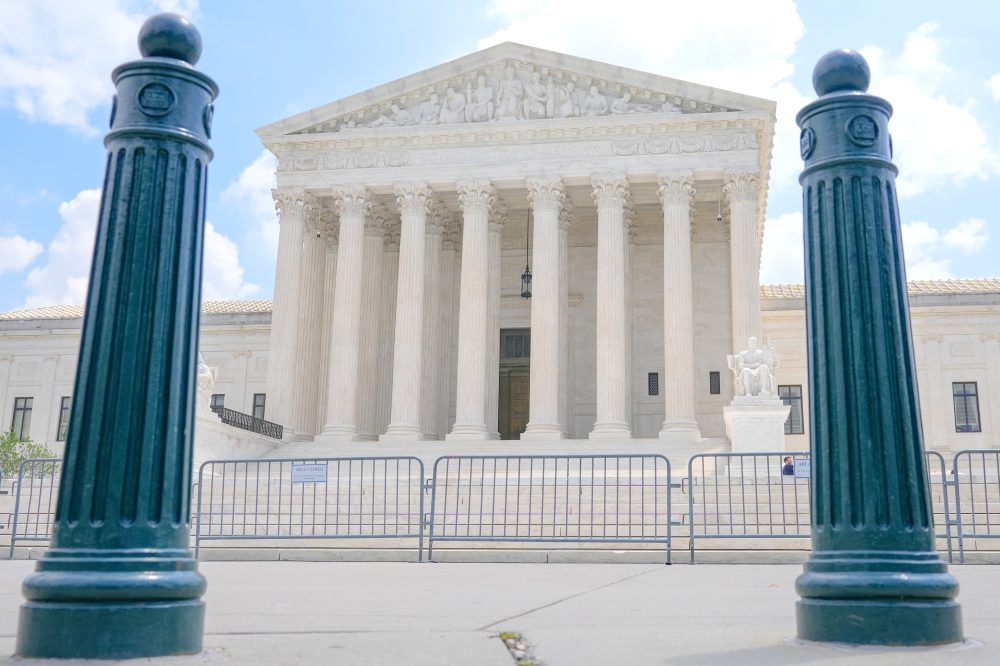

WASHINGTON — The U.S. Supreme Court ruled Tuesday that states have the right to prohibit transgender girls and women from participating on school athletic teams, marking yet another legal defeat for transgender Americans.
The court’s conservative majority determined that athletic bans enacted in Idaho and West Virginia do not conflict with the Constitution or Title IX — the federal law that forbids sex-based discrimination in educational settings.
More than two dozen other Republican-led states have passed similar bans, and legal experts expect Tuesday’s decision will apply to those laws as well.
Still unresolved are separate legal challenges to laws and regulations in Connecticut, California, and other states that allow transgender athletes to compete in accordance with their gender identity.
At the center of the West Virginia case is Becky Pepper-Jackson, a 16-year-old high school sophomore from Bridgeport, West Virginia. She has been on puberty-blocking medication, has publicly identified as a girl since the age of 8, and holds a West Virginia birth certificate that recognizes her as female. She is the only transgender person known to have sought to compete in girls’ sports in the state.
Pepper-Jackson’s athletic career has seen notable growth — she went from running near the back of the pack in middle school cross-country to winning a statewide shot put championship, finishing two feet ahead of the second-place competitor at last month’s West Virginia championship meet.
The Idaho case centers on Lindsay Hecox, who filed suit over that state’s first-in-the-nation ban after seeking to try out for the women’s track and cross-country teams at Boise State University. Her attorney, Kathleen Hartnett, told the court during January arguments that Hecox did not make either team because “she was too slow,” though she did compete in club-level soccer and running.
Well-known figures in women’s sports have taken opposing sides on the issue. Tennis legend Martina Navratilova, swimmers Summer Sanders and Donna de Varona, and beach volleyball player Kerri Walsh Jennings have voiced support for the state bans. Meanwhile, soccer stars Megan Rapinoe and Becky Sauerbrunn, along with basketball players Sue Bird and Breanna Stewart, have stood behind transgender athletes.
The court’s conservative wing has been steadily narrowing protections for transgender Americans. While the Supreme Court ruled in 2020 that LGBTQ employees are shielded from sex discrimination under federal civil rights law — finding that “sex plays an unmistakable role” when employers penalize transgender workers — the six conservative justices declined last year to extend that same reasoning when they upheld state bans on gender-affirming medical care for transgender minors.
States backing the athletic bans argued there is no basis for applying the workplace discrimination ruling to Title IX. Idaho’s state Solicitor General Alan Hurst argued that the law is “necessary for fair competition because, where sports are concerned, men and women are obviously not the same.”
Attorneys representing Pepper-Jackson acknowledged that such distinctions can be reasonable in general but contended that their client holds none of those physical advantages due to the particular circumstances of her early transition. In the Idaho case, Hecox’s legal team had asked the court to dismiss the matter entirely, since she had already pledged not to seek a spot on women’s teams.
NCAA president Charlie Baker told Congress in 2024 that he was aware of only 10 transgender athletes among more than half a million students competing on college sports teams. Despite those small numbers, the topic has taken on enormous political and cultural weight.
Following an executive order signed by President Donald Trump aimed at blocking transgender women from women’s sports, both the NCAA and the U.S. Olympic and Paralympic Committees moved to ban transgender women from competing in women’s athletic events.
Public opinion surveys show broad support for the restrictions. An Associated Press-NORC Center for Public Affairs Research poll from October 2025 found roughly 6 in 10 American adults either “strongly” or “somewhat” favored requiring transgender children and teenagers to compete only on teams matching the sex assigned at birth. About 2 in 10 were opposed, and approximately one-quarter had no opinion.
According to the Williams Institute at the UCLA School of Law, approximately 2.1 million adults — about 0.8% of the U.S. population — and 724,000 people between the ages of 13 and 17, or 3.3% of that age group, identify as transgender in the United States.