
It has now been 123 days since the United States and Israel launched the Iran war, and the world is once again watching as another round of diplomatic talks takes shape. President Donald Trump and Iranian officials remain at odds over the terms and even the format of any communication going forward.
Trump’s special Mideast envoy Steve Witkoff and son-in-law Jared Kushner are scheduled to meet with Qatari mediators to discuss putting an initial deal into effect to end the war in Iran — this following additional military exchanges in the Persian Gulf. Rather than sitting down directly with Iranian diplomats, the American side will rely on go-betweens. Majed al-Ansari, a spokesman for Qatar’s Foreign Ministry, confirmed that arrangement.
Iran is also sending a delegation to Qatar but has made clear it has no intention of meeting with the American side at any level. Iran’s Foreign Ministry spokesman Esmail Baghaei made that statement, though it left open the possibility that messages could be relayed through Qatari channels.
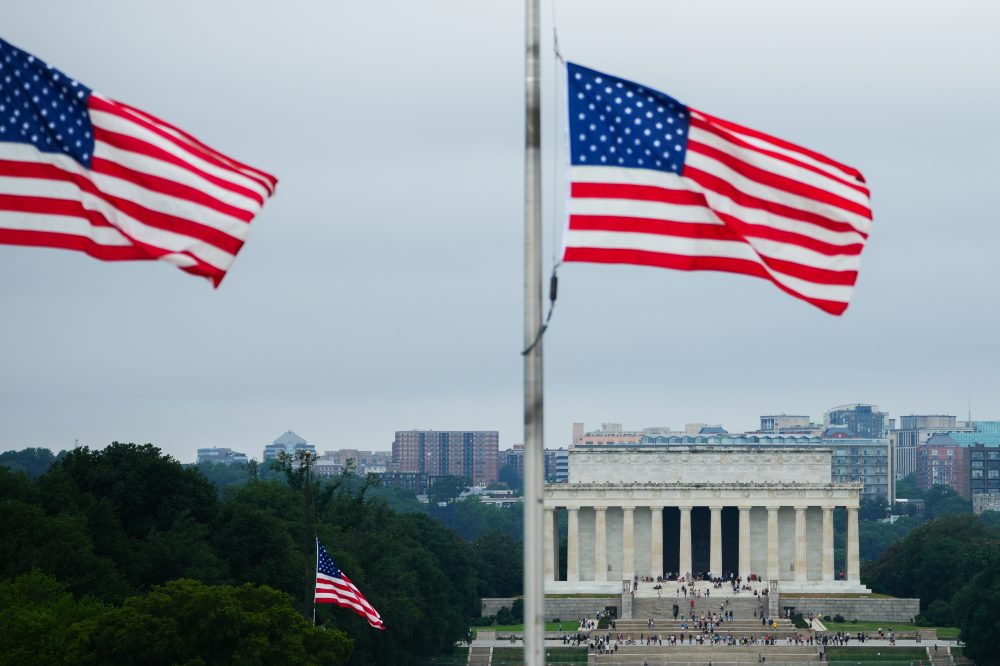
Meanwhile, a new survey from The Associated Press-NORC Center for Public Affairs Research — conducted ahead of the nation’s 250th birthday — paints a divided picture of how Americans feel about the flag. About 7 in 10 Republicans and roughly 6 in 10 Americans aged 60 and older say they fly the flag at least during holidays. In contrast, about 6 in 10 Democrats and independents say they never display it — a figure that climbs to 75% among Democrats under the age of 45.
Racial differences are also stark. Only about 3 in 10 Black adults say they ever display the American flag, compared to approximately half of white and Hispanic adults. Whether people view the flag as a unifying or divisive symbol appears to reflect broader differences in how Americans view their country’s history and achievements. The survey included 2,596 adults and was conducted April 16 through 20.
On the legal front, the Supreme Court ruled Monday that the Federal Reserve holds a unique level of independence from the presidency — unlike other federal agencies. In a 5-4 decision, the court determined that the president cannot remove members of the Fed’s board of governors without sufficient cause. The ruling came amid an ongoing clash between the Fed and President Trump, who has repeatedly called on the central bank to cut its key interest rate to reduce borrowing costs for homeowners, businesses, and the government. Trump had sought to remove Fed governor Lisa Cook last August, accusing her of mortgage fraud — a charge she denies. While the court preserved the Fed’s independent structure, it has allowed the president to fire leaders of other agencies, such as the Federal Trade Commission, at will.
Also Monday, Trump announced he will nominate Keith Sonderling to serve as secretary of labor. Sonderling has been serving as the agency’s acting director for two months, following the resignation of Lori Chavez-DeRemer amid abuse-of-power allegations. Sonderling previously served as deputy labor secretary and as a Republican member of the Equal Employment Opportunity Commission. In a Truth Social post, Trump wrote: “Throughout his career, Keith has proven his dedication to delivering strong results for the Hardworking People of our Country, and I know he will do an incredible job in his new role.” The nomination still requires Senate confirmation. During Trump’s second term, Sonderling has also served as acting director of the U.S. Office of Government Ethics and the Institute of Museum and Library Services, one of several agencies Trump targeted for closure through an executive order.
The Supreme Court is also expected to rule this week on several other major cases, including the constitutionality of Trump’s executive order restricting birthright citizenship for children born to parents who are in the country illegally or on a temporary basis. Also pending are cases involving transgender girls and women playing on public school and college sports teams in West Virginia and Idaho, two election-related cases involving mailed ballot deadlines and limits on political party spending, and a dispute over so-called geofence warrants that use cellphone location data to identify individuals near crime scenes.