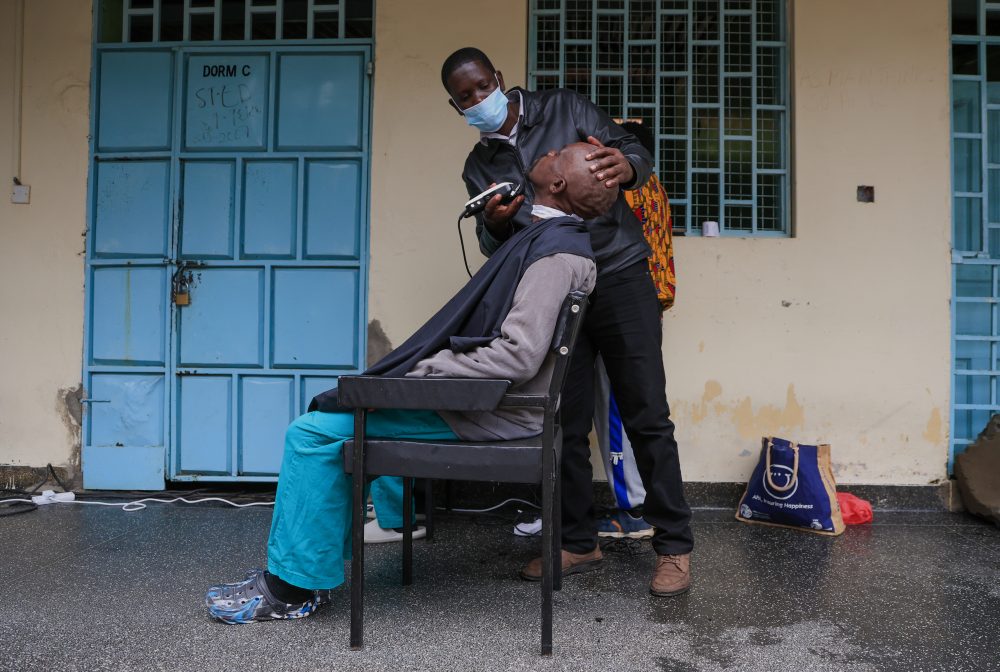

NAIROBI, Kenya — Inside Kenya’s largest mental health referral hospital, male patients are receiving an unexpected but powerful form of care: a free grooming session from two visiting barbers.
The moment the barbers begin setting up their equipment, a wave of excitement moves through the ward. Patients line up eagerly, each one looking forward to their turn in the chair.
Healthcare professionals say that personal grooming is a meaningful part of the healing process. One of the signs that someone may be struggling with mental illness is a loss of interest in their own hygiene and self-care.
Reliable data on mental illness in Kenya remains scarce, but the country’s 2015 Mental Health Policy estimated that roughly 25% of outpatients and 40% of inpatients across all health facilities experience some form of mental health condition.
Experts in the field say depression and anxiety are among the most frequently seen conditions, while substance use disorders — especially among men — continue to pose a significant challenge.
June is recognized as Men’s Mental Health Awareness Month. Francis Kabugua, a nursing officer at Mathari National Teaching and Referral Hospital in Nairobi, is urging men to talk openly about what they are going through rather than turning to alcohol or other substances as a way to cope.
“Among the things that you may see a person with depressive disorders is segregating themselves or separating themselves from the members of the family. They start also not providing for the family,” Kabugua said.
The free grooming program was created by Sheila Lugaliki, who founded a community-based organization called Uniquely Gifted. Lugaliki said her own experience as a patient in a psychiatric ward motivated her to launch the monthly service.
Her goal, she explained, is for each haircut to restore a sense of dignity, build confidence, and remind patients that they matter — rather than leaving them feeling forgotten.
“You find someone has been admitted for six months and yet no one has groomed their hair. How they look really does not reflect how they are feeling,” she said.
Psychiatric nurse Titus Enko echoed that sentiment, saying grooming directly supports patients’ self-esteem and plays a role in their broader recovery.
“More often we only think about medication, psychotherapy, and we tend to overlook the other part, which is the personal grooming. Many times, someone neglects themselves and they start not taking a shower or they don’t dress well. And personal grooming is an indication that someone is either doing good or they’re not doing okay,” Enko said.
As barbers worked their way through the ward, trimming beards and cutting hair, one patient captured the mood in a single word — he said the experience made him feel “alive.”