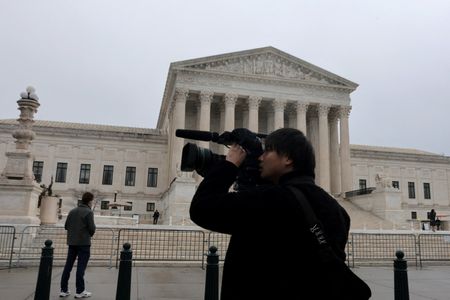

The nation’s highest court is preparing to examine a crucial enforcement tool used by federal securities regulators to combat financial fraud on Wall Street.
At the center of Monday’s Supreme Court arguments is whether the Securities and Exchange Commission must demonstrate that investors suffered financial losses before it can force defendants to surrender profits obtained through illegal means — a process known as disgorgement.
The case stems from an appeal by Ongkaruck Sripetch, who was directed by a court to return more than $3 million in illegal gains and interest connected to securities fraud. The Trump administration is supporting the SEC’s position in the dispute.
While the SEC’s general authority to pursue disgorgement isn’t being questioned — courts have long acknowledged this power and Congress has codified it into federal statute — the specific issue centers on whether regulators must establish victim harm before seeking the return of illegally obtained money.
The SEC has relied heavily on this enforcement mechanism in recent years. During fiscal 2025 under Trump, the agency collected approximately $1.4 billion through disgorgement, according to official figures that don’t include certain amounts. The previous year under President Biden, the SEC secured $6.1 billion via disgorgement, representing nearly three-quarters of all financial penalties imposed.
In 2020, the SEC pursued disgorgement against Sripetch for profits it alleged he obtained fraudulently, including through a pump-and-dump operation where he artificially boosted penny stock prices before selling his holdings for profit.
Sripetch acknowledged breaking securities laws and received a 21-month prison sentence in a related criminal proceeding. However, he’s contesting the disgorgement ruling, arguing that the SEC didn’t demonstrate his conduct caused stock values to decline or otherwise financially damaged investors.
Justice Department attorneys have maintained in legal filings that the SEC doesn’t need to establish that fraud caused financial or “pecuniary” damage before seeking repayment through the courts.
“Disgorgement is a remedy designed to strip ill-gotten profits from wrongdoers, not to compensate victims for their losses,” they stated in court documents.
A federal judge in California supported the SEC’s broader understanding of its disgorgement authority in a decision that was confirmed last year by the 9th U.S. Circuit Court of Appeals in San Francisco.
Federal appeals courts have reached different conclusions about whether the SEC must demonstrate victim financial harm as part of the remedy. Both the Trump administration and Sripetch asked the Supreme Court to review the matter to settle the disagreement among lower courts.
The SEC’s $1.4 billion disgorgement total for fiscal 2025 doesn’t include certain payments obtained by other federal agencies or an $8 billion payment made in January 2025, during Trump’s second week back in office, from ongoing SEC litigation involving a Ponzi scheme. In addition to disgorgement, the SEC can also seek fines, sanctions and other penalties.