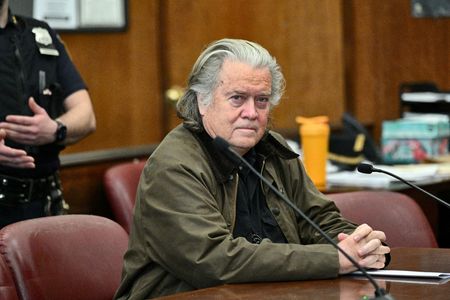

The nation’s highest court has opened the door for federal prosecutors to drop criminal charges against Steve Bannon, a close ally of President Donald Trump who was found guilty of defying a congressional subpoena related to the January 6th Capitol investigation.
On Monday, the Supreme Court justices overturned a lower court ruling that had maintained Bannon’s 2022 conviction for his refusal to provide documents or appear before the House committee examining the January 6, 2021, Capitol breach by Trump supporters.
The Trump administration’s Justice Department urged the Supreme Court to overturn the previous ruling, stating in legal documents that dropping Bannon’s case would serve “the interests of justice.” Federal prosecutors had already requested dismissal at the trial court level.
In a concise unsigned ruling, the Supreme Court sent the matter back to the lower court for additional review “in light of the pending motion to dismiss the indictment.”
A Washington jury had found Bannon guilty on two contempt of Congress charges for his failure to supply documents or testimony to the Democratic-controlled House committee probing the Capitol incident.
The January 6th protesters had attempted to block Congress from certifying Democrat Joe Biden’s electoral victory over Trump in the 2020 presidential race. Bannon characterized both the House committee’s investigation and the subsequent Justice Department charges during Biden’s administration as politically driven.
The 72-year-old Bannon played a crucial role as an advisor to Trump’s 2016 campaign and served as chief White House strategist in 2017 during Trump’s initial presidency, despite a temporary rift that was eventually resolved.
During sentencing proceedings, prosecutor J.P. Cooney stated that Bannon decided to “thumb his nose at Congress.” Cooney emphasized that Bannon “is not above the law, and that’s what makes this case important.”
Following the Supreme Court’s June 2024 rejection of Bannon’s attempt to avoid prison during his appeal, he completed a four-month term at a minimum-security federal facility in Danbury, Connecticut. His release occurred one week prior to Trump’s electoral victory over Democrat Kamala Harris in 2024.
Bannon portrayed himself as a political prisoner and declared to media upon his release, “I am far from broken. I have been empowered by my four months at Danbury federal prison.” He subsequently returned to hosting his “War Room” podcast.
A controversial figure, Bannon helped shape the “America First” right-wing populist movement and strong anti-immigration stance that has characterized Trump’s political agenda. He has been influential in conservative media and has supported right-wing movements and candidates both domestically and internationally.
House committee records indicate that Bannon communicated with Trump at least twice the day before the January 6th incident, participated in a strategy session at a Washington hotel, and declared on his podcast that “all hell is going to break loose tomorrow.”
The U.S. Court of Appeals for the District of Columbia Circuit upheld Bannon’s conviction in 2024, leading to his Supreme Court appeal.
Bannon’s legal team has presented multiple arguments challenging the subpoena, including matters concerning executive privilege—a legal doctrine allowing presidents to maintain confidentiality of certain communications—and the congressional committee’s power to issue subpoenas.
Bannon has encountered additional legal troubles. In February 2025, he entered a guilty plea in New York state court to fraud charges after prosecutors alleged he misled donors in a 2019 private fundraising effort for Trump’s border wall project. He avoided incarceration in that matter.
Trump granted Bannon a pardon in 2021 following his federal indictment on charges also connected to the border wall fundraising scheme.