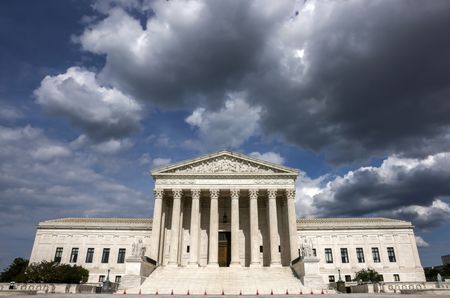

WASHINGTON — The U.S. Supreme Court is approaching the end of its current term with a handful of significant cases still unresolved, including three that put Donald Trump’s expansive claims of presidential power to the test.
The high court, which leans conservative by a 6-3 margin, has seven cases left to rule on and has designated Monday as its next scheduled day for issuing decisions. The court’s terms begin each October and generally conclude around the end of June, though they occasionally run into early July.
At the heart of the Trump-related cases are his moves last year to remove a member of the Federal Reserve Board of Governors and a member of the Federal Trade Commission, as well as an executive order he issued to limit birthright citizenship. All three actions are being scrutinized for how far presidential power can legally reach.
The court handed Trump wins in two immigration cases on Thursday and has sided with him in several emergency rulings since he returned to office last year, allowing certain policies to take effect while legal fights continued in lower courts. However, the justices dealt him a notable defeat in February, rejecting his sweeping tariffs that were issued under a law designed for national emergencies.
Firing Federal Officials
During arguments in January, the justices appeared doubtful about Trump’s attempt to remove Lisa Cook from the Federal Reserve — a move seen as a threat to the central bank’s independence from political influence.
No president has attempted to fire a Fed official since the institution was established in 1913. When Congress created the Fed, it built in protections against political interference, requiring that governors only be dismissed “for cause.” The law does not spell out what that phrase means or lay out any removal process.
Trump pointed to unverified allegations of mortgage fraud — which Cook has denied — as his justification for the firing. Cook, who has remained in her position throughout the legal battle, has said the allegations are simply a cover for removing her over disagreements on monetary policy.
Meanwhile, the conservative justices signaled during December arguments that they would likely uphold Trump’s dismissal of Rebecca Slaughter, a Democratic member of the Federal Trade Commission, citing policy disagreements. Lower courts had previously ruled that Trump overstepped his authority in that case.
U.S. Solicitor General D. John Sauer, representing the administration, urged the court to overturn a 1935 precedent — Humphrey’s Executor v. United States — which has long limited a president’s ability to remove the heads of independent federal agencies. While the court has chipped away at that precedent in recent decades, it has not yet fully overturned it.
The conservative wing of the court appeared receptive to the administration’s argument that congressional job protections for leaders of independent agencies infringe on the president’s constitutional authority. The court allowed Trump to remove Slaughter while the case was still being litigated last year.
Election-Related Cases
Two rulings tied to election law are also expected, with the November midterm elections on the horizon and Republicans working to hold onto their congressional majority.
During March arguments, the conservative justices seemed skeptical of a Mississippi law — challenged by Republicans — that allows mail-in ballots received up to five business days after Election Day to be counted, as long as they were postmarked by Election Day or earlier. A lower court had ruled against the law, and the outcome of this case could tighten voting rules across the nation.
The administration backed the challenge to Mississippi’s law. Separately, Trump signed an executive order in March aimed at restricting mail-in ballots nationwide, but a federal judge in Boston blocked that order from taking effect on Thursday.
The court also heard arguments in December in a case involving Vice President JD Vance, centered on a Republican-led effort to strike down federal limits on how much political parties can spend in coordination with their candidates. Some conservative justices appeared open to the challenge, while the court’s liberal members seemed inclined to keep the restrictions in place. The dispute centers on whether those spending limits violate the First Amendment’s free speech protections. A lower court had upheld the restrictions.
Transgender Athletes
In January, the court heard arguments over laws in Idaho and West Virginia that prohibit transgender athletes from competing on female sports teams at public schools, including universities. The conservative justices appeared prepared to uphold those laws. Supporters say the measures protect fair competition for women and girls, while critics argue they are part of a broader push to curtail the rights of transgender Americans.
‘Geofence’ Warrants
The court also heard arguments in April in a Virginia case examining whether law enforcement’s use of so-called “geofence” warrants — which use cellphone location data to identify potential suspects near a crime scene — runs afoul of the Fourth Amendment’s prohibition on unreasonable searches.