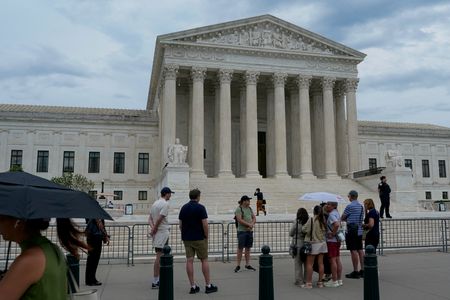

WASHINGTON — Since returning to the White House with a pledge to dramatically tighten immigration enforcement and pursue mass deportations, President Donald Trump has found a willing ally in the U.S. Supreme Court — at least most of the time.
The nation’s highest court, which holds a 6-3 conservative majority, has largely cleared the path for the Republican president’s immigration policies targeting both those in the country legally and those who are not. The court’s three liberal justices have opposed most of those moves.
Three more examples emerged this week, with the court handing the administration a trio of wins — each decided along ideological lines — that expand the government’s power to deport individuals or deny them entry, including some who hold legal status.
‘A RUBBER STAMP’
Elora Mukherjee, who directs the Immigrants’ Rights Clinic at Columbia Law School in New York, was blunt in her assessment: “The Trump administration has turned the immigration system into a deportation machine.”
“In most cases, the Supreme Court has been a rubber stamp for Trump’s mass deportation agenda,” Mukherjee added.
In a 6-3 ruling Thursday, the court allowed the administration to revoke Temporary Protected Status for hundreds of thousands of Haitian and Syrian immigrants. That humanitarian designation permits people from countries devastated by war or disaster to live and work in the United States while conditions at home remain dangerous.
Legal experts warned the real-world consequences are severe. Immigrants losing that protection now face a stark choice: remain in the U.S. and risk arrest, or return to countries the U.S. State Department advises against visiting due to widespread violence, crime, terrorism, and kidnapping.
Tirana Hassan, CEO of Doctors Without Borders USA, addressed the situation Thursday, saying, “These are not conditions to which people should be returned” — a reference to Haiti.
Ahilan Arulanantham, an immigration law expert at UCLA who also represented Syrian plaintiffs in the TPS case, said, “The Supreme Court has consistently ruled against the rights of immigrant communities in important cases in the last several years, and this case fits that pattern.”
He added that the ruling “hands to the administration, and to the far right wing of the anti-immigrant movement, an important victory that they have been unable to obtain through Congress for a number of years.”
Also on Thursday, the court ruled 6-3 to uphold the government’s authority to physically block asylum seekers from crossing the U.S.-Mexico border when officials determine border crossings are overwhelmed. This practice, known as “metering,” was discontinued under Trump’s Democratic predecessor Joe Biden. The Trump administration has indicated it may seek to bring the policy back.
Earlier in the week, on Tuesday, the court again split 6-3 to make it easier to remove lawful permanent residents — commonly known as green-card holders. The ruling determined that border agents do not need to meet the demanding “clear and convincing evidence” standard to prove a green-card holder committed a crime before blocking their re-entry into the country after traveling abroad.
‘THE RULE OF LAW’
Department of Homeland Security General Counsel James Percival praised the decisions, saying, “These three rulings are all victories for the rule of law and common sense.” He noted that Temporary Protected Status “was always supposed to be temporary.”
“Thanks to these decisions, we now have several more important tools to continue securing our borders,” Percival said.
Since Trump returned to office in January 2025, the Supreme Court has repeatedly stepped in to allow his immigration policies to move forward — often on an emergency basis — even while legal challenges work their way through the courts. These orders are issued through what is known as the court’s “shadow docket,” a process that allows justices to make significant decisions without the usual extensive legal briefings or oral arguments.
Among the policies the court has permitted: deporting migrants to countries where they have no connections, conducting aggressive immigration raids that may target individuals based on race or language, and eliminating humanitarian protections — including TPS and another form of protection called parole — for hundreds of thousands of immigrants.
Ashley Sanchez, who leads the Immigration Clinic at the University of Notre Dame’s law school, noted that immigration laws themselves haven’t changed dramatically. Rather, she said, the current administration is choosing to enforce them in ways designed to restrict both legal and illegal immigration as aggressively as possible.
The court’s current ideological balance has been in place since October 2020, when Trump appointed conservative Justice Amy Coney Barrett to fill the seat left vacant by the death of liberal Justice Ruth Bader Ginsburg. Sanchez said that conservative supermajority has been central to the direction of immigration rulings.
“This more conservative group appears much more willing to side with the president,” Sanchez said.
She pointed to a June 2020 decision, during Trump’s first term, in which the court blocked his effort to end a program shielding from deportation hundreds of thousands of migrants — often called “Dreamers” — who came to the U.S. illegally as children. At that time, the court had a 5-4 conservative majority, but conservative Chief Justice John Roberts joined the liberal justices to block Trump’s move.
“It’s hard to imagine this current court coming to that same decision,” Sanchez said.
The court has not sided entirely with the administration. In several instances, justices have ruled that migrants must be afforded basic fairness protections guaranteed under the Constitution’s due process clause. Last year, the court twice placed limits on the administration’s use of a 1798 law called the Alien Enemies Act — historically invoked only during wartime — which Trump had used to rapidly deport Venezuelan migrants accused of belonging to the Tren de Aragua gang.
BIRTHRIGHT CITIZENSHIP
As the court’s current term nears its end, one major immigration case remains unresolved. Based on questions the justices posed during oral arguments in April, the court may actually rule against Trump in a case involving his executive order that would deny birthright citizenship to hundreds of thousands of babies born in the United States each year.
Trump’s order directed federal agencies to refuse to recognize citizenship for children born on U.S. soil if neither parent is an American citizen or a lawful permanent resident. Lower courts found the order conflicts with the Constitution’s 14th Amendment, which has long been interpreted as granting citizenship to virtually all people born on U.S. soil, with limited exceptions such as children of foreign diplomats or members of an enemy occupying force.
The relevant section of the 14th Amendment, known as the Citizenship Clause, reads: “All persons born or naturalized in the United States, and subject to the jurisdiction thereof, are citizens of the United States.”
A ruling in that case could come as early as Monday.