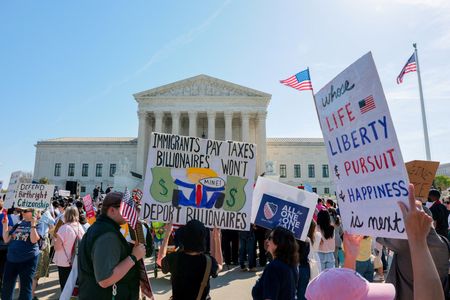

WASHINGTON – In a historic Supreme Court appearance Wednesday, President Donald Trump witnessed what appeared to be strong judicial resistance to one of his most controversial immigration policies.
Trump became the first sitting president to observe oral arguments involving his own administration’s case, watching as most of the nine justices expressed doubt about his executive order eliminating birthright citizenship for certain newborns.
The policy in question would strip citizenship rights from hundreds of thousands of infants born annually on American soil if neither parent holds U.S. citizenship or permanent legal status.
Chief Justice John Roberts, who has led the conservative-majority court for over twenty years, appeared particularly unconvinced by the administration’s legal reasoning, calling their constitutional interpretation “quirky.”
“I do not think that Chief Justice Roberts wants to go down in history as presiding over a court that ended birthright citizenship,” observed Kevin Johnson, who specializes in immigration law at the University of California, Davis.
The constitutional battle centers on the 14th Amendment’s Citizenship Clause, which declares: “All persons born or naturalized in the United States, and subject to the jurisdiction thereof, are citizens of the United States.”
Lower courts previously blocked Trump’s directive, finding it violated this constitutional provision that has traditionally granted citizenship to nearly everyone born on U.S. territory, with limited exceptions for diplomatic families or enemy occupying forces.
During arguments, U.S. Solicitor General D. John Sauer defended the policy by citing concerns about “birth tourism,” where foreign nationals travel to America specifically to secure citizenship for their children.
“Eight billion people are one plane ride away from having a child who’s a U.S. citizen,” Sauer argued.
Roberts quickly countered: “Well, it’s a new world. It’s the same Constitution.”
However, not every justice appeared opposed to the administration’s position. Conservative Justice Samuel Alito showed interest in arguments that birthright citizenship should only apply to those with “lawful domicile” in America, defined as “lawful, permanent residence within a nation, with intent to remain.”
Trump signed this executive order on his first day returning to office in January 2025, making it a cornerstone of his comprehensive plan to limit both legal and unauthorized immigration.
The Supreme Court’s apparent reluctance contrasts sharply with previous decisions that have generally supported Trump’s immigration enforcement efforts, including ending migrant humanitarian protections and permitting aggressive deportation raids.
Columbia University law school’s immigrant rights clinic director Elora Mukherjee suggested this case differs fundamentally from other immigration disputes.
“Birthright citizenship is core to our identity as a nation,” Mukherjee explained. “It is unlike any of the other contexts… which are not central to how all Americans live their lives and are not central to how we as a nation for generations have viewed ourselves.”
Constitutional law professor Ilya Somin from George Mason University noted that while the court has often deferred to Trump on immigration matters, “the weight of argument and precedent is strongly on one side here, more so than in most of the other cases.”
This potential setback follows another recent Supreme Court defeat for Trump, when justices struck down his global tariff program in February by a 6-3 margin.
That ruling prompted Trump to criticize the court harshly, calling justices who opposed him unpatriotic and labeling two of his own appointees – Neil Gorsuch and Amy Coney Barrett – an “embarrassment to their families.”
Following Wednesday’s session, Trump continued his criticism: “The Supreme Court’s not been acting very well,” he said, suggesting certain justices he appointed want to demonstrate independence. “Stupid people,” he called them.
Johnson believes the court will likely respect both the clear language of the Citizenship Clause and the “long, unbroken history” of birthright citizenship, despite some justices exploring potential limitations.
“The questions of the justices touched on some possible cracks in the rule but it remains intact,” Johnson said.
Trump’s presence in the ornate courtroom is unlikely to influence the final decision, with a ruling expected by late June. As he observed the proceedings, the president could have noticed a marble sculpture above the judicial bench depicting “Majesty of the Law” – a figure holding a book symbolizing constitutional authority.