
Ashley Dreahn’s life after college took a very different path than she had imagined.
She started her career as a teacher, then returned to school and borrowed additional money hoping to land a better-paying position in the chemical processing field. That opportunity never came. Then Hurricane Harvey hit, she lost her job, and her car broke down. By 2022, her financial situation had become so dire that she filed for bankruptcy.
Dreahn eventually found employment at a Texas prison and was slowly putting her life back together — setting aside money for weight-loss surgery — when a credit-monitoring service delivered a shocking message this spring. The student loans she believed had been wiped out in bankruptcy had actually grown to $94,298 with accumulated interest, and she was now required to make payments. She was officially in default.
“I absolutely broke down,” said Dreahn, 40.
Nationwide, the number of borrowers carrying defaulted student loans climbed by more than 4.2 million between April 2025 and March 2026, according to an Associated Press analysis. The spike includes large numbers of borrowers who fell behind in 2024, when loan payments resumed after being frozen during the pandemic.
Hundreds of thousands of additional borrowers are several months behind on their payments, and another wave of defaults may be coming. Millions of people are facing steeper monthly bills as the government phases out its most affordable income-driven repayment option — the SAVE plan — as part of changes the Education Department says are meant to simplify a complicated system.
Borrowers are considered in default once they have missed nine months of payments. The fallout can be severe, damaging credit scores and triggering debt collection efforts.
“I am seeing despair and outrage and despondency and just a very wide mix of pretty extreme emotions, the likes of which I have not seen before,” said Alan Collinge, the founder of Student Loan Justice and the author of “The Student Loan Scam.”
The federal government has the authority to garnish wages and Social Security payments from people in default, though the Trump administration stepped back from plans to begin collections in January. A Moody’s Analytics report released this spring warned that garnishments are likely to begin within the next year, calling it “an additional headwind in an increasingly fragile economy.”
Dreahn was the first in her family to attend college, enrolling at Texas Woman’s University in 2004. She worked multiple jobs — babysitting, at a call center, and at an automotive shop — but still needed to borrow heavily to stay enrolled.
“There was one point where they were like, ‘If you don’t come up with the money, we’re dropping you from your classes,’” said Dreahn, who graduated with a history degree focused on education and social studies. “And it was, ‘OK, what do I need to sign?’”
She said no one ever clearly explained what taking on student loan debt would really mean down the road.
“You just kind of trust these advisers and trust these financial aid people that this is what you’re supposed to do,” Dreahn said.
While working as a teacher, she took out more loans to earn two associate degrees from a public community college in Texas. She received a job offer at a chemical refinery, but it was pulled back because she exceeded the weight limit for the company’s safety gear.
When she filed for bankruptcy in 2022, she hoped it would wipe the slate clean. Checking her credit report afterward, each student loan entry showed a message reading: “Nice! You’ve paid off 100% of this loan.” That message can appear when loans are consolidated or transferred to new servicers — even when a balance still exists.
In reality, student loans are almost never eliminated through bankruptcy. Borrowers must demonstrate what is known as “undue hardship,” a difficult and rarely met standard, according to advocates.
Dreahn had no idea.
“I was so relieved, like, ‘OK, now I can start life over,’” she said. “‘I can save some money.’”
She began working last year as a supervisor at a prison in Huntsville, about 70 miles north of Houston, and was living in an RV park to cut costs when the default notice arrived.
“I just feel like, where is that light at the end of the tunnel now that I thought I had?” Dreahn said.
As a pandemic relief measure, the federal government allowed borrowers to pause student loan payments until 2023. The Biden administration then extended a one-year grace period, which ended in fall 2024 — after which loans could enter default following nine months of missed payments.
A flood of defaults followed. Today, roughly 9.5 million borrowers — more than one in five — are in default, including those whose loans were already overdue before the pandemic, according to the AP analysis. The previous record was 8 million borrowers in default, set in December 2019.
Federal data also shows that 870,000 borrowers have loans between 181 and 270 days past due, putting them on the edge of default. Additionally, 33% of borrowers who attended for-profit schools were at least 90 days late on payments — more than double the rate seen among borrowers who attended public schools.
Most private colleges offering traditional degrees operate as nonprofits, while for-profit schools typically focus on career-oriented programs and frequently serve students of color. Career Education Colleges and Universities, an association representing private trade schools, has formed a task force to contact students about the importance of keeping up with loan payments, according to Jason Altmire, the group’s president and CEO.
“We take it seriously,” he said.
Some borrowers, overwhelmed by their debt and the constant changes to the federal loan system, have simply stopped paying.
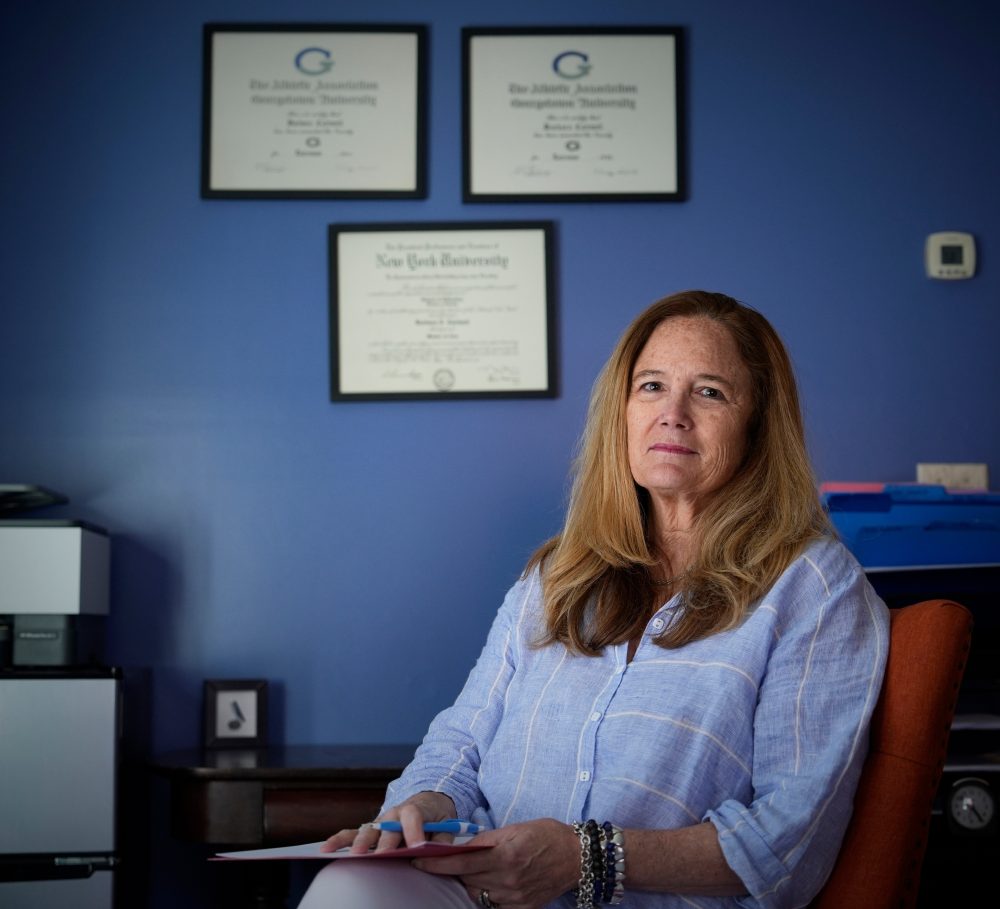
Barbara Howaniec, a 63-year-old psychiatric nurse practitioner from Auburn, Maine, has already defaulted. She borrowed roughly $62,000 to earn a master’s degree from New York University, graduating in 2001. After two decades of payments, she still owes around $67,000 due to accumulated interest. She had temporarily deferred her loans while raising young children, not realizing interest would keep building during that time.
Howaniec had counted on having her loan forgiven after 25 years under an income-based repayment plan. Instead, she received a letter informing her that the repayment schedule had changed and she now owed 355 more payments — meaning she would be 91 years old by the time she finished paying.
She made repeated calls seeking help, but said the guidance she received changed depending on who answered the phone. Last year, while also paying for her own children’s college education, she stopped making payments on her own loans.
“I had already paid what I had borrowed. I’m like, no, I’m not going to pay anymore,” Howaniec said. As a self-employed person, she said she does not fear wage garnishment.
Shannon Khan, a 46-year-old mental health worker from Webster, Texas, has not made a student loan payment in two months while she explores her options.
She had been enrolled in the SAVE plan and owed nothing monthly, but was moved last fall to a different income-driven repayment plan with a required payment of $847 per month. She believed she was close to having her remaining balance forgiven, but recently learned her payment would jump to $1,683 a month — an amount her loan servicer said she would need to pay for nearly a decade.
She has spent hours on the phone trying to get clear answers.
“It’s just a bunch of chaos and confusion,” Khan said.
For Dreahn, the confusion began when she was still a student. As an adult, the system remained murky. Her loans were transferred between multiple servicers, and they were deferred when she went back to school.
“It’s a huge, huge mess,” Dreahn said. “It’s almost like it just gets sold off and you’re just lost in the system somewhere until you figure out that, ‘Oh, they want $700 this month. What?’”
Now in default, she hopes she may eventually qualify for Public Service Loan Forgiveness, a program that requires 10 years of payments while working for a nonprofit or government employer.
“I’m trying to figure out: One, how I’m going to make it work. And two, what do I give up?” Dreahn said. “How do I manage buying groceries as well as making sure the bills are covered and this payment never gets missed?”
She finds herself thinking about the chemical plant job that slipped away.
“That was a six-figure career that I lost due to my weight,” she said, her voice breaking. “The money that I’m trying to save now that was going to be for surgery is going to be paid to student loans instead.”