
Brazil has turned to forensic science in its battle against illegal gold mining in the Amazon rainforest — one of the most serious threats facing the region’s ecosystem, Indigenous populations, and surrounding communities. The practice has accelerated the destruction of forest land and pushed mercury pollution to alarming levels.
At the National Institute of Criminalistics in Brasilia, the nation’s capital, federal police have established what they call a “gold lab” — a facility that gathers and examines gold samples collected from locations throughout the country.
The goal is straightforward: determine whether a given gold sample, perhaps seized during a police raid, originated from a protected area where mining is prohibited. The technique is referred to as “gold fingerprinting” — a method that pinpoints the source of gold with a high degree of accuracy.
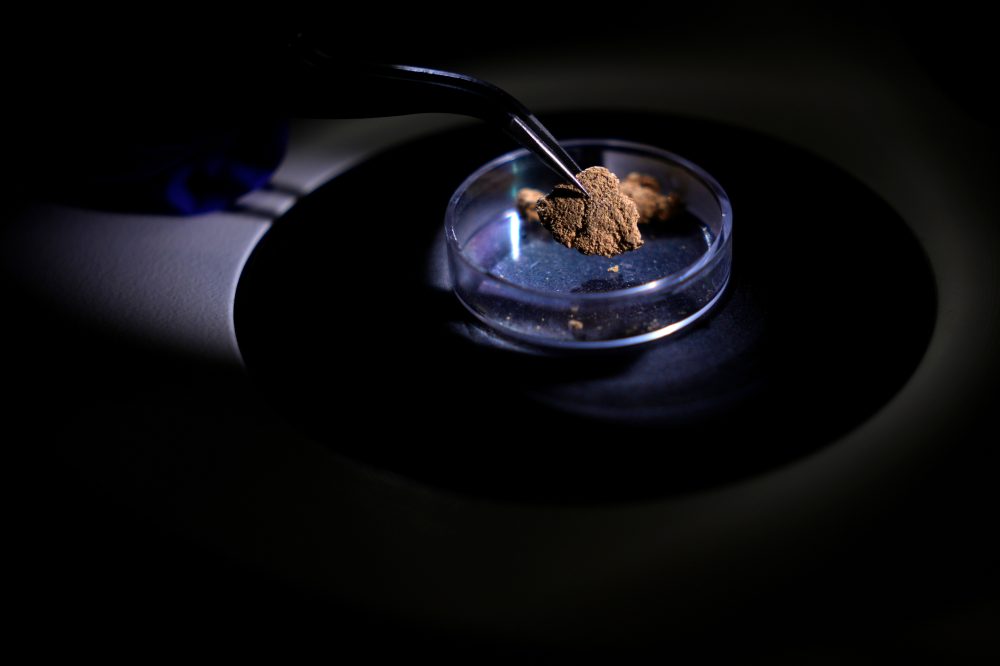
Inside the lab, tiny coin-shaped containers hold glittering gold flakes. But the real value lies not in the metal itself, but in the chemical information it carries. Every speck of gold is chemically distinct because, as it forms within rock or riverbeds, it absorbs surrounding particles — traces of metals like silver and copper — that are unique to that location.
Those trace elements serve as the fingerprint. Investigators can compare the chemical profile of seized gold against a stored database of samples from protected regions. If the profiles match, it indicates the gold was illegally pulled from a national forest or Indigenous territory.
Gustavo Geiser, a forensics expert with the federal police, said the method has been in development since 2019, built through partnerships with Brazilian universities. The lab employs sophisticated analytical tools including X-ray fluorescence spectrometry, scanning electron microscopy, and laser ablation mass spectrometry.
“As we advanced, the forensic examinations became increasingly complex,” Geiser said, noting that the central question driving their work has always remained the same: “Where did this gold come from?”
Once forensic analysis confirms that a gold sample was illegally mined, that evidence helps law enforcement build criminal cases and pursue further investigations and potential charges.
People engaged in environmental crimes in the Amazon regularly use fraudulent means to introduce illegal goods — including gold, cattle, and timber — into legitimate markets. A worldwide spike in gold prices has only intensified the rush to mine in the rainforest.
Amazon Mining Watch, a platform that tracks mining activity via satellite imagery, estimates that roughly 496,000 hectares — about 1.2 million acres — of rainforest have been cleared for mining since 2023, with approximately 223,000 hectares (551,000 acres) located in the Brazilian Amazon.
Brazil’s Federal Court of Accounts, the country’s highest auditing body, reported last year that evidence suggested mining permits issued by the National Mining Agency to small-scale operators were being exploited to pass off gold extracted from protected Amazon areas as legally sourced material.
An independent Greenpeace report released in May, drawing on public records, satellite data, and aerial surveillance, laid out exactly how the scheme operates. A legally permitted mine operator would claim on paper to have extracted large quantities of gold from their authorized site. Yet satellite and aerial imagery would show no activity at that location, while nearby Indigenous lands — where mining is strictly forbidden — would reveal extensive mining operations underway. Greenpeace has labeled this a “ghost mine” scam.
A federal court in Pará, a northern state heavily affected by illegal mining, issued an order this month directing institutions including the Central Bank and the National Mining Agency to establish effective controls and traceability for all gold from the point of extraction to the marketplace. Federal prosecutors have also filed a lawsuit against the National Mining Agency demanding stronger oversight of mining permits.
Prosecutor André Porreca, who is leading that case, said the permits have effectively become a tool used “to launder gold extracted by criminal organizations from Indigenous territories and protected areas.”
Geiser views the Brasilia gold lab as a critical component in the broader effort to combat environmental crime and reinforce the integrity of the global gold supply chain.
“Being able to state that it (gold) has a legitimate origin and therefore is valid for inclusion in a country’s or a bank’s financial reserves, I believe provides solidity not only to the market but also to the countries’ financial bonds,” he said.
While there are no figures on how many individuals the lab’s work has helped convict, Geiser noted that criminal networks have recently begun routing illegally mined gold through neighboring countries — including Venezuela, French Guiana, and Suriname — to launder it. Samples originating from those countries have since been added to the lab’s ever-expanding database.
The growing scale of the problem has also prompted regional nations to deepen cooperation through the Amazon International Police Cooperation Center, based in the Brazilian city of Manaus.
The Amazon is the largest rainforest on Earth and plays a critical role in regulating the global climate. Researchers warn that continued degradation of the forest could speed up global warming.
A 2023 analysis by MapBiomas, a nonprofit organization that monitors land use, found that more than 90% of Brazil’s mining activity occurs in the Amazon region, with nearly 40% of it taking place illegally in protected areas.
Although illegal gold mining contributes less to deforestation than agriculture does, the environmental damage it causes is nearly impossible to undo — largely due to the use of mercury in the gold extraction process. After gold is separated, mercury is discharged into rivers, contaminating the water and the fish that Indigenous communities depend on for survival.
A 2023 study by Fiocruz, a Brazilian science institute, found that 21.3% of fish sold in Amazonian markets contained mercury levels exceeding World Health Organization safety thresholds. Among the most vulnerable: children between the ages of 2 and 4 were found to be consuming mercury at levels up to 31 times the recommended maximum.
Brazil is a signatory to the United Nations agreement known as the Minamata Convention on Mercury, which obligates the country to phase out mercury use in gold mining. The Ministry of Mines and Energy published a draft plan this month outlining how that phase-out might occur, with a public comment period open through August 7. Federal prosecutors have called for Indigenous communities — those most directly harmed by mercury contamination — to be formally consulted, though that has not yet taken place.
A complete mercury ban would not only reduce environmental harm but would also strengthen forensic investigations, according to Geiser, whose lab is capable of detecting mercury traces in any sample it analyzes.
“It will make it even clearer that any mining using mercury … is illegal,” he said.