
Elon Musk’s space exploration company SpaceX revealed its initial public offering documents on Wednesday, providing the first public look at the financials of a business that has transformed rocket technology while setting its sights on Mars colonization and artificial intelligence ventures in space.
The stock market debut is expected to become the first trillion-dollar U.S. public offering and may pave the way for several major IPOs in the coming months, potentially including technology companies OpenAI and Anthropic. The public sale would instantly establish SpaceX among the world’s most valuable publicly traded corporations, marking the second company in Elon Musk’s extensive business portfolio to exceed $1 trillion in market value.
Since its establishment in 2002, SpaceX has evolved into the globe’s biggest space enterprise by deploying thousands of Starlink internet satellites. The company’s groundbreaking approach to reusable rocket technology has reshaped space economics, leaving rivals such as Jeff Bezos’ Blue Origin working to catch up.
Although SpaceX built its reputation through rocket construction and satellite launches, the majority of its $18.67 billion in revenue last year originated from its Starlink satellite internet operations, with much of its projected growth tied to artificial intelligence ventures. According to the filing, its developing xAI division continues to operate at a loss.
A successful public offering could establish a record-breaking company valuation of $1.75 trillion, potentially positioning its founder to become history’s first trillionaire, proving the worth of years spent challenging conventional wisdom through developing rockets capable of landing and flying multiple times.
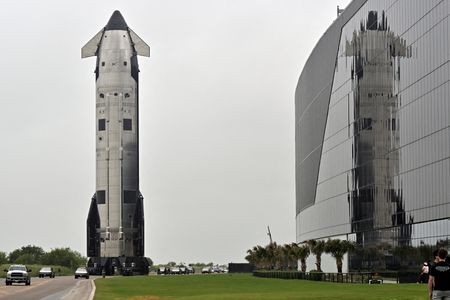
The regulatory filing arrives during an important week for the rocket manufacturer, as it prepares for a test flight of its next-generation Starship rocket.
Musk’s ambitions for lunar and Mars missions, along with expanding the Starlink satellite internet service, rely on this new rocket. The test launch, initially planned for Tuesday, is now anticipated later this week.
The board has granted Musk authority over the company while linking much of his pay to ambitious goals of creating a permanent human settlement on Mars and constructing space data centers with computing power equivalent to 100 terawatts, or 100,000 one-gigawatt nuclear reactors, Reuters previously reported.
SpaceX hopes to begin trading its shares as soon as June 12, with a roadshow launch planned for June 4 and the share sale potentially starting June 11, Reuters reported last week.
Musk’s celebrity status as CEO may carry more weight with certain investors than SpaceX’s core business metrics, analysts and academics noted, since no comparable companies exist for valuation benchmarking.
The company stated it was pursuing a potential total market worth $28.5 trillion across its various businesses, with most of that possible revenue connected to AI.
These numbers, revealed publicly for the first time in its S-1 regulatory document, support Reuters’ earlier reporting, demonstrating SpaceX’s reliance on Starlink-generated revenue while believing its future success depends on artificial intelligence and related infrastructure operations that currently lose money.
The $1.75 trillion valuation goal, if reached, would surpass Saudi Aramco’s 2019 offering, which established a record for the world’s largest IPO when it launched on Riyadh’s exchange valued at $1.7 trillion. SpaceX had intended to raise more than $75 billion in the offering, Reuters previously reported.
The magnitude of this offering has highlighted the growing interconnected nature of Musk’s business empire, frequently called the “Muskonomy,” which encompasses leading electric vehicle manufacturer Tesla, along with his artificial intelligence and brain-chip implant ventures.
SpaceX combined with Musk’s artificial intelligence startup xAI in a transaction that assigned the rocket company a $1 trillion value and the Grok chatbot developer a $250 billion value.
Worries about Musk’s capacity to manage multiple companies with combined market values exceeding trillions could affect investor confidence, analysts suggested.
The competition to commercialize space has grown more intense as private companies led by SpaceX and Blue Origin work to reduce launch expenses, establish satellite networks and obtain government contracts.
Previously controlled by government agencies like NASA and Russia’s Roscosmos, the industry now attracts billions in private investment.
SpaceX’s income comes primarily from Starlink, the world’s biggest satellite operator. The network of approximately 10,000 satellites provides broadband internet to consumers, governments and business customers. However, the company’s growing presence in aviation, maritime and enterprise markets is helping transform expensive space projects into a steady revenue source.
Prominent AI companies, including OpenAI and Anthropic, are also considering potential public listings later in 2026. Interest in SpaceX’s listing could affect the timing and demand for other upcoming IPOs.
SpaceX intends to reserve a substantial portion of shares for individual investors and will host approximately 1,500 of them at a June event following the IPO roadshow launch, Reuters reported in April.
The company expects to trade on the Nasdaq using the ticker symbol ‘SPCX.’
Goldman Sachs, Morgan Stanley, Bank of America, Citigroup and J.P. Morgan serve as the bookrunners.