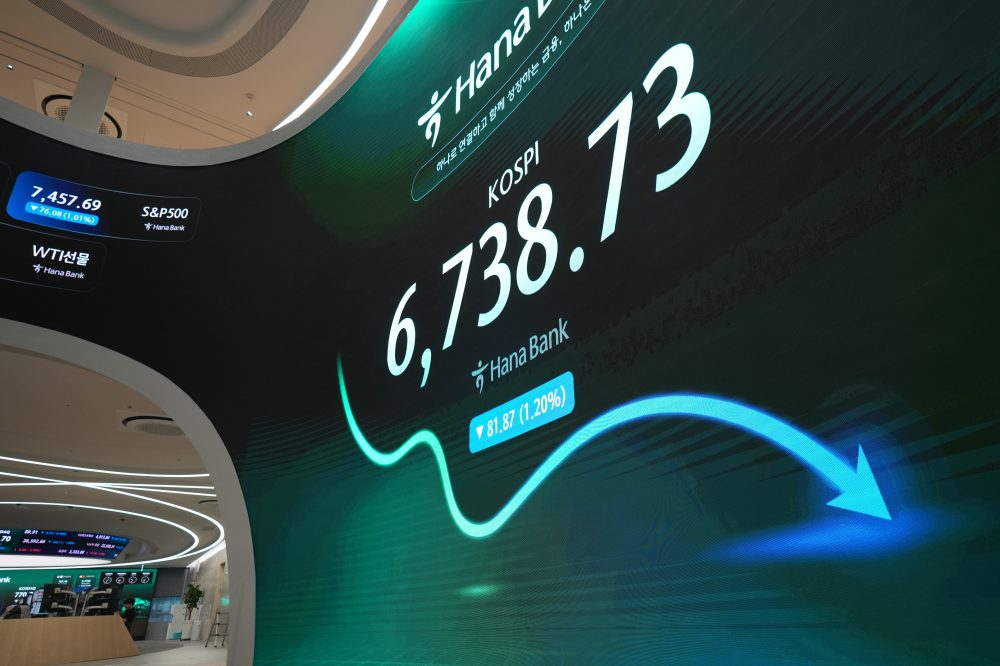

Asian stock markets were largely up on Monday, but South Korea’s Kospi index took a significant hit, dropping 4.9% to 6,490.97 as investors continued to dump shares tied to artificial intelligence technology.
Japan’s financial markets were shut down Monday due to a national holiday, and U.S. futures showed no clear direction.
Oil prices surged more than 2%, with Brent crude climbing above $90 a barrel as hostilities between the U.S. and Iran showed no signs of cooling. Early Monday, the U.S. reported another round of strikes — the ninth consecutive night of attacks. Iran has been retaliating against U.S. allies throughout the Middle East in response to American military action.
Brent crude, the international benchmark, jumped 2.6% to reach $90.40 per barrel, while U.S. benchmark crude rose 2.2% to $83.58 per barrel.
ING commodities strategists Warren Patterson and Ewa Manthey addressed the situation in a Monday commentary, writing: “The U.S. and Iran continue to exchange strikes, which are proving to be deadly for both sides. If this escalation goes unchecked, we could return to an environment of wide-scale attacks across the Persian Gulf.”
The analysts also pointed out that tanker traffic through the Strait of Hormuz — a critical chokepoint for global oil shipments — has nearly come to a standstill, adding further strain to global oil supplies.
The Kospi, which had ridden the global AI wave to significant gains, saw two of its most prized stocks suffer losses. Samsung Electronics dropped 4.4%, and memory chip manufacturer SK Hynix fell 3.3%.
Taiwan’s Taiex, another index with heavy exposure to AI-related companies, barely moved, slipping less than 0.1%. Its flagship chipmaker, Taiwan Semiconductor Manufacturing Co. — known as TSMC — actually gained 2%, recovering some ground after plunging 7.3% on Friday following the company’s announcement that it plans to invest an additional $100 billion to grow its U.S. chipmaking operations.
Hong Kong’s Hang Seng index climbed 2.1% to 25,105.78, and the Shanghai Composite advanced 1.2% to 3,808.39. Australia’s S&P/ASX 200 edged up 0.2% to 8,815.30, while India’s Sensex dipped 0.9%.
The broader sell-off in AI-related and chipmaking stocks that began Friday dragged global markets lower. Massive pledges of AI spending have sparked fears that the sector may be overvalued, prompting many investors to cash out and lock in profits from recent gains.
Markets were also unsettled by the debut of another powerful Chinese AI model from Beijing-based Moonshot AI. The release of its Kimi K3 open-source model caused a reaction similar to what happened when China’s so-called “DeepSeek moment” sent shockwaves through global markets in early 2025. Analysts see it as further evidence that lower-cost but highly capable Chinese AI systems are becoming serious competition for products like Anthropic’s Claude and OpenAI’s GPT.
On Wall Street, the S&P 500 closed the week down 1% at 7,457.69. The Dow Jones Industrial Average slid 0.8% to 52,146.42, and the tech-focused Nasdaq composite dropped 1.4% to 25,520.24.
Chipmakers bore the brunt of the losses, with Nvidia falling 2.2% and both Broadcom and Advanced Micro Devices — known as AMD — each declining 1%.
SpaceX, the rocket company owned by Elon Musk, saw its stock fall 5.4%, dropping below its initial public offering price of $135 per share and hitting its lowest level since the company began trading on the Nasdaq last month.
In currency markets, the U.S. dollar slipped to 162.37 Japanese yen from 162.43 yen. The euro rose slightly to $1.1446 from $1.1438.