
South Korean President Lee Jae Myung has demanded strict disciplinary measures against government officials who failed to properly recover victims’ remains from a devastating 2024 airline disaster, according to his office on Thursday.
The president expressed remorse and extended sympathies to families after a follow-up investigation revealed that body parts from seven victims had remained unrecovered for more than a year following the Jeju Air tragedy that claimed 179 lives, a presidential spokesperson announced during a briefing.
Lee has directed government agencies to investigate why these remains, alongside 648 personal belongings and 155 aircraft fragments, were neglected for such an extended period, according to the official.
Authorities have yet to release their complete investigation findings to the public, missing their initial one-year target date.
While the transportation department issued an apology Monday regarding the recovery delays, grieving families have condemned officials for abandoning remains and personal effects in outdoor storage facilities and are demanding accountability.
“We are appalled by the transport ministry’s late and inadequate apology, which the families say is like killing the victims a second time,” a family spokesperson stated Monday.
A different family representative praised Lee’s Thursday announcement, calling it “due time” for officials to demonstrate accountability.
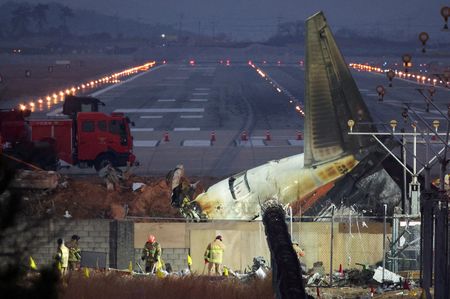
The fatal December 2024 incident occurred when a Boeing 737-800 aircraft encountered bird strikes, performed an emergency belly landing, and slid beyond the runway at Muan International Airport. The plane collided with a concrete barrier supporting navigation equipment, killing nearly all passengers and crew. Only two cabin crew members seated in the aircraft’s rear section survived.
Thursday’s presidential directive follows a government audit published this week that revealed the transportation ministry had permitted defective airport safety infrastructure for over twenty years, contributing to the crash’s severity.
The audit determined that a solid concrete structure beneath navigation equipment at Muan airport – instead of the breakaway design mandated by international aviation standards – worsened the death toll.
Investigators also uncovered decades of inadequate certifications and overlooked safety inspections at similar installations across multiple airports nationwide.