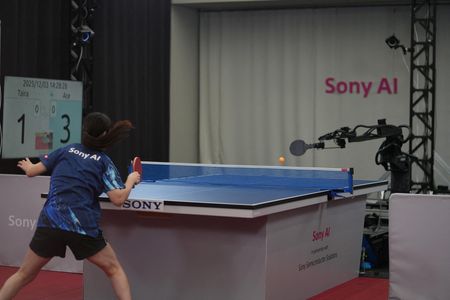

A revolutionary table tennis robot has reached a historic milestone in Tokyo, becoming the first artificial intelligence system to consistently compete with and defeat highly skilled human players in the fast-paced sport.
The robot, called Ace and developed by Sony’s artificial intelligence research team, represents a major breakthrough in robotics by mastering a competitive physical sport that demands split-second decision-making and pinpoint accuracy, according to the project’s director.
While table tennis robots have existed since 1983, none had previously been capable of challenging elite human competitors until Ace’s development. The machine proved its capabilities in official matches conducted under International Table Tennis Federation regulations with certified referees overseeing the competition.
“Unlike computer games, where prior AI systems surpass human experts, physical and real-time sports such as table tennis remain a major open challenge due to their requirements for fast, precise and adversarial interactions near obstacles and at the edge of human reaction time,” explained Peter Dürr, who directs Sony AI Zurich and leads the Ace project.
According to Dürr, the initiative aimed not just to excel at table tennis but to understand how machines can perceive, strategize and respond with human-level speed and accuracy in constantly changing situations.
“The success of Ace, with its perception system and learning-based control algorithm, suggests that similar techniques could be applied to other areas requiring fast, real-time control and human interaction — such as manufacturing and service robotics, as well as applications across sports, entertainment and safety-critical physical domains,” Dürr stated. His research team published their findings Wednesday in the scientific journal Nature.
The study documented Ace’s performance in April 2025, where it secured victories in three of five matches against elite-level competitors while falling short against two professional players, who represent the sport’s highest skill tier. Sony AI reported that Ace has since improved, defeating professional players in December 2025 and as recently as last month.
This achievement comes as robotics companies worldwide continue pushing technological boundaries. Just this past Sunday, robots outpaced human competitors in a half-marathon race held in Beijing.
While artificial intelligence has already dominated digital strategy games like chess and Go, along with complex video games, table tennis presents unique challenges that occur in the physical world rather than simulated environments.
The sport demands rapid decision-making, exact physical movements and constant adjustment to an unpredictable opponent, Dürr noted. Players and machines must operate at the very limits of sensing, prediction and movement control as the ball travels at high velocities with intricate spins and flight paths.
Ace’s design incorporates nine coordinated cameras and three visual systems that can track a spinning ball with remarkable precision and lightning-fast processing speeds.
“This is fast enough to capture motion that would be a blur to the human eye,” Dürr said.
The research team built a specialized robotic platform equipped with eight joints, which Dürr identified as the minimum required for competitive play: three controlling the paddle’s position, two managing its angle, and three determining the shot’s velocity and power.
Professional table tennis player Mayuka Taira, who lost to Ace last December, described the robot’s advantages in comments shared by Sony AI. The machine’s strengths “are that it is very hard to predict, and it shows no emotion,” she said.
“Because you can’t read its reactions, it’s impossible to sense what kind of shots it dislikes or struggles with, and that makes it even more difficult to play against,” Taira explained.
Elite-level player Rui Takenaka, who has both won and lost matches against Ace, offered strategic insights in comments provided by Sony AI. “When it came to my serve, if I used a serve with complex spin, Ace also returned the ball with complex spin, which made it difficult for me. But when I used a simple serve — what we call a knuckle serve — Ace returned a simpler ball. That made it easier for me to attack on the third shot, and I think that was the key reason why I was able to win.”
Despite its achievements, Ace still has areas for enhancement, according to Dürr.
“Ace has a superhuman ability to read the spin of incoming balls, and superhuman reaction time. As it learns to play not from watching humans play, but is trained by itself in simulation, it also reacts differently from human players and creates surprising situations,” he explained. “At the same time, professional human athletes are very good at adapting to their opponent and finding weaknesses, which is an area that we are working on.”