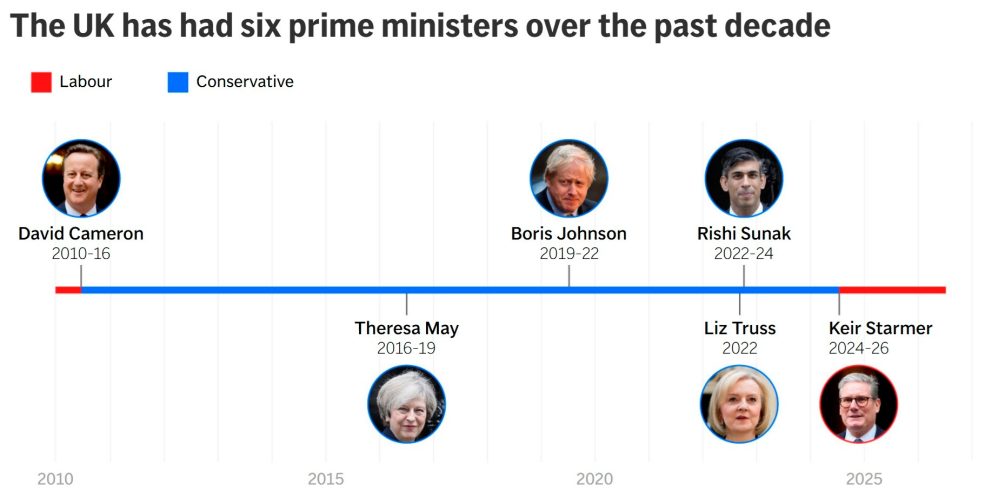

LONDON (AP) — British Prime Minister Keir Starmer announced Monday that he is resigning, making him the sixth leader in ten years to deliver a farewell address outside 10 Downing Street — a remarkable streak of political instability in the United Kingdom.
Starmer rode into office in 2024 on a sweeping Labour Party election victory, promising to bring order after years of Conservative-led turmoil, grow the economy, and deliver on a pledge to “rebuild Britain.” Less than two years into his tenure, his approval ratings collapsed and his government fell short of those ambitious goals, ultimately forcing him out.
Here is a look at how six prime ministers have cycled through Britain’s top office since 2016:
Cameron won a parliamentary majority in 2015, but resigned in June 2016 — the day after British voters chose to leave the European Union in a historic referendum that he had strongly opposed. Ironically, it was Cameron himself who called the referendum, hoping to put to rest long-running divisions within his party over Britain’s ties to Europe.
May governed from 2016 until May 2019, spending three largely unsuccessful years trying to steer Britain through its departure from the EU. She managed to reach a withdrawal agreement with the bloc, but her own Conservative colleagues repeatedly blocked it. Parliament rejected the deal three times — opposed by pro-EU lawmakers on one side and Brexit-hardliners on the other, who felt the agreement kept Britain too tightly linked to Europe. “I have done my best,” she said upon her exit.
Johnson, a polarizing and larger-than-life figure, guided Britain through its formal EU exit and led the country during the COVID-19 pandemic. But a mounting pile of ethics controversies ultimately ended his time in office. Accusations included being too cozy with party donors, shielding allies from misconduct allegations, and misleading Parliament about social gatherings held at government offices during pandemic lockdowns. After dozens of officials and close supporters walked away from his administration, Johnson had no choice but to go.
Truss holds the record as Britain’s shortest-serving prime minister, stepping down in October 2022 after just six weeks on the job. She came in promising to shake up the economy with bold free-market reforms, but her sweeping tax cut plan triggered financial and political chaos, gutting her support within the Conservative Party almost immediately.
Sunak took over from Truss in 2022 after earning the backing of his Conservative colleagues. He pledged to bring down inflation, clear a massive backlog in the public healthcare system, and crack down on illegal migration. Despite those promises, he was unable to reverse his party’s sliding poll numbers, and in 2024 he led the Conservatives to their worst electoral defeat in two hundred years of party history.
Starmer arrived at Downing Street in 2024 as the first Labour prime minister in 14 years, promising to repair the economy, restore crumbling public services, and renew public confidence in government. But close to two years later, he acknowledged that members of his own party no longer believe he is “best placed to lead us into the next general election” — and announced he would step aside.