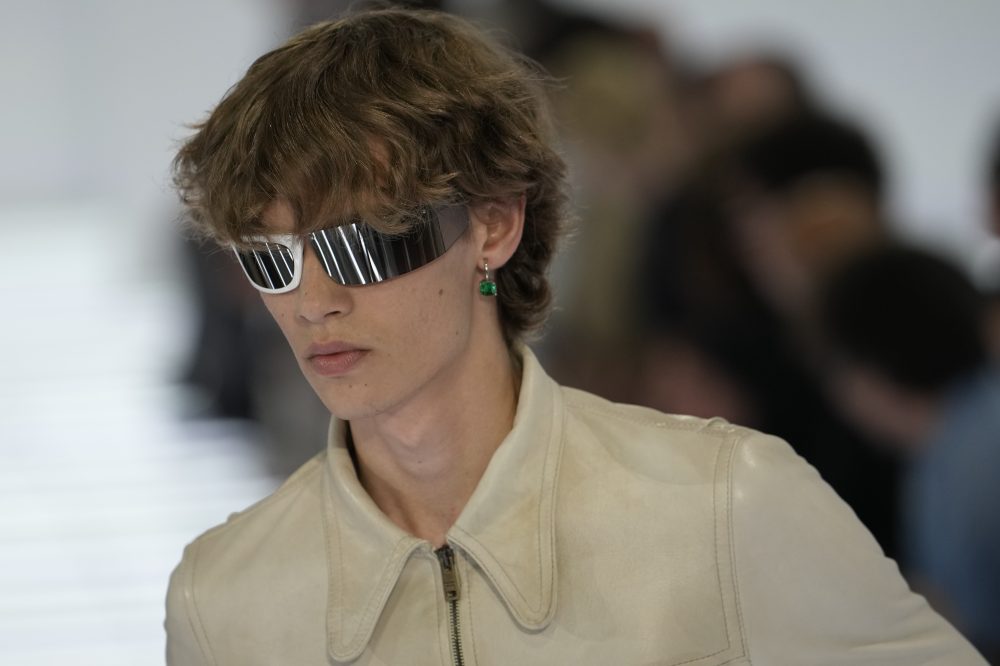

MILAN (AP) — As the world grapples with economic uncertainty and geopolitical tensions, Milan’s fashion designers responded by stripping things down — at least in terms of silhouette, if not always in fabric choice.
During a sweltering Milan Fashion Week, designers largely opted for cleaner lines and simplified looks ahead of next summer’s season. Prada set the tone early, with co-creative directors Miuccia Prada and Raf Simons championing simplicity and familiar wardrobe staples reimagined through new proportions and fabrication choices.
That said, dressing for warm weather was far from simple on Milan’s runways. Leather and knitwear featured prominently in the Spring-Summer 2027 collections, raising the question of whether fashion’s elite will need air-conditioned spaces, mountain retreats, or cooler climates to pull off some of these looks.
The menswear collections, which concluded Monday, highlighted several key trends: a love of luxury materials, creative approaches to ventilation, and more relaxed tailoring — though a handful of designers threw restraint out the window entirely in favor of full-on glamour.
One of the season’s most unexpected themes was the staying power of leather. Prada drew inspiration from the everyday appeal of denim, creating slim five-pocket trousers paired with cropped, flat-pocketed jackets worn in place of shirts. Other houses used woven and perforated leather techniques to add breathability, even as the heat outside continued to rise.
After several seasons dominated by oversized, boxy fits, menswear appears to be moving back toward the body. Designers widely agreed that the well-dressed man still reaches for a suit — the question was simply how to make one wearable in the heat.
The answer, for many, was ventilation. Dress shirts were left unbuttoned, made sheer, or eliminated altogether. Long trousers stayed dominant, but cuts moved closer to the body. Dolce & Gabbana pushed this idea to the extreme with microshorts that put muscular legs on full display, while other brands left torsos uncovered.
Tailoring remained a cornerstone of the Milan collections, though it appeared in softer, more relaxed forms. Designers loosened construction, opened up necklines, and explored fabrics that allowed for better airflow. The overall effect was formal dressing adapted for a warming world.
The message was unmistakable: the suit isn’t disappearing, but it is evolving.
Not everyone got the memo on minimalism, however. Philipp Plein unveiled a crystal-covered denim outfit that requires days of painstaking handwork to produce. Dolce & Gabbana also leaned into decoration, incorporating beaded details reminiscent of coral.
Where Prada offered reduction, these designers delivered unapologetic excess and spectacle.
A less crowded Milan schedule gave newer designers room to shine alongside established powerhouses. Martin Quad made his Milan debut, bringing the inventive tailoring techniques that first earned him recognition in his home city of Copenhagen. Domenico Orefice presented a co-ed collection rooted in leather and richly textured woven fabrics.
Japanese designer Shinya Kozuka also made his Milan debut with what many considered one of the season’s most poetic and warm-weather-appropriate collections, highlighted by a bare-chested model in a flowing sheer teal coat styled over baggy white trousers.