
NEW YORK (AP) — The brooding Danish prince is everywhere these days. William Shakespeare’s timeless tragedy “Hamlet” is experiencing an unprecedented cultural revival across screens, stages, and social media platforms.
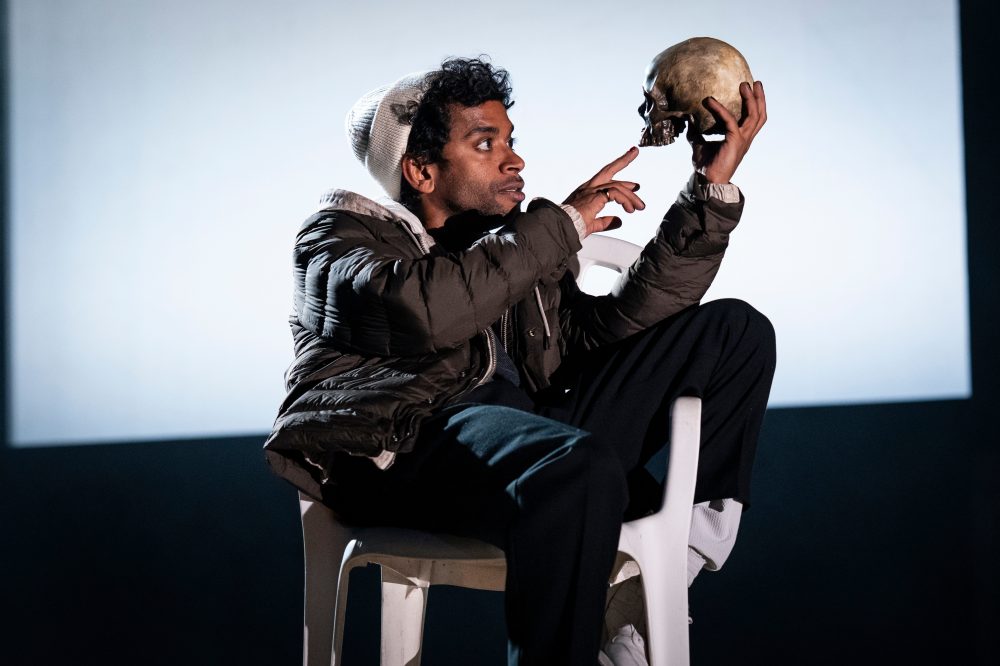
The National Theatre’s production featuring Hiran Abeysekera has arrived at Brooklyn Academy of Music. Meanwhile, a contemporary film adaptation starring Riz Ahmed showcases the story within London’s South Asian community. At 88 years old, Anthony Hopkins has captivated TikTok users by performing portions of Hamlet’s famous “To be, or not to be” monologue. Jessie Buckley received an Oscar for “Hamnet” — a fictional account exploring the tragedy that supposedly inspired Shakespeare’s masterpiece. Taylor Swift’s “The Fate of Ophelia,” referencing Hamlet’s former love interest, reached the top of Billboard’s singles chart. Eddie Izzard continues her solo interpretation of the complete play during a global tour.
After four centuries, this tale of a troubled protagonist contemplating action following his father’s murder by his uncle remains remarkably relevant to contemporary audiences.
The cultural momentum shows no signs of slowing. A stage adaptation of Maggie O’Farrell’s “Hamnet” novel is touring throughout the United Kingdom with the Royal Shakespeare Company. Shakespeare & Company has scheduled a northeastern United States tour of “Hamlet” for this year. Canada presents “Hamlet, Sweet Prince” through a modern, queer perspective. New York’s Acting Company will feature a contemporary verse adaptation led by a female performer. Teatro La Plaza, a Peruvian theater group, recently staged an off-Broadway version featuring eight Spanish-speaking performers with Down syndrome.
According to Harvard Shakespeare expert Jeffrey R. Wilson, “Hamlet” perfectly captures our current moment, when overwhelming negative news prompts constant existential questioning about how everyone is coping.
“People are exhausted from the onslaught of awfulness in the world,” he says, “and ‘Hamlet’ gives audiences both permission to ‘go there’ to explore those emotions and a tool kit of ideas to help us process angst.”
These contemporary interpretations demonstrate remarkable creativity and energy, featuring everything from a beanie-wearing Hamlet in Brooklyn to one enjoying Bollywood-inspired choreography in London.
“Great plays survive not because they remain untouched, but because they can continue to be transformed,” says director and playwright Chela De Ferrari, from Teatro La Plaza, whose neurodiverse “Hamlet” is a visceral and urgent call from those often excluded from cultural narratives.
“Working with actors with Down syndrome and cognitive disabilities brought me back to something essential in ‘Hamlet’: that beneath its philosophical brilliance there is an exposed human being asking, in one way or another, how to exist in a world that keeps misreading him,” she said.
During one particularly powerful scene, a performer attempts to recreate Laurence Olivier’s famous delivery of Hamlet’s signature soliloquy while the legendary actor’s image appears on screen. The moment gains additional significance when delivered by someone whose presence in public or artistic venues is frequently challenged.
“I like to imagine a kind of continuity between our actors and all the great actors who have carried the play before. I believe Shakespeare lives in all of them,” says De Ferrari.
Filmmaker Aneil Karia recalls feeling disconnected during school visits to Shakespeare productions.
“I felt like I was primarily watching an intellectual experience unfold and I had to use my brain to keep up with the plot and the language and everything like that,” he says.
Karia collaborated with Ahmed and screenwriter Michael Lesslie to create a streamlined, contemporary retelling that emphasizes the protagonist’s discomfort with participating in corrupt business practices.
“That feels so pertinent to the moment we’re in politically and everything. It feels like the question a lot of people are asking,” says Karia. “It feels like these stories are actually a conversation through time itself.”
This modern Hamlet celebrates in neon-lit nightclubs and delivers his famous monologue while speeding through rain-soaked London streets in a BMW, removing his hands from the steering wheel as an oncoming truck approaches. The existential question becomes literally life-or-death.
“The best best-case scenario here is that it’s opening up Shakespeare to audiences who didn’t think it was for them, or who struggled with it previously,” says Karia, whose film starts streaming Tuesday. “This is a big call, but I feel like Shakespeare would approve. I feel his whole thing was like, ‘Take this stuff and do your thing.’”
The Brooklyn production emphasizes the play’s comedic elements for a practical reason: the actor portraying Hamlet possesses natural comic timing.
Abeysekera brings manic and playful energy while highlighting the work’s physical comedy, speaking directly to audiences during soliloquies and sometimes positioning himself at the stage’s edge to make direct eye contact.
“It’s a very self-aware play. It sort of really knows that it’s a play, if that makes any kind of sense,” says director Robert Hastie. “Hamlet knows he’s in a play called ‘Hamlet,’ like Deadpool knows he is in a film called ‘Deadpool.’”
Abeysekera approaches his “To be, or not to be” speech as a spontaneous reflection rather than the traditional planted-feet, theatrical delivery style.
“Rather than thinking, ‘Oh, here’s the big speech coming up and that’s freaking me out,’ I started thinking, ‘It’s such a thought that most of us kind of have,’” he says. “Sometimes, in front of the mirror, we just see ourselves and go, ‘Oof. Today’s a tough day.’”
Hastie considers “Hamlet” among those works that consistently reveals fresh insights. Rooted in universal human experiences, it communicates different messages to each audience while allowing us to uncover elements that were always present.
“One of the reasons I think why we’re still talking about Shakespeare, and this play in particular, is that whenever those words fuse with a new actor or a new group of actors, it becomes a different play,” he says. “Maybe that’s a good working definition of a classic.”
Caitlin Cardile works diligently to maintain the 400-year-old playwright’s relevance in today’s TikTok-dominated landscape. She and her three-member Mad Spirits Theatre Company maintain presence across virtually every social media platform to spread awareness.
“We wanted to bring Shakespeare to a modern audience and make it understandable,” Cardile says. “We want people to feel more comfortable with Shakespeare and not think that it’s old English and such a hard thing to understand.”
While they share live readings and play analysis on YouTube, their Instagram and TikTok content showcases true innovation. They discover popular audio clips — ranging from “The Office” dialogue to Lady Gaga songs — and assign Shakespeare characters to perform them.
Kitty Forman’s memorable “I may have been a little irrational today” line from “That ’70s Show” gets lip-synced by an actress portraying Ophelia. Dialogue between Scar and Simba from “The Lion King” is performed by actors playing Claudius and Hamlet.
“We’re like, ‘Hey, wouldn’t it be funny if we took these silly trending sounds that everybody’s doing and what if we put them to Shakespeare characters?’” says Cardile. “This has ended up being so much fun.”