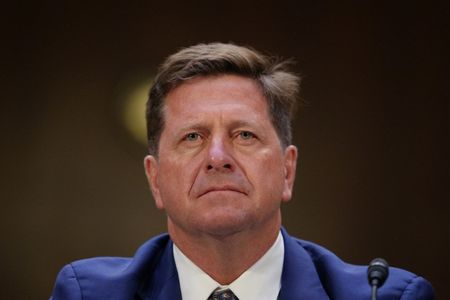

WASHINGTON — The U.S. Senate could begin casting votes as early as Monday on whether to confirm Manhattan U.S. Attorney Jay Clayton as the country’s next director of national intelligence, with final approval expected before the week is out.
President Trump tapped Clayton for the role, which oversees all 18 of the nation’s intelligence agencies. If confirmed, he would take over a position that has been vacant since June, when Tulsi Gabbard departed after a tenure defined by repeated conflicts with congressional Democrats. Those lawmakers accused her of serving Trump’s political interests and spreading disproven claims about elections.
A procedural vote was scheduled for Monday evening to determine whether the full Senate would move forward with considering Clayton’s nomination. Should he clear that hurdle with a simple majority in the 100-member chamber, a final confirmation vote would likely follow later in the week. Republicans currently hold a 53-47 advantage in the Senate and seldom break with the White House, making Clayton’s confirmation likely even if Democrats oppose him.
The director of national intelligence position was established following the September 11, 2001 terrorist attacks as a way to bring coordination to the country’s vast intelligence network. A number of senators are particularly eager to see Clayton confirmed because of dissatisfaction with the current interim director — Federal Housing Finance Agency Director Bill Pulte, a Trump loyalist who lacks national security experience and has been reducing staff at the agency.
ROCKY ROAD TO CONFIRMATION
The Senate Intelligence Committee advanced Clayton’s nomination to the full Senate by a narrow 9-8 margin on Tuesday. Every yes vote came from Republican committee members. Democrats on the panel voted against him, largely due to his repeated refusal during his confirmation hearing to directly state that Trump lost the 2020 presidential election.
Clayton also drew sharp criticism over his decision to issue subpoenas requiring New York Times reporters to testify before a federal grand jury. That move came after the newspaper published reporting on security concerns related to Trump’s new Qatari-donated Air Force One aircraft. A prosecutor told a judge at a court hearing Tuesday that the administration planned to withdraw those subpoenas following pointed questioning from the bench about the investigation.
Oregon Senator Ron Wyden, a senior Democrat on the Intelligence Committee, made clear his opposition in a statement: “From start to finish, Mr. Clayton has proven himself incapable of telling the truth or demonstrating an iota of independence from Donald Trump. For those reasons, I voted ‘no’ on his nomination.”
On the other side, Republican Arkansas Senator Tom Cotton, who chairs the committee, praised Clayton as a “highly qualified nominee with a deep experience combating a wide range of national security threats.”
The controversy surrounding Clayton’s nomination began well before his July 15 confirmation hearing. In mid-June, Trump suddenly cast doubt on the nomination by ordering the hearing to be postponed — a move widely seen as an attempt to pressure Congress into passing changes to U.S. voting rules. Senators, including Cotton, initially said the hearing would proceed as planned, but ultimately confirmed that Clayton would not appear after Trump directed him to stay away.