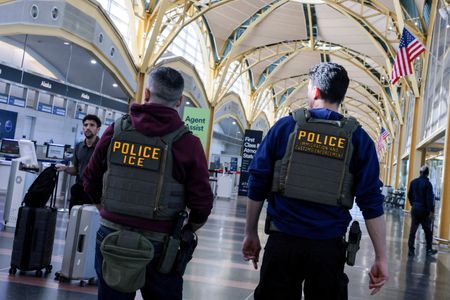

Senate Republicans are preparing to advance legislation that would provide funding for immigration enforcement agencies through the conclusion of Donald Trump’s presidency in January 2029, with floor action potentially starting within days.
Senate Majority Leader John Thune is driving efforts to expedite consideration of the measure, which would authorize financial support for Immigration and Customs Enforcement and U.S. Border Patrol operations under the Department of Homeland Security umbrella.
Speaking to media representatives Tuesday, Thune indicated the complete Senate chamber might commence deliberations “as early as next week.” Lawmakers are set to enter a seven-day break beginning May 1.
Current annual appropriations for ICE and Border Patrol remain stalled due to disputes between Republican and Democratic lawmakers regarding new operational requirements for both organizations.
To secure approval without Democratic backing, Republicans plan to employ a specialized Senate mechanism that enables passage through simple majority votes, circumventing the typical 60-vote threshold required for most measures in the 100-member chamber.
Drawing from recent years’ baseline appropriations for ICE and Border Patrol, expenditures across the three-year period could reach $50 billion or higher.
This funding would supplement the more than $100 billion in multi-year appropriations Republicans secured last July through separate channels outside standard budget procedures.
Thune is advocating for streamlined legislation to prevent attempts by some among the 53 Republican senators to include unrelated provisions.
Louisiana Senator John Kennedy expressed to Reuters Tuesday his desire to incorporate the “SAVE America Act,” which would establish additional voting limitations across the nation. Trump has actively promoted this measure ahead of November 3 congressional contests.
“If (other) senators start getting their stuff, I want my stuff, and I think you’ll have most senators feel the way I feel,” Kennedy stated.
Republicans contend the election-focused legislation is necessary to block non-citizens from voter registration. Democrats reject the proposal, maintaining that fraudulent voting incidents in states occur extremely infrequently and that SAVE would ultimately prevent millions of eligible voters from registering and participating in elections.
Thune worries that including SAVE or additional unrelated measures could jeopardize the complete initiative.
Florida Republican Senator Rick Scott desires any additional ICE and Border Patrol funding to be balanced through reductions in other federal budget areas. Scott indicated he would review the forthcoming legislation’s specifics before determining his position on supporting or opposing the measure.
Republicans must navigate a two-phase congressional process for this legislation.
Initial passage involves a non-binding budget framework in both the Senate and House of Representatives. Subsequently, a reconciliation measure containing actual spending provisions would require presidential signature to become law.