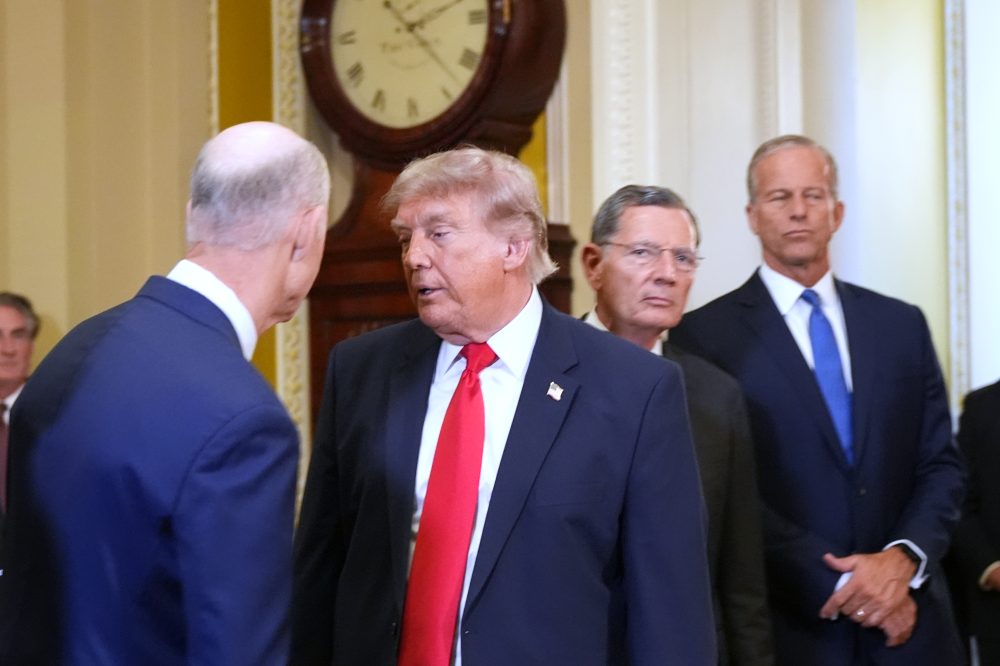

WASHINGTON — Senate Republicans found themselves on the defensive Wednesday after President Donald Trump showed up at a Capitol luncheon to scold members of his own party for allowing a vote to restrict his war in Iran. Hours later, those same senators gathered for a late-night vote and rejected a war powers resolution — just one day after a nearly identical measure had passed.
Trump had been invited by Florida Sen. Rick Scott to address a closed-door GOP luncheon, where he was expected to push senators on his proof-of-citizenship voting legislation. Instead, the conversation quickly turned to Tuesday’s war powers vote, which marked the first time the Senate had adopted such a resolution regarding the Iran conflict.
The most heated exchange of the afternoon involved Louisiana Sen. Bill Cassidy, one of four Republicans who had sided with Democrats on Tuesday’s measure. Cassidy stood up and defended his position directly to the president.
“I stood and said, ‘You have not told the American people what’s going on,’” Cassidy told reporters after the meeting. “This was supposed to last four weeks, it’s lasted four months. Our original objectives have not been achieved.”
Cassidy said the two men “went back and forth” and that he “matched his tone and volume.” He said he eventually tried to calm things down, but made clear he would not be intimidated. “I am voting for war powers until I get a briefing,” he said.
According to someone with knowledge of the private meeting who was not authorized to speak about it publicly, Trump repeatedly told Cassidy to sit down and at one point called the senator a “lunatic.”
Publicly, Trump offered a different impression on his way out of the building. “We had a really great meeting,” he told reporters, though he hinted at the tension underneath. “We like everyone in the room. I don’t like a few people, but that’s OK.”
Despite the confrontation, Cassidy’s position shifted by evening. He was invited to the White House for a personal briefing on the Iran war from Vice President JD Vance and envoy Steve Witkoff. He then returned to the Capitol and voted against the second war powers resolution.
“I want to thank Vice President Vance and Special Envoy Witkoff for the thorough briefing this afternoon on Iran. I appreciate the quick invitation to the White House to address many of my concerns,” Cassidy wrote on X. Cassidy lost his reelection bid last month after Trump endorsed his opponent.
Kentucky Sen. Rand Paul, another Republican who had previously voted with Democrats to limit the war, chose to vote present this time. He said on X that he did so “to give the President more space and leverage to negotiate a lasting peace.”
The resolution ultimately failed 47-50-1 just before midnight Wednesday. Senate Majority Leader John Thune, R-S.D., along with a small group of GOP colleagues, called Trump after the vote. Thune later told reporters the president was “pleased with the outcome.”
Trump responded on social media by thanking Thune and noting that both Cassidy and Paul had changed their votes. “This vote puts Iran on notice!” he wrote.
It is worth noting that both the Tuesday and Wednesday votes were largely symbolic. Neither resolution carries the full weight of law, and they were moving on separate legislative tracks.
The day’s tensions extended beyond the war powers debate. Before the luncheon even began, Trump announced on social media that he was pulling back from a scheduled signing ceremony for a housing bill that had passed both chambers with overwhelming bipartisan support. He said he would not sign it until Congress sent him the SAVE America Act — his bill requiring proof of citizenship for all voters.
North Carolina Sen. Thom Tillis pushed back on the move. “It makes no sense to me,” he said as he walked into the luncheon, adding that he doesn’t understand why Trump is holding the housing bill “hostage” for a voting bill that “will never pass in this Congress.”
Thune described the housing legislation as “an affordability issue” and said, “Eventually I hope he finds a way to sign it.”
Republicans have grown increasingly worried that Trump’s resistance to the housing bill signals indifference toward voters’ economic concerns ahead of November’s midterm elections.
The friction is part of a broader pattern of tension between Trump and Senate Republicans in recent weeks. Trump has blocked the Senate from confirming one of his own nominees, requested funding for parts of a White House renovation project despite pushback, and pushed senators to defend the Iran war even as many question its strategy and goals.
Trump has also endorsed primary challengers to two sitting GOP senators — Cassidy and Texas Sen. John Cornyn — both of whom have become more outspoken critics since losing their reelection bids.
“If we’re going to win the midterm elections, we need to get on the same page,” Cornyn said ahead of the meeting. “We’re not on the same page now, and that I think is dangerous.”
Trump has also been pushing Republicans to eliminate the Senate filibuster in order to pass his voting bill, even though Thune has told him repeatedly that there are not enough votes to do either. Democrats are uniformly against the citizenship bill, and the 60-vote threshold required under the filibuster rules makes passage unlikely in the current 53-47 Senate.
“I think people at some point have to come to grips with that,” Thune said.