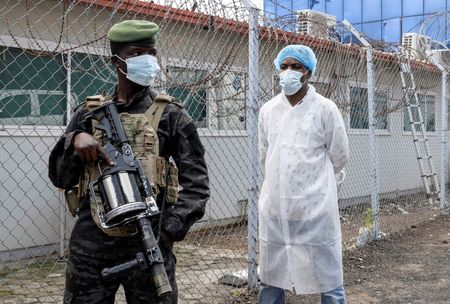

Seven American aid workers who had been fighting the Ebola outbreak in the Democratic Republic of Congo are now quarantining at an isolation facility located on a Kenyan air force base, following new U.S. travel restrictions, the head of the charity that employs them confirmed to Reuters.
These workers are the first individuals to actually use the facility, which has been the subject of significant controversy in Kenya and is currently tied up in an active court case. A judge has ordered a halt to activity at the site pending a final ruling, yet U.S. officials and satellite images reviewed by Reuters indicate that work at the location has continued regardless.
Under the new U.S. government policy, American citizens returning from the Democratic Republic of Congo — where an Ebola outbreak is ongoing — are required to spend three weeks in a third country before they are permitted to re-enter the United States.
The bio-isolation unit was constructed by the U.S. government on an air force base in central Kenya to house Americans who may have been exposed to the Ebola virus while working in Congo or Uganda. The facility has drawn sharp criticism from many Kenyans, who argue the U.S. is essentially shifting the health burden of caring for potentially exposed individuals onto their country.
Last month, Kenya’s health minister announced an immediate stop to construction at the site after being found in contempt of court for ignoring suspension orders that had been issued by a local court against the project.
Franklin Graham, president and CEO of Samaritan’s Purse, confirmed the situation to Reuters. “Samaritan’s Purse has seven American Disaster Assistance Response Team staff members there,” Graham said. “None of them have any symptoms, but they are being quarantined by the Kenyan government for 21 days.”
A U.S. State Department official also weighed in, telling Reuters that the group of Americans — who had served on the front lines of the Ebola response — had “voluntarily moved to the Kenya facility for precautionary monitoring and isolation.” The official added that “Kenyan authorities have authorized their movement into the facility under the observation of the U.S. Public Health Service clinicians,” and that the decision was made “strictly out of an abundance of caution.”
Kenyan health ministry officials did not respond to requests for comment, and a senior Kenyan foreign ministry official stated they had no information about the situation.
A source familiar with the matter, who requested anonymity, said the group arrived at the central Kenya site on Monday and are currently sleeping on army cots inside tents. Some members of the group had worked directly as medical staff treating Ebola patients at the charity’s treatment centers, while others served in non-medical roles with no direct patient contact, such as construction work.
“There is one potential high risk exposure,” the source said, noting that the health of all seven individuals is being actively monitored. Kenyan authorities are not permitting the group to leave the facility or travel elsewhere within the country, the source added.