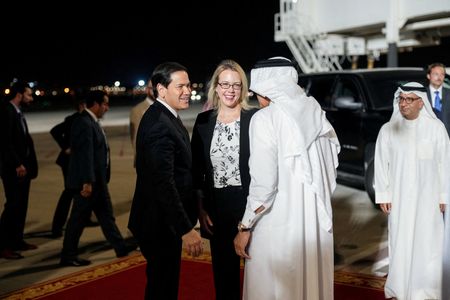

U.S. Secretary of State Marco Rubio arrived in Bahrain’s capital, Manama, on Wednesday night for the final stop of a three-day diplomatic tour through the Gulf region, where he has been working to build support for the Trump administration’s preliminary nuclear agreement with Iran.
The mission is a delicate one. Gulf Arab leaders are concerned that too many concessions to Tehran could shift the region’s security balance and disrupt oil flows — fears Rubio has openly acknowledged as he makes his case for the deal.
In Bahrain, Rubio is scheduled to meet with government officials on Thursday. He will also sit down with the Gulf Cooperation Council — a bloc of six Sunni-led monarchies that includes Saudi Arabia, Qatar, Oman, the United Arab Emirates, and Kuwait.
This trip marks the first high-level U.S. diplomatic mission to the oil-rich Gulf since the U.S.-Iran framework agreement was reached last week to bring an end to the conflict.
At earlier stops in the UAE and Kuwait, Rubio worked to convince officials that the proposed deal does not unfairly favor Iran, which launched strikes against several Gulf nations during the U.S.-Israeli war.
“We’re not going to do anything that undermines the security of our allies, our longstanding allies in the region,” Rubio told reporters during his stop in Kuwait.
The deal has already sparked confusion over its terms. President Donald Trump stated Tuesday that Iran had agreed to nuclear inspections stretching to “infinity,” but Tehran pushed back, saying it had made no such commitment — casting doubt on the durability of the fragile agreement.
The two countries, which concluded an initial round of negotiations in Switzerland on Monday, have also offered contradictory accounts regarding financial incentives for Iran, control of the Strait of Hormuz, and Israel’s ongoing conflict in Lebanon.
All six GCC member nations are long-standing U.S. strategic partners that provided varying levels of logistical support to Washington during the war, and all faced Iranian airstrikes as a consequence. Together, they form the foundation of America’s military and security presence in the Middle East, meaning any shift in their relationship with the U.S. could have wide-ranging consequences for American strategy in the region.
The draft agreement contains no restrictions on Iran’s ballistic missile program, calls for a proposed $300 billion reconstruction fund, and includes provisions that critics say could expand Tehran’s regional influence and its grip on critical oil shipping routes.
Rubio has stated he will not ask Gulf allies to contribute to any reconstruction fund during this trip, even as the memorandum of understanding with Iran suggests that regional countries could be expected to help cover those costs.
Several U.S. Gulf partners are privately expressing disappointment with the interim deal, which could open a path toward U.S. normalization with Iran — a predominantly Shiite nation that most Sunni-led GCC states view as their primary adversary.
Bahrain presents a particularly sensitive case: its Shiite majority population is governed by a Sunni monarchy that fears a financially empowered Iran could stoke internal unrest.