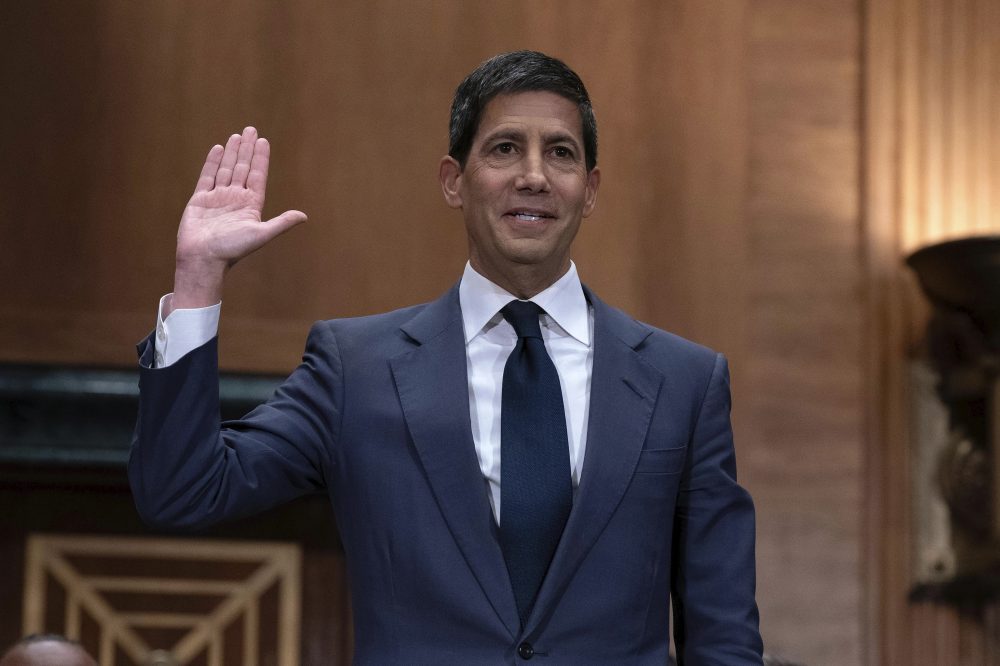

The U.S. Senate voted Wednesday to confirm Kevin Warsh as the new chairman of the Federal Reserve. President Donald Trump selected the former Fed governor to take over from Jerome Powell, with hopes that Warsh can deliver the strong economic performance the president promised during his campaign.
Warsh assumes leadership of a central bank facing significant challenges as it grapples with economic consequences from the conflict between the U.S. and Israel against Iran that began on Feb. 28. This ongoing war has pushed energy costs higher and created additional obstacles for the Fed’s efforts to reduce inflation to its 2% goal.
However, Trump has called for lower interest rates, rather than the higher rates that economists say may be necessary to control inflation. While Warsh previously established himself as someone who favored aggressive action against inflation, he has recently shifted to support Trump’s perspective, contending that artificial intelligence and emerging technologies can drive productivity and economic expansion without triggering inflation.
Trump repeatedly criticized Powell for rejecting the significant rate reductions the president believes would stimulate economic growth. Additionally, his Justice Department initiated an investigation into the Fed that many viewed as an effort to remove Powell from his position. This legal controversy delayed Warsh’s confirmation process. Sen. Thom Tillis, a North Carolina Republican, stated he would vote against Warsh unless the Justice Department ended its investigation, which finally occurred last month.
In a rare decision, Powell announced he plans to stay on the Fed’s governing board for an indefinite period after Warsh assumes the chairman role, pointing to Trump’s “unprecedented” criticism of the central bank’s independence. While Powell’s chairmanship is concluding, his position as a Fed governor continues until 2028.
Powell’s decision to remain could create tension for Warsh, particularly if he attempts to persuade other Fed officials to support interest rate reductions.
Trump described Warsh as someone who looks like he comes from “central casting,” which provides insight into the president’s opinion of the 56-year-old’s appearance and traditional background. Warsh possesses many characteristics typical of a conventional choice to head the world’s most influential central bank, though he takes charge during an unusually turbulent period for the Fed as Trump has stated the new chairman must reduce its key rates to satisfy the White House.
Interest rate reductions of the magnitude Trump desires might provide short-term economic growth, but they also create risks of economic overheating when inflation remains high and cost of living concerns affect many Americans.
Warsh previously came close to being selected for the Senate-confirmed Fed Chair position in 2017, when Trump chose Powell to lead the central bank. Trump has subsequently stated that he received poor guidance about Powell.
Warsh holds educational credentials from Stanford University and Harvard University Law School. He is married to Jane Lauder, whose father is billionaire cosmetics heir Ronald Lauder, a significant Republican donor.
Senate Democrats have criticized Warsh for failing to completely disclose details about his personal wealth, which totals at least $100 million. His investment portfolio includes positions in Polymarket and SpaceX, though he has not revealed the extent of these holdings. He has committed to selling all such investments within 90 days of taking his oath.
At age 35, Warsh became the youngest member of the Fed’s seven-person board, holding that role from 2006 to 2011. He previously worked as an economic advisor in George W. Bush’s Republican administration and served as an investment banker at Morgan Stanley.
Warsh collaborated closely with then-Chair Ben Bernanke during 2008-09 as the central bank worked to address the financial crisis and the Great Recession. Bernanke later described in his autobiography that Warsh was “one of my closest advisers and confidants” and noted that his “political and markets savvy and many contacts on Wall Street would prove invaluable.”
Nevertheless, Warsh seemed at crucial times to misunderstand the severity of problems facing the U.S. economy as mortgage failures and job losses increased during the Great Recession. He advocated for the Fed to maintain higher benchmark rates when the economy faced risks of deflation and potential collapse.
Warsh expressed worries in 2008 that additional interest rate reductions by the Fed might trigger inflation. However, even after the Fed lowered its rate to nearly zero, inflation remained subdued.
He also opposed the Fed’s 2011 decision to buy $600 billion in Treasury bonds, a strategy to reduce long-term interest rates, though he eventually supported the measure at Bernanke’s request.
Warsh sometimes acted like a traditional Republican, stating in a 2010 address his opposition to ending “the creep of trade protectionism” which he called contrary to “pro-growth policies.” Trump has since transformed GOP philosophy by advocating for substantial increases in import taxes, implementing them unilaterally last year by declaring an economic emergency.
Warsh currently works as a visiting economics fellow at the Hoover Institution, a conservative research organization at Stanford University. He also teaches at the Stanford Graduate School of Business and serves as a partner at the Duquesne Family Office, which oversees the assets of billionaire investor Stanley Druckenmiller.
In what seemed like an intentional effort to secure the Fed position, Warsh attacked the Fed in media appearances, demanding “regime change” and condemning Powell for involvement in climate change and diversity, equity and inclusion issues, which Warsh claimed exceed the Fed’s authority.
During a CNBC interview last year, Warsh declared Fed policy “has been broken for quite a long time.”
“The central bank that sits there today is radically different than the central bank I joined in 2006,” he continued. By permitting inflation to rise dramatically in 2021-22, the Fed “brought about the greatest mistake in macroeconomic policy in 45 years, that divided the country.”