
VENICE, Italy — Utah sculptor Alma Allen found himself with only a few months to create his exhibition for one of the art world’s most prestigious events after a controversial selection process for the Venice Biennale went down to the final moments.
The self-taught artist, who creates his work in Mexico, understands his position as an outsider in the exclusive art community and is preparing for intense scrutiny as he steps onto one of contemporary art’s most important platforms.
The selection process, which critics have labeled as lacking transparency, has created controversy surrounding the exhibition’s debut.
Major art institutions that usually compete for the highly sought-after Biennale commission stayed away, apparently worried about becoming entangled in political issues after the application requirements dropped language about diversity, equity and inclusion in favor of promoting “American values.”
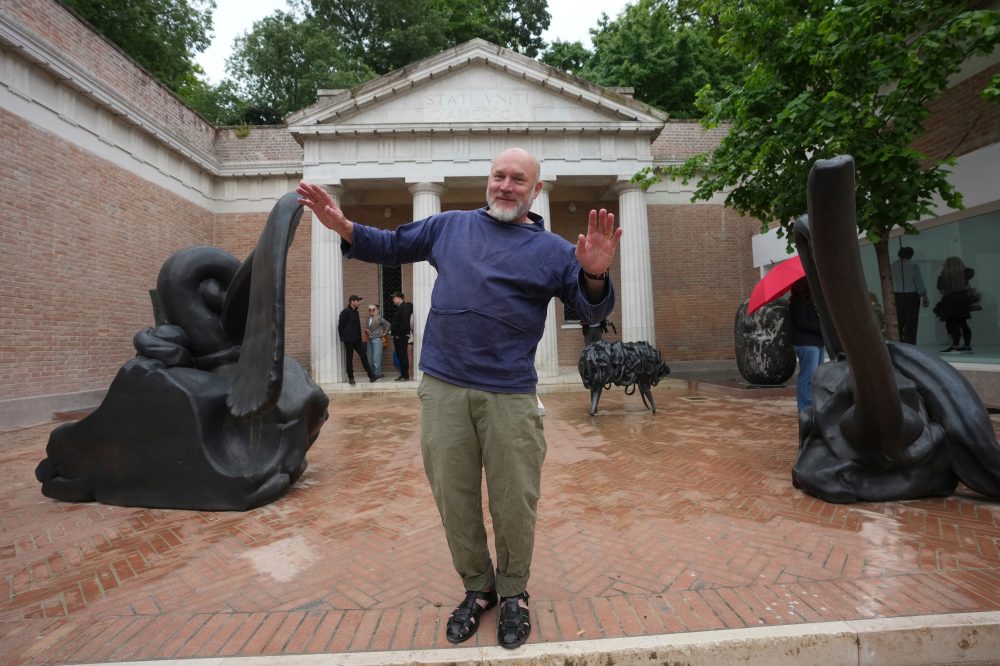
In what appears to be a tongue-in-cheek response, Allen crafted a bronze evil eye to display on the outside of the brick, Jefferson-style U.S. Pavilion as protection against negative energy, he said with humor. This piece joins eleven other new works he created for an exhibition that could become the defining achievement of his three-decade career.
However, just days before Saturday’s Biennale opening, the protective evil eye sculpture had yet to be delivered.
“This is really the first circumstance in my life as an artist where I felt the need to defend myself, or my work,” Allen shared with The Associated Press during a recent tour of the pavilion. He admitted that working away from critical attention for thirty years “has been actually a pleasure.”
Allen creates organic-shaped sculptures using wood, stone and bronze, and prefers not to title them so viewers can have “a moment of creation when they can decide what it is.”
His Biennale display, called “Call Me the Breeze,” features pieces spanning the past two decades alongside his newest creations. Allen explained he selected this title to represent his talent for navigating around barriers.
“And that’s been my necessity and it’s also because of being self-taught and not having any institutional support very often in life,” he said.
Exhibition commissioner Jeffrey Uslip said Allen’s independence from institutions was attractive to him.
“I am deeply interested and invested in artists who are not, I guess, academicized … or lobotomized,” he said.
An earlier proposal featuring artist Robert Lazzarini, organized by art historian John Ravenal, collapsed in September despite receiving U.S. State Department approval when the required institutional sponsor withdrew, Ravenal explained to AP.
When State Department efforts to connect the Lazzarini project with the newly established American Arts Conservancy failed, the current project featuring the AAC as sponsor, Uslip as curator and Allen as artist was quickly announced.
Uslip refused to provide details about the selection process.
Ravenal described the process as extremely unusual, lacking any apparent committee review or formal application procedure, and pointed out that the application deadline had passed in July.
“It’s really a loss of a 40-year history of open call and peer review,” Ravenal told AP by phone, characterizing Allen as “a pawn in this whole thing.”
Allen recognizes that his decision to proceed with the exhibition has generated some criticism. However, he maintains that the Trump administration has not influenced the show in any manner.
“My art is not propaganda,” he said.
In the pavilion’s central courtyard, a headless sheep sculpture stands without direction, serving as Allen’s self-portrait as an outsider. He characterized it as “a bit shunned because it’s the wrong sheep.”
His newest pieces include bronze wall sculptures treated with chemicals in a painting technique, handling the solid metal “as an instantaneous material, like watercolor,” he explained.
Allen’s path to the Biennale included a time of homelessness in New York City when he sold his artwork from an ironing board, a desperate action that inadvertently launched his artistic career and attracted his first collectors.
The Los Angeles County Museum of Art and Palm Springs Art Museum have acquired Allen’s works, and he was featured in the 2014 Whitney Biennial. He made his European debut in Brussels in 2022.
After receiving the Biennale commission, he visited Venice for the first time in November to examine the U.S. Pavilion, a neoclassical brick structure built around a courtyard and rotunda. A Hieronymus Bosch painting called “The Visions of Hereafter” at Venice’s Accademia, showing heaven, hell and purgatory, provided the organizing concept for his exhibition.
“I wanted there to be a bit of the chaos that we go through,” he said.
Beyond his artistic portfolio, Allen credits his selection to his ability to handle last-minute challenges and embrace unexpected opportunities.
“When they do, I’m prepared to try it, and fail at it. That’s fine,” he said.