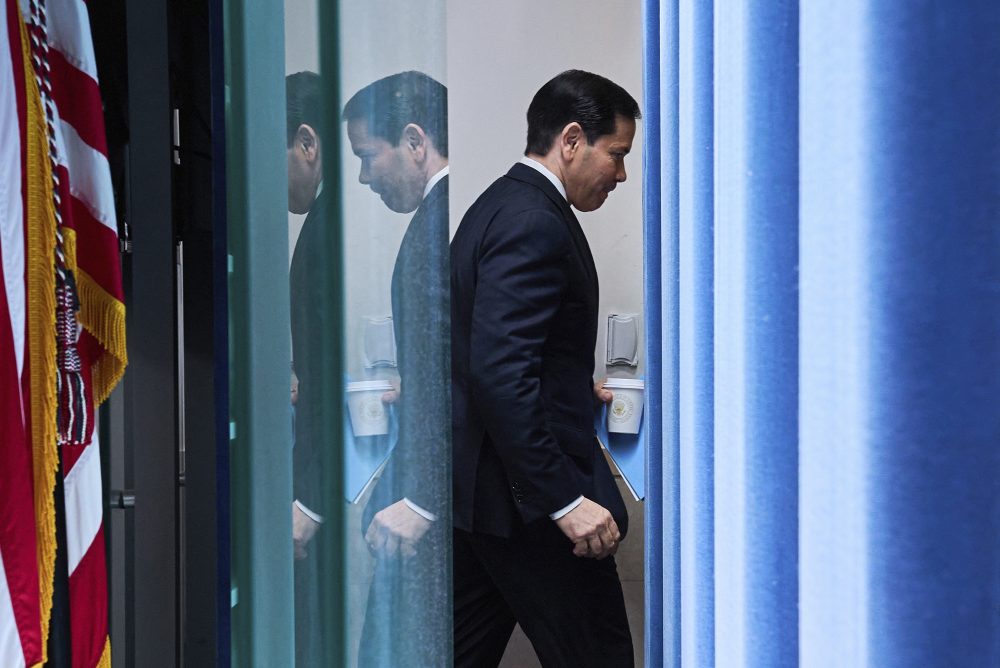

VATICAN CITY — America’s top diplomat Marco Rubio is embarking on a diplomatic mission to Vatican City and Italy aimed at repairing damaged relationships following President Donald Trump’s public attacks on Pope Leo XIV regarding Iran policy and the ongoing conflict.
The Secretary of State, who practices Catholicism, is scheduled to meet with Pope Leo XIV on Thursday in what has become a more complex diplomatic encounter due to Trump’s recent harsh words directed at the Chicago-born pontiff. The Pope has responded by defending his position, stating Trump has mischaracterized his stance on Iran and nuclear armaments, emphasizing he is simply delivering the Gospel’s message of peace.
Rubio’s Friday discussions with Italian Premier Giorgia Meloni and Foreign Minister Antonio Tajani may prove equally challenging for the nation’s chief diplomat, as both officials have publicly supported the Pope against Trump’s verbal assaults and have condemned the Iranian conflict as unlawful — actions that have angered the president.
When asked about the timing, Rubio acknowledged this week that the diplomatic trip had been planned previously but admitted “obviously we had some stuff that happened.”
The diplomatic crisis emerged when Trump attacked Pope Leo XIV through social media posts last month, accusing the pontiff of being lenient on crime and terrorism due to his statements regarding the administration’s immigration enforcement and deportation policies, as well as the Iranian conflict. The Pope responded by declaring that God does not hear the prayers of those who engage in warfare.
Trump subsequently shared a social media post that seemed to compare himself to Jesus Christ, which he removed following public criticism. He has declined to offer an apology to Pope Leo XIV and has attempted to justify the post by claiming he believed the image depicted him as a physician.
According to Rubio, Trump’s recent attacks on the Pope stem from his concerns about Iran potentially acquiring nuclear capabilities, which could threaten millions of Catholics and other Christians worldwide.
“The president and I, for that matter, I think most people, I cannot understand why anyone would think that it’s a good idea for Iran to ever have a nuclear weapon,” Rubio explained to reporters Tuesday at the White House.
Pope Leo XIV has never advocated for Iran obtaining nuclear weapons and emphasized that the Catholic Church “for years has spoken out against all nuclear weapons, so there is no doubt there.”
“The mission of the church is to preach the Gospel, to preach peace. If someone wants to criticize me for announcing the Gospel, let him do it with the truth,” Pope Leo XIV stated late Tuesday, responding to Trump’s renewed accusations that he supports Iran acquiring nuclear weapons.
The Pope acknowledged that the Catholic Church has historically allowed nations to defend themselves and recognized the church’s “just war” doctrine.
However, given the nuclear age, “the whole concept of war has to be reevaluated in terms today,” he explained. “And I always believe that it’s much better to enter into dialogue than to look for arms.”
Rubio has frequently been tasked with moderating or clarifying Trump’s aggressive statements. Trump has also criticized Meloni and other NATO partners for insufficient backing of the Iranian conflict, recently declaring intentions to withdraw thousands of military personnel from Germany in the coming months.
Giampiero Gramaglia, former director of the ANSA news service and previous Washington correspondent, expressed skepticism about Rubio’s visit producing meaningful results for Italian or Vatican diplomatic ties. He and other Italian analysts believe Rubio is primarily seeking to improve relations with the Pope for his own political future, including the approaching midterm elections and 2028 presidential campaign.
“I doubt Rubio has the role of conciliator for Trump,” he told Italy’s Foreign Press Association. “I have the perception that Rubio’s mission is more about himself” and his political aspirations as a prominent Catholic Republican.
Father Antonio Spadaro, undersecretary in the Vatican’s culture department, said Rubio’s objective isn’t to “convert” the Pope to Trump’s perspective. Instead, Washington “has come to acknowledge — implicitly but legibly — that (Leo’s) voice carries weight in the world that cannot simply be dismissed.”
“The situation created by President Trump’s remarks required a high-level, direct intervention, conducted in the proper language of diplomacy: a semantic corrective to a narrative of frontal conflict with the church,” he wrote in a recent essay.
Journalist Massimo Franco, writing in the Corriere della Sera publication, noted that the Vatican’s choice to maintain the Pope’s meeting with Rubio despite Trump’s latest criticism demonstrates its commitment to continued dialogue.
However, relations with the Meloni administration, which faces significant Italian public resistance to the Iranian war, cannot be easily repaired. “Keeping the alliance with the United States firm while criticizing the president is showing itself to be increasingly difficult,” Franco wrote Wednesday.
Farian Sabahi, a contemporary history professor at the University of Insubria with Iranian heritage, suggested Meloni should more forcefully oppose the conflict to position Italy favorably for future Iranian reconstruction efforts. Italy ranks as the second-largest European Union trade partner with Iran, following Germany, operating within EU sanctions.
“From a purely opportunistic standpoint, it would actually be advisable to condemn the Israeli-U.S. aggression precisely to give Italian companies the opportunity to do business, given that there are many other players on the international stage ready to enter the Iranian market,” she explained.
Rubio indicated that subjects beyond the Iranian conflict would be addressed during the Vatican visit, including Cuba. The Holy See is especially worried about the Trump administration’s warnings of possible military intervention there following January’s removal of Venezuelan President Nicolás Maduro.
Trump has repeatedly stated that Cuba could be “next” and has even suggested that naval forces currently deployed in the Middle East could return to the United States via Cuba once the Iranian war concludes.
Rubio, whose parents emigrated from Cuba, has long maintained a hardline stance toward the island nation.
“We gave Cuba $6 million of humanitarian aid, but obviously they won’t let us distribute it,” Rubio said. “We distributed it through the church. We’d like to do more.”