
KATHMANDU, Nepal — Hundreds of adventurers remain determined to conquer the world’s tallest peak despite facing a treacherous ice formation blocking their path, soaring expedition expenses, and higher permit costs.
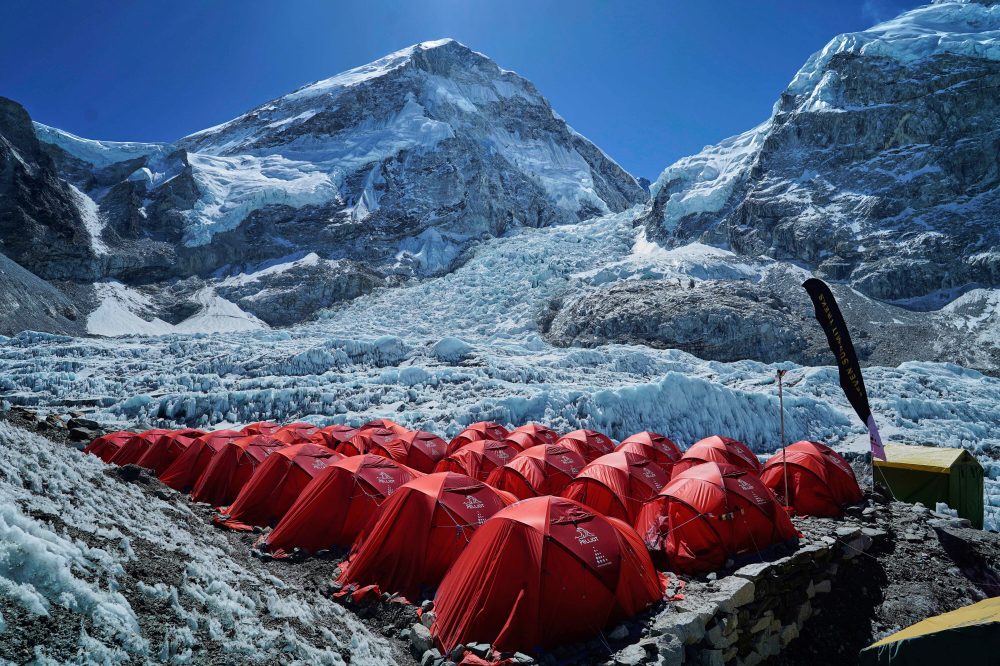
Approximately 410 mountaineers along with an equal number of Nepali guides have assembled at base camp, preparing for their ascent of the 8,850-meter summit (roughly 29,000 feet) during this month’s anticipated favorable weather conditions.
Expeditions started assembling at the 5,300-meter base camp (17,340 feet) last month, but a colossal unstable ice formation, known as a serac, prevented their progress up the mountain for over two weeks.
Specialized route-setting teams called “Icefall doctors,” deployed by the Sagarmatha Pollution Control Committee (SPCC) to establish the annual climbing path by installing ropes and positioning aluminum ladders across deep gaps, typically complete their work by mid-April.
This season proved different.
The route through the Icefall finally opened on April 29, accompanied by an urgent advisory: “The serac has multiple cracks and may collapse at any time. SPCC strongly urges all expedition operators and climbers to exercise extreme caution.”
The dangerous ice block remains in place, with the newly established path running underneath it.
This serac forms part of the Khumbu Icefall, a continuously moving glacier featuring deep chasms and massive overhanging ice formations that can tower as high as 10-story structures. Climbers consider this section among the most challenging and hazardous portions of the entire ascent.
Both mountaineers and expedition leaders express a mixture of anticipation and concern regarding current mountain conditions.
Experienced mountain guide Lukas Furtenbach, leading 40 international climbers, 11 guides and 90 Sherpas on the expedition, expressed his apprehension.
“Anyone who says they’re not concerned is either inexperienced or not paying attention,” Furtenbach said from the base camp. “The serac is a real, objective hazard.”
He noted that this year’s route presents greater complexity and exposure compared to last season in certain areas.
“The Icefall is constantly changing, but right now it’s not just more broken — it’s also forced into a line that passes under unstable features,” he said.
His team has implemented safety measures including lighter loads, shortened exposure periods, strategic timing for Icefall crossings, and reliance on veteran Sherpa guides for danger evaluation.
Additional expedition companies are also warning their clients about the risks while maintaining close surveillance of conditions.
“If you go in the morning, it might be safer because the ice is frozen, but in the afternoon it becomes dangerous as weather gets warmer, with the risk of ice melting and falling,” said Ang Tshering Sherpa of the Kathmandu-based Asian Trekking. “It is very necessary to be cautious this year.”
A collapsing serac caused an avalanche in the Khumbu Icefall during 2014 that claimed the lives of 16 Nepali guides and workers.
Scientists have raised increasing alarm about accelerated glacier melting due to global warming and climate change. U.N. Secretary-General António Guterres visited a Nepali mountain in 2023 and issued warnings about the catastrophic rate of glacier loss throughout the Himalayan range.
According to Ang Tshering Sherpa, substantial numbers of climbers are participating in this season’s attempts despite ongoing conflicts and elevated travel expenses. While fewer mountaineers from Western nations like the United States and Europe are participating, Asian climber participation has grown.
Mount Everest spans the Nepal-China border and offers climbing routes from both countries. However, China has closed its northern route this year, forcing all climbers to attempt the summit via Nepal’s southern approach.
Thousands of individuals have successfully reached the summit since New Zealander Edmund Hillary and Sherpa guide Tenzing Norgay first conquered the peak on May 29, 1953.