
An unseen substance that accounts for 85% of everything in the universe has left the world’s brightest scientific minds searching for answers, leading many to experience profound wonder.
Scientists refer to this mystery as “dark matter” — a material they characterize as cosmic adhesive, framework, and a network that employs gravitational force to gather, mold and bind stars, planets and galaxies together. However, its exact nature remains unknown.
The presence of dark matter can only be detected through how its gravity influences visible materials. Along with dark energy — an enigmatic force driving the universe’s accelerating expansion — these represent today’s most significant scientific puzzles.
It’s hardly surprising that dark matter and dark energy, potentially containing clues to how the universe began and will end, have generated deep religious and philosophical discussions — inspiring some researchers while making others uncomfortable.
The realms of scientific inquiry and religious belief aren’t as disconnected as one might assume. Numerous researchers have shared how examining the grandeur of space can complement rather than clash with their faith or spiritual practices.
Vera Rubin, the astronomer whose galaxy rotation observations in the 1970s offered the first solid proof of dark matter’s presence, welcomed her Jewish heritage as guidance for comprehending her place in the cosmos.
During a 2009 meeting between Chanda Prescod-Weinstein and Rubin, when Prescod-Weinstein was pursuing her doctorate, the celebrated astrophysicist asked an surprising question: “So how do you think we solve the dark matter problem?”
Prescod-Weinstein, who identifies as agnostic-atheist and Jewish, credits Rubin’s thoughtful inquiry as influential in her decision to research a hypothetical particle known as the axion, which might potentially resolve the dark matter mystery. Prescod-Weinstein explains she finds scientific motivation in Reconstructionist Jewish teachings and Torah study.
“The stories in the Torah are about people who lived in a very intimate relationship with the land and with the night sky, and with a sense of all of that as a part of creation and the creation story,” she said.
A fascination with dark matter and dark energy drew Brittany Kamai into astrophysics. She became just the second Native Hawaiian to receive a doctorate in this discipline. Following years creating the Fermilab Holometer, a device built to comprehend the composition of space and time, Kamai reconnected with her Hawaiian spiritual heritage as a trainee navigator and crew member aboard a voyaging canoe.
Kamai practices celestial navigation, employing stars, winds and ocean swells to cross waters without contemporary equipment. She considers whether the missing piece in these cosmic puzzles might exist in spirituality — an element she notes many researchers reject.
Through canoeing, Kamai explains she’s discovering the significance of being “spiritually tuned,” looking for hints her forebears might have preserved. She questions whether being in deep ocean waters could unlock the dark energy enigma.
“When you boil down physics, it’s all a bunch of waves — particles, sound waves,” she said. “Why wouldn’t we need to be in the deepest part of our ocean to have the deepest connection to the entire universe?”
Doug Watson experienced uncertainty as a postdoctoral researcher investigating dark matter. When exhaustion set in, his spouse introduced him to the International Society for Krishna Consciousness, or ISKCON, commonly called the Hare Krishna movement, a Hindu branch that honors Lord Krishna as the Supreme Being. Watson, previously non-religious, said he adopted a faith tradition that welcomed doubt, inquisitiveness and scientific exploration.
He examined sacred writings like the Srimad Bhagavatam, which portrays a moment when Krishna’s divine vision brings the universe to life. This strikes Watson as “eerily similar” to quantum mechanics’ observer effect — the occurrence where measuring or watching a quantum system, like a proton or electron, alters its condition.
Watson has drawn from these narratives as motivation to overcome obstacles that led to his burnout.
“I definitely don’t think drawing direct lines between religious texts and scientific facts is the right approach,” he said. “Rather, I see how these stories could inform and inspire new ways of thinking about the origins of the universe.”
Certain researchers, including astrobiologist Adam Frank, caution that finding sacred meaning in subjects like dark matter could result in letdown since scientific understanding continuously changes.
“You don’t want to base your faith or spirituality on a graph in a scientific paper that goes up or down,” he said.
For Frank, a Zen Buddhist practitioner, the genuine connection between scientific work and spiritual pursuit lies in the wonder both create.
“Whether it’s the poetry of your scripture that you love or the beauty of the equations you are deriving, they’re both calls toward that feeling,” he said.
For believers, accepting that nothing transcendent exists in this world remains impossible, explained Caner Dagli, an Islamic scholar and religious studies professor at the College of the Holy Cross in Massachusetts.
“Transhumanists and other philosophers might think that if we just had enough computing power, we might be able to get the equations to really understand the universe completely,” he said. “But that’s off the table for Muslims because we believe God intervenes in history, he answers prayer.”
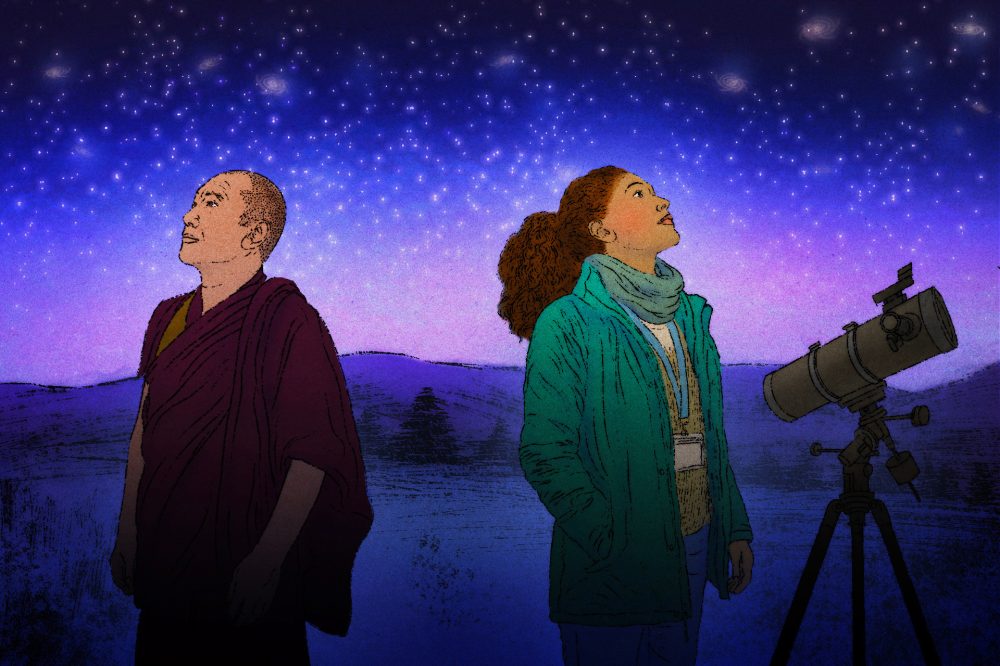
Chris Impey, astronomy professor at the University of Arizona, has repeatedly traveled to India to instruct Tibetan monks and nuns at the Dalai Lama’s request. Feeling amazed by a puzzling universe resembles a spiritual encounter, he explains.
Impey, an agnostic, has discovered numerous Buddhist elements that align with contemporary cosmology.
“They can accommodate in their tradition an ancient universe, billions of years old,” he said. “They can accommodate many worlds, life in other worlds, life more advanced than us.”
Adam Hincks, a Jesuit priest teaching at the University of Toronto and serving as an adjunct scholar at the Vatican Observatory, thinks that for some people, pondering dark matter and dark energy might lift their thoughts toward God.
“There are also other things in the universe that for some, would be a similar conduit, such as a beautiful waterfall,” he said. “As the creator, God is present in all of creation, and contemplating creation is a portal to contemplating the divine.”
Australian astrophysicist Ken Freeman earns recognition as a “dark matter pioneer” mainly for his groundbreaking 1970 study that supplied some of the earliest contemporary proof of invisible mass in spiral galaxies. Freeman practices Christianity; like numerous researchers before him, he contemplates intuition’s function in scientific breakthroughs.
“You wake up in the middle of the night with a thought and you have no idea where that came from,” he said. “People of faith might look at it as the action of the Holy Spirit.”
Did the Holy Spirit inspire his drive to investigate dark matter?
“I would not paint it that way, but it’s a nagging possibility,” he said.
Jennifer Wiseman, a Christian astrophysicist, relies on her faith for guidance while exploring the universe’s major, mysterious questions and considering how to use scientific advancement to benefit humanity.
“Studying the deep universe may make us feel insignificant,” Wiseman said. “But it also gives us a sense of unity that we’re all on the same planet. … The hope is we get a sense of joy, humility and love from these contemplations.”