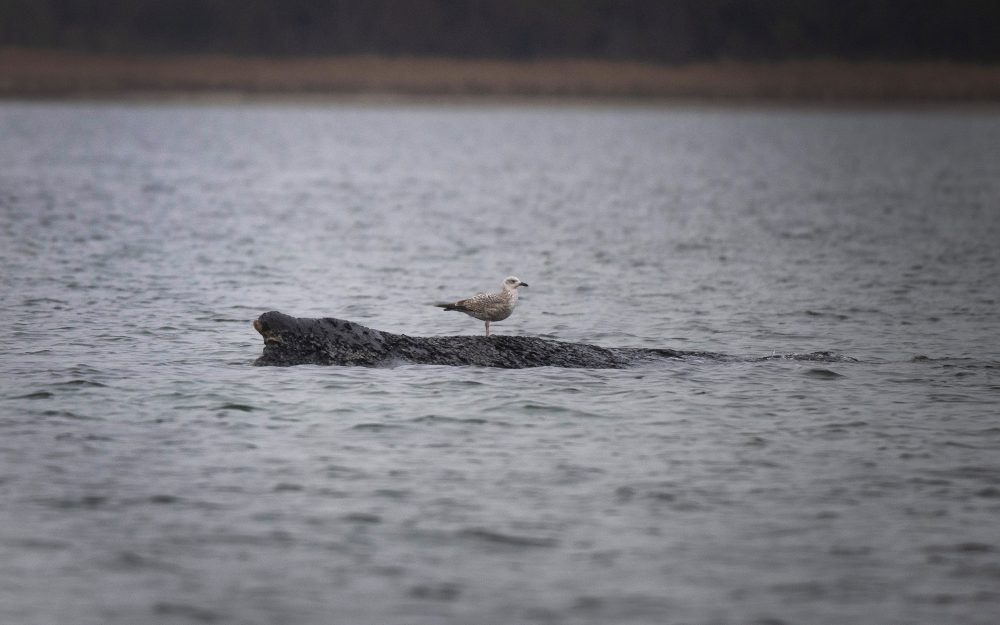

BERLIN — Marine biologists are growing increasingly concerned about a humpback whale that remains trapped in Germany’s Baltic Sea, as the massive creature displays troubling signs of declining health following unsuccessful rescue operations this week.
German officials established a 500-meter safety zone around the distressed whale near the coastal community of Wismar on Sunday, hoping the marine mammal might recover enough strength to free itself from its predicament.
“He would be able to do so if he regains his strength, and that is why we decided to leave him alone, allowing him to actually set off and then successfully leave this area,” said Till Backhaus, the environment minister of the state of Mecklenburg-Pomerania, where Wismar is located.
However, Backhaus acknowledged the grim reality facing the creature. “But we also have to assume that he is weakened. And he is also sick,” he explained, noting the humpback whale may have sustained injuries from entanglement with fishing equipment.
Earlier rescue operations involving heavy machinery and watercraft attempted to create powerful waves that might help the 39-to-49-foot whale escape from shallow waters at Timmendorfer Strand beach and Wismar Bay. These dramatic efforts captured nationwide attention in Germany, with news outlets providing continuous coverage and live video feeds of the unfolding situation.
The whale’s plight became a widespread topic of discussion throughout the country, with citizens sharing updates about the rescue mission via text messages and social media.
Unfortunately, optimism for the whale’s survival continues to diminish as experts observe its deteriorating condition and question whether it possesses sufficient energy to navigate back to the Atlantic Ocean through German and Danish waterways.
“It is very noticeable that the animal is showing significantly less activity,” said Stefanie Groß from the Institute for Terrestrial and Aquatic Wildlife Research at the University of Veterinary Medicine Hannover. “Its respiratory rate has dropped considerably. The animal is not moving. It did not react even when we drove closer.”
Scientists remain uncertain about what led the whale into Baltic waters initially. Some researchers theorize the animal may have become disoriented while pursuing a school of herring or during its natural migration pattern, particularly since it appears to be male.
The Baltic Sea environment poses serious threats to the whale’s survival due to insufficient salt levels in the water. The creature has already developed skin complications, and while whales can survive weeks without eating, it cannot locate appropriate food sources in these waters.
For any chance of survival, the whale must successfully return to Atlantic Ocean waters by way of the North Sea.
“When you consider how narrow the straits are and that there are still about 500 kilometers (310 miles) to go, you realize that it’s a real bottleneck you have to navigate, and naturally, the chances of success are relatively slim,” said Burkard Baschek, the director of the German Maritime Museum in Stralsund.
Marine observers first documented the whale swimming in Baltic waters on March 3, though reports of it becoming stranded only emerged last week.