
BEAVERTON, Ore. — Heat, moisture, and national pride were the driving forces behind the design of this year’s World Cup soccer uniforms, including kits for powerhouse nations like France and Brazil, as well as host countries the U.S. and Canada.
With storm delays and temperatures reaching around 90 degrees Fahrenheit (32 Celsius) at some venues, player comfort and performance were the first priorities for designers.
Phil McCartney, Nike’s chief innovation, design and product officer, said the company collaborated with athletes, coaches, and national football federations to better understand how a uniform can actually impact how the game is played.
“We also talk to fans — so what does it mean to wear a Uruguay jersey, what does it mean to represent France, what does it mean to play for Canada?” McCartney told the Associated Press. “We take that and we merge that with all the science and the innovation to make sure that we have beautiful designs.”
Adidas, which created jerseys for defending champion Argentina, host nation Mexico, and Colombia, also introduced cooling technology for the tournament. Puma handled the kits for Portugal, Morocco, and Senegal — the two finalists at the most recent African Cup of Nations. A handful of other teams are wearing uniforms from additional apparel brands not among the big three.
McCartney spoke with the AP from Nike’s sports research lab at the company’s headquarters just outside Portland, Oregon, where much of the experimentation behind the kits took place.
The indoor facility is equipped with a 200-meter (219-yard) track, a small soccer field, and a basketball court, with hundreds of motion-capture cameras positioned throughout. Thermal chambers inside the lab are used to simulate the effects of heat and humidity on clothing worn by both athletes and robotic mannequins.
“We take motion-capture to see how they’re moving in the kit, how the kits are responding,” McCartney said. “We also use the thermal chambers that we have to test the kit’s breathability, to test wicking and moisture management.”
For this year’s tournament, Nike developed a new fabric it describes as more breathable and constructed entirely from recycled materials. Strategic mesh stitching throughout the jerseys allows increased airflow, helping to deliver what McCartney called “that thermal regulation that all the players have been asking for.”
Even with extensive testing, the launch of the kits hit a few snags. Earlier this year, visible bulges appeared along the shoulder seams of jerseys worn by teams including France and Uruguay, according to the Guardian. Nike told the AP it identified the problem before the World Cup kicked off and worked with the relevant federations “to ensure kits show up as intended.”
Beyond performance, the look of a jersey matters deeply — not just to players, but to the millions of fans who wear them and want to feel a genuine connection to their country.
“We take inspiration from lots of different places, from the past, from art, from music, from culture, so anything that gets us connected to the country we really want to harness,” McCartney said.
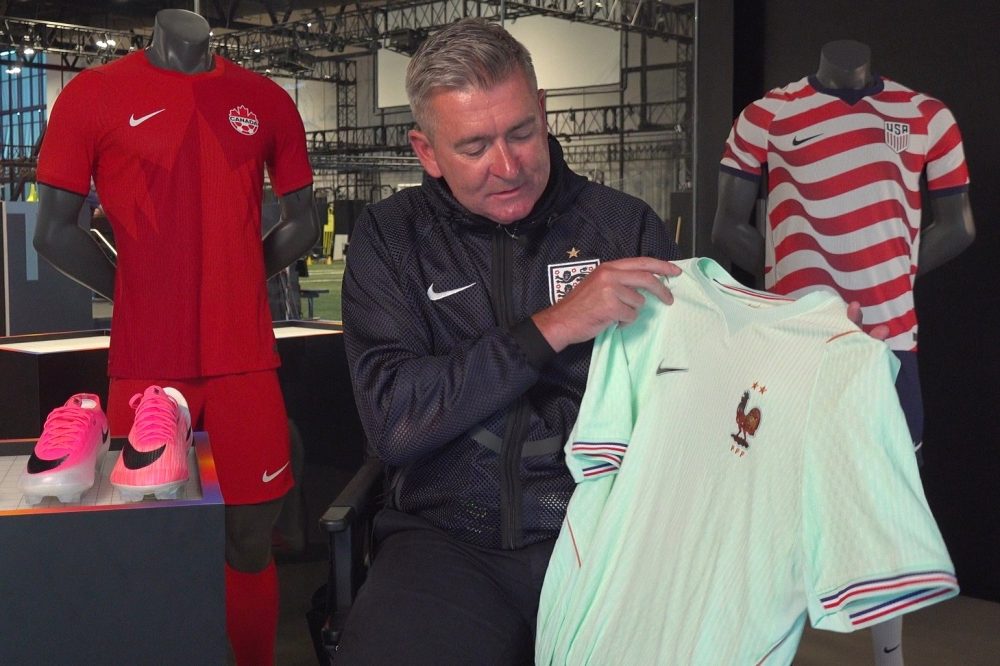
France’s away jersey, for instance, is a light shade of green meant to evoke the color of the Statue of Liberty — a monument France gave to the United States in the late 1800s. The inside tag carries the word “Liberté” printed inside an outline of the statue’s crown. The front of the jersey displays a rooster, a longstanding symbol of both the French national team and the country itself, along with two stars marking France’s previous World Cup championship wins.
France’s home jersey includes a collar, as does Uruguay’s. Nike said those decisions came from the national federations themselves — France drawing on its reputation as a global fashion hub, while Uruguay sought a more traditional soccer aesthetic reminiscent of earlier eras when collared jerseys were the norm.
National symbols played a central role in designing the U.S. and Canadian kits as well. The American home jersey features horizontal red and white stripes meant to recall a waving American flag, while Canada’s kit prominently displays a maple leaf.
“Especially in an event like the World Cup, we really play into national pride,” McCartney said.