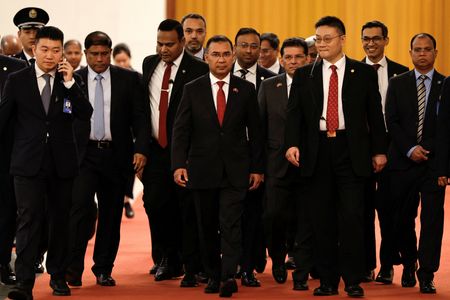

BEIJING — Bangladeshi Prime Minister Tarique Rahman sat down with Chinese President Xi Jinping in the Chinese capital on Friday, making a direct appeal for China to help shrink the trade gap between the two countries, broaden the range of Bangladeshi goods exported to China, and back key development initiatives in Bangladesh.
The meeting came during a three-day visit to China that began Wednesday — Rahman’s first trip to the country since he took office as prime minister in February.
Bangladesh has been working to strengthen its relationship with China, one of its biggest trading partners and a major source of development funding.
The trip also carries significant diplomatic weight. Rahman is working to maintain balanced relationships with both Beijing and New Delhi. His predecessor, Sheikh Hasina, was widely regarded as having closer ties to India. While relations between Dhaka and New Delhi have improved under Rahman’s leadership, tensions remain, including disagreements over border issues.
During his meeting with Xi, Rahman made the case that China could help reduce Bangladesh’s trade deficit by allowing more Bangladeshi products into its market.
“We request China to consider import our fresh mangoes, jackfruit, guava, aquatic products, raw leather, jute products and pharmaceutical products,” Rahman said, according to a media pool report.
He also stressed that Bangladesh needs China’s assistance in “implementing our major signature projects and upgrading and modernisation of our existing industrial units.”
Bangladesh became part of China’s Belt and Road Initiative in 2016, a large-scale infrastructure and development program championed by Xi that aims to link Asia, Africa, and Europe.
In response, China indicated it is prepared to work with Bangladesh on importing more quality Bangladeshi products, encouraging Chinese companies to invest there, and growing cooperation in areas like new energy, the digital economy, and artificial intelligence, according to a statement from the Chinese government.
Earlier in the visit, Rahman met with Premier Li Qiang on Thursday, where the two sides signed several cooperation agreements aimed at strengthening bilateral ties, state media reported.
Bangladesh currently owes China $6.2 billion, according to World Bank figures. The Beijing-based Asian Infrastructure Investment Bank has provided an additional $2.3 billion in loans. By comparison, India has lent its neighbor $1.6 billion.
Chinese companies have also invested $7.7 billion in Bangladesh, roughly half of it in the country’s energy sector, according to data from the American Enterprise Institute think tank.
However, China has grown more selective about where it puts its financing dollars, said Chim Lee, a senior analyst at the Economist Intelligence Unit in Beijing.
“Not least because it tends to be looking for key logistics corridors these days that can be scaled up, and Bangladesh is a bit tricky because it just doesn’t provide the same kind of corridor as say Central Asia or Myanmar,” Lee said.