
He thought he was falling for someone named “Eliza” — and ended up losing everything he had saved. Meanwhile, halfway around the world, a young man was smuggled into a criminal compound, beaten, and forced to become “Ella” online. Though separated by thousands of miles, Chris Colocousis and Safeer Mohammed Koorimannil found themselves on opposite ends of the same ruthless global cyberscam machine.
A joint investigation by AP and FRONTLINE uncovered that American technology is woven throughout the digital supply chains connecting scammers to their victims. While most public attention has been directed at the social media platforms where victims are first contacted, the infrastructure enabling these crimes stretches much further back — from artificial intelligence tools that help create convincing fake personas, to satellite equipment that helps scammers dodge internet restrictions, to internet service providers carrying data out of the lawless border regions of Myanmar to the devices of millions of unsuspecting people worldwide.
Watchdogs note that while U.S. tech companies aren’t breaking any laws, they possess the technical ability to do more to prevent these abuses — yet face little legal, regulatory, or financial pressure to act.
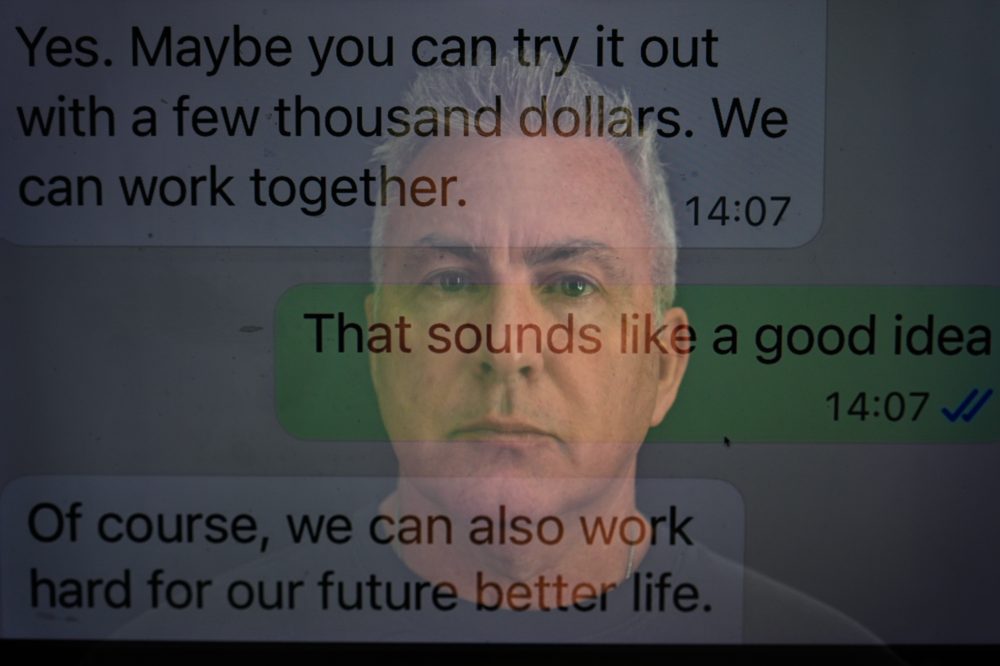
For Colocousis, the trouble began when a woman reached out to him on Facebook. She had a New York phone number and claimed to work at a well-known financial firm in Atlanta. “Eliza” suggested they video chat, and when he saw her on screen — the same blonde woman from her profile photos, complete with small bags under her eyes — she seemed completely real.
Now, Colocousis, a divorced man in his 60s, has no way of knowing where “Eliza” actually is, whether he was ever speaking with a real person or an AI like ChatGPT, or even whether “she” is actually a woman. What he does know is that the $400,000 he said he “invested” at Eliza’s direction has vanished — along with the comfortable retirement he spent years building.
“I think I have a degree of PTSD from it, to be honest with you. I still wake up occasionally in the middle of the night with anxiety where it just all of a sudden hits me,” he said from his home in Massachusetts. “I really never want to leave my house.”
Colocousis said he had planned to retire within a few years, but now faces the prospect of continuing to work and possibly taking out a home equity loan to stay afloat.
“Most people react when they find out somebody was scammed, is like, how stupid could you be? Well, I’m an educated guy. You know, what is my flaw in this? My flaw is I was looking for a companionship,” he said. “I’m at peace for now being by myself.”
Koorimannil, 30, had a very different experience with the same criminal industry. According to records he managed to smuggle out to AP, the software on his computer at the Tai Chang scam compound in Myanmar allowed him to target approximately 50,000 victims from at least 17 countries in a single month. Among those targeted were a widowed tailor in Kurdistan, a pastry chef in Turkey, soldiers in Iraq, an engineer in Russia, and a building painter in Germany. Working with security nonprofit C4ADS, AP determined that the tools Koorimannil was forced to use were partly powered by American artificial intelligence models.
On a typical work shift, Koorimannil said he was managing conversations with more than 100 people across dozens of fake profiles simultaneously, all while supervisors walked the floor carrying electric batons. He said he was beaten when he failed to scam people effectively, and photographs document the red, swollen marks left on his body.
“When they came near my computer, my hands would shake and sweat,” he told AP in his native Malayalam language from his home in southern India.
At night, he said, he and his closest friend would huddle together in a single narrow bunk, too scared to sleep on their own.
Koorimannil said he ultimately paid more than $5,000 to secure his release and has since returned to work in his family’s fish business. He sometimes struggles to accept the limits of the life he was born into, but says the price of chasing something more was far too high.
“I’ve learned to stay hungry and I have learned to be patient,” he said. “I was not like this before. After coming back from Myanmar, I know how to be hungry and patient.”
This story is based on a documentary photo essay curated by AP photo editors.