
COLUMBIA, S.C. — Republicans in South Carolina have launched an effort to reshape congressional boundaries targeting a district with a Black majority, following a recent U.S. Supreme Court decision that weakened safeguards for minority representation in voting.
With encouragement from President Donald Trump, GOP lawmakers in the Palmetto State are working to alter the congressional map in hopes of capturing all seven of the state’s House seats, including one currently represented by a longtime Black Democratic congressman.
South Carolina’s initiative mirrors similar actions already underway across the South. Special legislative sessions are currently happening in Alabama and Tennessee to modify their federal House districts, while Louisiana officials are also preparing new congressional boundaries after the Supreme Court invalidated their existing map last week.
The nation’s highest court determined that Louisiana placed excessive emphasis on racial considerations when establishing a second district with a Black majority while trying to follow Voting Rights Act requirements. This decision dramatically changed how the law has been interpreted for decades, providing Republicans with justification to challenge majority-Black districts that typically elect Democratic candidates.
The court’s decision has intensified nationwide redistricting conflicts before November’s midterm elections, which will decide control of the narrowly divided House of Representatives.
Following Trump’s encouragement for Texas to redraw its House districts last year, eight states have now implemented new congressional maps. Republicans believe they could pick up as many as 13 seats from these changes, while Democrats estimate they might gain up to 10. However, some newly drawn districts may be competitive in November, potentially limiting gains for both parties.
Democratic Representative Jim Clyburn has served South Carolina’s 6th Congressional District since it was restructured to benefit minority voters in 1992, and he’s seeking his 18th term. However, his reelection prospects could become more challenging if Republicans successfully redraw his district boundaries.
State legislative leaders have indicated that any redistricting initiative requires approval from two-thirds of both the House and Senate. The matter could be addressed as early as Wednesday, though success depends on near-unanimous Republican support.
Senate Majority Leader Shane Massey has cautioned that redistricting efforts might backfire due to narrow political margins, potentially creating a second Democratic House seat. Massey informed reporters Tuesday that he had a respectful discussion with Trump regarding redistricting, with both expressing their respective concerns.
The state’s primary elections are set for June 9, with early voting beginning in three weeks.
On Wednesday, the House may consider legislation allowing Alabama to conduct a special congressional primary if the Supreme Court permits the state to modify its House districts.
Based on the court’s Louisiana ruling, Alabama officials have requested that courts suspend a judicial mandate requiring a House map with two districts containing significant Black populations. Republicans prefer using a 2023 Legislature-approved map that could help the GOP win at least one of those seats currently held by Democrats.
Alabama’s primaries are planned for May 19. If the Supreme Court approves the state’s request after or close to the primary date, proposed legislation would disregard those primary results and direct the governor to schedule new primaries under revised district lines.
Democrats have criticized the legislation as a Republican attempt to seize power that recalls the state’s disgraceful history of denying Black citizens equal rights and representation.
Republicans are “working to secure an electoral victory by taking Alabama back to the Jim Crow era, and we won’t go back,” Democratic Representative Terri Sewell declared to a crowd assembled outside the Alabama Statehouse.
Republican Governor Bill Lee has convened Tennessee lawmakers for a special session to examine a Trump-endorsed proposal that could dismantle the state’s only Democratic-held House district, which centers on Memphis, a majority-Black city. Republicans provided few details about the plan Tuesday.
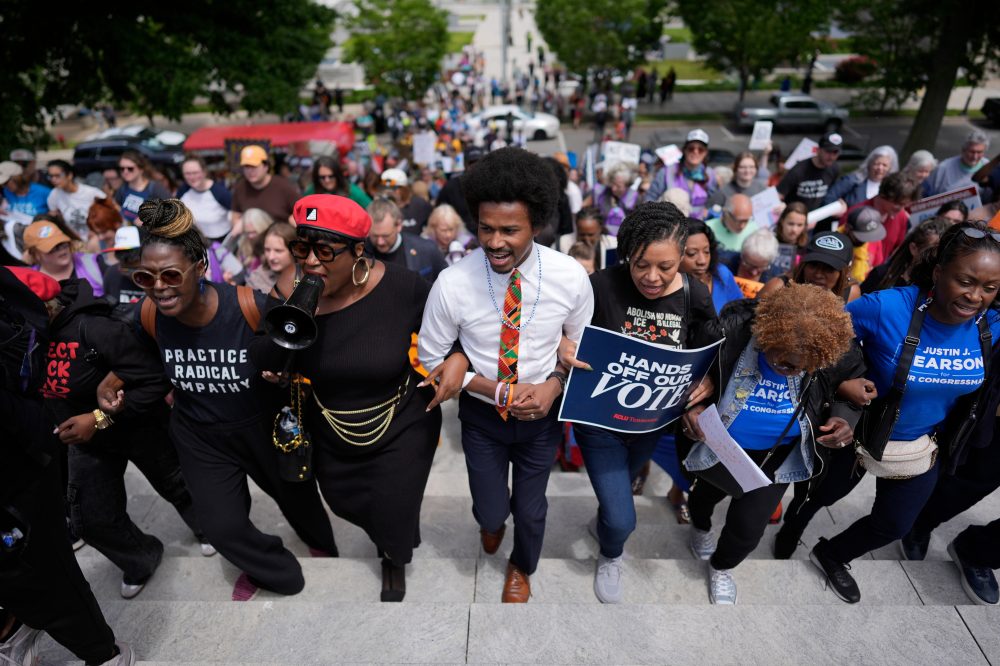
As the Senate commenced work Tuesday, protesters in the hallways could be heard shouting “shame, shame, shame” inside the chamber. On the floor, Senator Raumesh Akbari, a Black Democrat from Memphis, described the redistricting as “an act of hate.”
Martin Luther King III wrote to Tennessee legislative leaders expressing “grave concern” about plans to split Memphis, stating the action could undermine the voting rights work accomplished by his father, Martin Luther King Jr.
Tennessee’s candidate filing period concluded in March, with the primary election scheduled for August 6.
Following last week’s Supreme Court ruling, Republican Governor Mike Landry delayed Louisiana’s May 16 congressional primary to provide time for lawmakers to approve new House districts. Republican State Senator Caleb Kleinpeter, who chairs a redistricting committee, announced plans for a public hearing Friday.
Louisiana voters had already submitted more than 41,000 absentee ballots by last Thursday when Landry suspended the House primaries, according to the Secretary of State’s Office. This represents about one-third of all distributed absentee ballots, with approximately 19,000 from registered Democrats, 17,000 from registered Republicans, and the remainder from unaffiliated voters.
Democrats and civil rights organizations have filed multiple lawsuits challenging Louisiana’s congressional primary suspension.