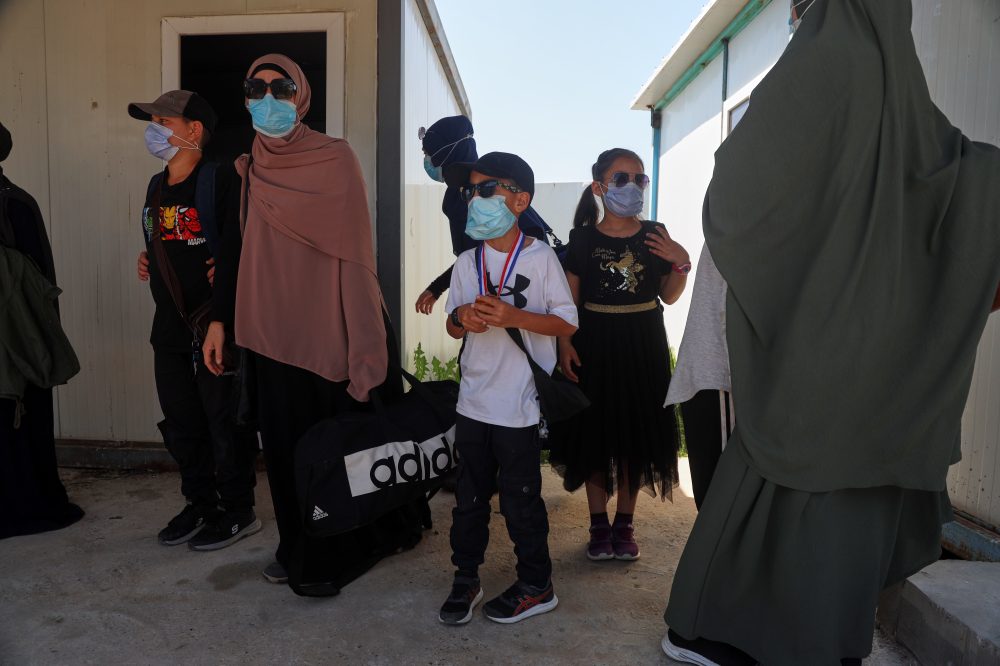

MELBOURNE, Australia — Australian authorities announced Wednesday that several women suspected of having connections to Islamic State militants will face immediate arrest and criminal charges when they arrive back in the country from Syria.
Home Affairs Minister Tony Burke confirmed that his government received notification Wednesday that four women and nine children had secured flight reservations from Damascus to Australia, though he declined to specify their expected arrival date.
Police Commissioner Krissy Barrett revealed that the Australian Federal Police have been conducting investigations since 2015 into the activities of Australian citizens who journeyed to what the Islamic State called its caliphate in Syria.
These investigations have examined possible terrorism-related offenses as well as crimes against humanity, including human trafficking, Barrett explained.
“Some individuals will be arrested and charged. Some will face continued investigations when they arrive in Australia,” Barrett stated during a press conference.
Barrett added that the children accompanying these women would be enrolled in programs designed to counter violent extremism.
While the Australian government is legally obligated to issue travel documents for these individuals, officials have consistently emphasized they are providing no assistance with their return journey.
“The individuals concerned traveled … in support of one of the most horrific terrorist organizations we’ve seen in recent history or in our lifetimes,” Burke explained to reporters.
“There is a reason why the government has drawn a very hard line saying we will do nothing to assist. The government’s complete lack of support for these individuals is a direct reflection of the decisions that they made,” Burke continued.
The women had been confined at Roj Camp, located near the Syrian-Iraqi border. While they departed the facility last week, Syrian officials informed The Associated Press at that time that Australia had “refused to receive them.”
Burke acknowledged his government’s limited authority to block their return, noting “There are very serious limits on what can be done with respect to preventing a citizen of a country returning to their country.”
This follows a failed February attempt when 34 women and children from the same facility were prevented from reaching Australia after Syrian authorities turned them back.
During that incident, Australian officials issued a temporary exclusion order against one woman, effectively barring her return.
The government has not disclosed the identity of this woman, who remains subject to the exclusion order that can prevent high-risk citizens from returning for up to two years.
These exclusion powers were established through 2019 legislation aimed at preventing defeated Islamic State fighters from re-entering Australia. No previous public use of such an order has been reported.
While these orders cannot be applied to children under 14, Australia has maintained its policy against separating children from their mothers.
Burke confirmed that the February exclusion order against the unidentified woman remains active.
Australian law made unauthorized travel to Raqqa, the former Islamic State stronghold in Syria, punishable by up to 10 years imprisonment for trips made between 2014 and 2017 without legitimate justification.
Following the Islamic State’s territorial defeat in Syria in 2019, former fighters from various nations, along with their families, were detained across multiple camps and facilities in northeastern Syria. Despite its territorial losses, the group continues conducting attacks in Syria and Iraq through remaining fighters.
The larger al-Hol detention facility has since closed, with thousands of suspected militants previously held in Syria transferred by U.S. military forces to Iraq for prosecution.
These transfers occurred following January clashes between government forces and the Syrian Democratic Forces, during which government troops captured significant SDF-controlled territory. The resulting disorder allowed many detainees to escape from al-Hol and other detention facilities.
Australian governments have previously facilitated the return of Australian women and children from Syrian detention camps twice, while other Australians have managed to return independently.