
The groundbreaking shale technology that transformed America into the globe’s leading oil producer has now arrived in the Arabian Peninsula.
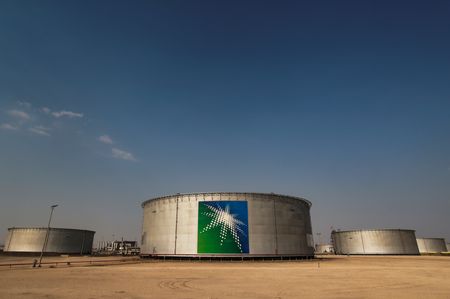
Located in the desert sands near Saudi Arabia’s massive Ghawar oil field, the state-owned energy giant Aramco has launched production at a colossal natural gas development that could generate billions in new revenue for the kingdom over the next several years.
The company has partnered with American and Chinese corporations including Halliburton and Sinopec, utilizing cutting-edge equipment such as ‘walking rigs’ – massive drilling towers that can relocate short distances without being taken apart and rebuilt – to accelerate drilling operations at the Jafurah basin.
Despite scaling back other ambitious mega-developments and abandoning plans to increase oil production capacity, Aramco – the planet’s largest oil exporter – has actually increased its natural gas production goals, placing this $100 billion investment at the heart of its strategy to become a dominant force in the global gas market.
The Jafurah field is believed to hold 229 trillion standard cubic feet of raw gas and 75 billion barrels of condensate, making it possibly the largest shale gas project anywhere outside American borders.
For many years, Saudi Arabia has burned some of its most precious resource – crude oil – to generate electricity for its power system. With less than five years remaining to achieve Crown Prince Mohammed bin Salman’s Vision 2030 plan to reduce dependence on oil revenues, there’s mounting urgency to substitute those liquid fuels with gas.
“Jafurah is not just a large gas field: it is a strategic platform that supports the Kingdom’s broader growth ambitions across key sectors, including energy, artificial intelligence, and major industries like petrochemicals,” Aramco stated in response to questions.
On Thursday, Aramco formally declared the beginning of operations at Jafurah, marking a significant achievement for a development that required years of preparation similar to the early stages of America’s shale revolution. The company revealed that production commenced in December 2025, information that was previously disclosed in the Saudi finance ministry’s budget documents.
“The excellent progress at Jafurah is a testament to a decade of relentless innovation and focus on value creation,” Aramco’s Upstream President Nasir Al-Naimi stated.
“Early well performance has been outstanding, validating our high-tech approach and reaffirming the significance of this flagship project to our gas growth strategy.”
The economic calculation is straightforward: Saudi Arabia currently consumes more than 1 million barrels daily of crude oil and fuel oil for domestic electricity production. Aramco plans to substitute 500,000 barrels per day of that consumption with gas by 2030, allowing that crude to be sold internationally. With current oil prices around $70 per barrel, 500,000 daily barrels would create approximately $12.8 billion in annual revenue.
In Thursday’s announcement, Aramco projected the gas expansion will produce additional operating cash flows between $12 billion and $15 billion in 2030.
“Through our strategic gas expansion, we anticipate attractive double-digit returns as we set about unlocking significant volumes of high-value liquids and capitalize upon captive domestic gas demand,” Al-Naimi explained.
Analysis of drilling equipment data from Baker Hughes, contract awards, and corporate documents shows that Jafurah has become the kingdom’s top capital investment and represents a new opportunity for American oilfield service companies as the U.S. shale expansion matures and they seek growth elsewhere.
Jafurah presents an exceptional opportunity: an enormous, undeveloped unconventional resource requiring the hydraulic fracturing and horizontal drilling techniques mastered in Texas.
Equipment activity data indicates that while drilling in America’s Permian Basin has stabilized, gas exploration in Saudi Arabia has grown as Jafurah development accelerated and investment was redirected after the kingdom canceled a previously planned 1 million barrel-per-day oil capacity increase.
Aramco has disclosed approximately $26 billion in contracts for Jafurah’s initial two phases since 2018, when it granted Halliburton a deal for unconventional gas stimulation, typically involving fracking. Additional first-phase agreements went to Sinopec, South Korea’s Samsung Engineering and Italy’s Saipem.
To make shale extraction feasible in the harsh desert conditions, engineers have created specialized technology, according to company publications. Innovations include processing Gulf seawater to eliminate well-blocking sulfates for underground injection and ultra-durable diamond drill bits designed to penetrate abrasive rock without overheating.
Aramco is working toward 2 billion standard cubic feet daily of gas from Jafurah, 420 million standard cubic feet daily of ethane, and 630,000 barrels daily of associated liquids by 2030.
At maximum output, Jafurah could yield up to 1 million barrels daily of condensates, according to a knowledgeable source. Condensates are liquid hydrocarbons that can be refined to create petrochemical raw material naphtha and other processed products.
In November, Aramco announced it was increasing its nationwide gas expansion target to 80% above 2021 production levels, up from a 60% increase goal set in March 2024. Using the company’s 2021 baseline of 9.2 billion cubic feet daily, calculations indicate the revision means Aramco seeks to produce nearly 2 billion cubic feet daily more by decade’s end, matching the volume targeted from Jafurah.
Some industry experts question the timeline for production increases. Aramco had initially indicated Jafurah would begin operations in early 2024.
“There is still a lot of uncertainty around the pace of ramp-up and how much of the condensates will be exported or used as feedstock,” noted Monica Malik, chief economist at ADCB.
She estimated that Jafurah revenue could contribute 0.3% to Saudi GDP growth in 2026.
The gas development aims to prolong Saudi Arabia’s hydrocarbon income, which continues to represent more than half the government budget, while positioning the kingdom to capitalize on growing Asian demand, according to Neil Quilliam, associate fellow at Chatham House think tank.
Beyond freeing crude for export, Aramco is constructing a worldwide liquefied natural gas portfolio through international investments. The company has acquired stakes in LNG firm MidOcean and secured 20-year supply contracts from Commonwealth LNG’s planned Louisiana facility and NextDecade’s Rio Grande terminal in Texas.
Aramco’s gas emphasis comes as Qatar – whose reserves are conventional and therefore simpler to extract than shale – advances its own production expansion to maintain regional gas dominance. Abu Dhabi National Oil Company is also pursuing significant gas and LNG investments domestically and internationally.
The International Energy Agency and market observers anticipate a wave of new Qatari and American LNG this decade that could create global oversupply and reduce prices. Aramco’s long-term goal is LNG capacity of 20 million tons annually, Chief Executive Amin Nasser told analysts in August. Qatar operates 77 million tons annually of capacity, expected to reach 142 million tons by 2030, while ADNOC targets 20 to 25 million tons by 2035.
Aramco anticipates domestic gas demand will continue growing, fueled by industrial expansion including manufacturing, mining, and petrochemicals, Al-Naimi stated.