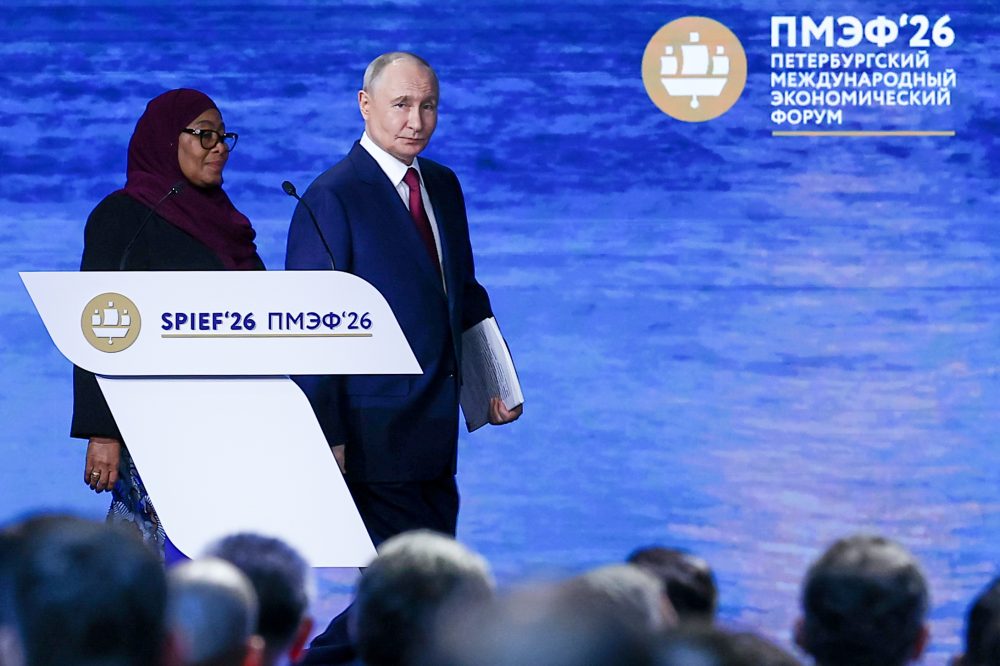

ST. PETERSBURG, Russia — The Russian president delivered remarks Friday at the annual St. Petersburg International Economic Forum, claiming that emerging nations have taken on a more significant position in worldwide commerce while Western nations’ economic influence has diminished.
During his address, he criticized Western countries for harming international economic stability through one-sided sanctions policies.
He argued that Western nations damaged confidence in their own monetary systems by freezing Russian financial assets overseas.
“The sanctions and blocking of Russia’s sovereign reserves have irreversibly impacted the standing of international currencies, the dollar and the euro,” he stated. “Just like Russia, any other country could lose access to their legitimate assets in dollars or euros, as well as Western financial and payment systems.”
The leader also claimed that excessive government debt has contributed to declining worldwide confidence in Western financial institutions.
“The roots of the current global turbulence lie in the transition from a vertical, hierarchical model, which served the interests of a small number of states, to a more complex, distributed and multipolar one,” he remarked. “Russia views global changes not only as a threat but also as immense opportunities. And to capitalize on them, we aim to act swiftly and pragmatically.”
The gathering occurs while Russia faces economic challenges related to the ongoing Ukrainian conflict. Government officials have implemented tax increases and expanded domestic borrowing to manage budget shortfalls.
During a Thursday media session, the Russian leader disputed claims that his nation’s economy was in serious trouble. He explained that his administration had deliberately implemented cooling measures to control rising prices.
The St. Petersburg event, often compared to the World Economic Forum in Davos, Switzerland, traditionally serves as a platform for showcasing the country’s economic progress and attracting international investment. Since military operations began in Ukraine in 2022, Western officials and business representatives have avoided attendance, prompting Russia to invite participants from other regions to support its vision of a “multipolar world.”
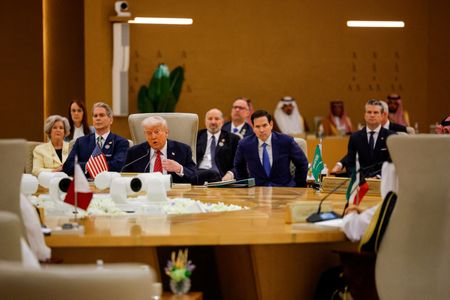
This year’s attendees include a substantial delegation from Saudi Arabia, along with the presidents of Uzbekistan and Tanzania and China’s vice president. Notably, a U.S. official, Rodney Mims Cook Jr., head of the U.S. Commission of Fine Arts, is participating for the first time in several years.
On Thursday, he also discussed Ukrainian drone strikes within Russian territory and promised to strengthen defensive capabilities.
“To our regret, some of them break through,” he told reporters regarding the aerial attacks. “Russia has an air defense system, we need to improve it, strengthen it, and we will do that.”
Just before the forum began Wednesday, a Ukrainian drone strike ignited an oil facility in the city and struck a nearby military installation.
The Russian leader indicated openness to Ukrainian compromise based on agreements from last year’s meeting with U.S. President Donald Trump in Anchorage, Alaska, stating that Ukraine must accept these terms to resolve the conflict, now in its fifth year.
Thursday brought a public letter from Ukrainian President Volodymyr Zelenskyy proposing direct negotiations. Zelenskyy recognized changing U.S. priorities, noting it would be unwise to wait for America to refocus on Ukraine while dealing with the Iran conflict.
From Washington, Trump expressed support for potential talks between the two leaders, calling such a meeting “great.”
Kremlin spokesman Dmitry Peskov reported that the Russian president had not yet reviewed the letter and reiterated previous statements that Zelenskyy could visit Moscow for discussions, a proposal Zelenskyy has firmly declined. Last month, the Russian leader suggested the possibility of meeting in a neutral location, but only when there is an agreement ready for signing.
Speaking Thursday, he again dismissed Zelenskyy’s calls for an immediate ceasefire, emphasizing Moscow’s preference for a complete resolution rather than temporary peace.
“Naturally, the Ukrainian side would like us to suspend the advances made by Russian troops,” he explained. “But it would be better to end the war by agreeing to the compromises that were discussed in Anchorage.”