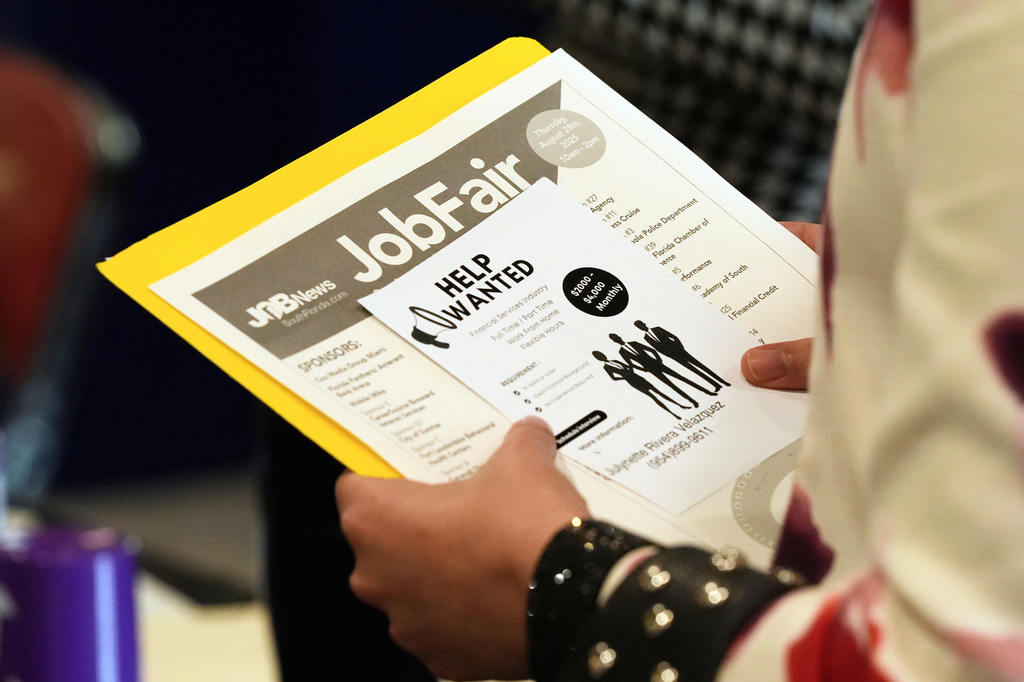

WASHINGTON — The nation’s employment sector displayed remarkable durability in May, weathering the financial burden of the Iran war with stronger-than-anticipated results.
Companies nationwide created 172,000 new positions last month — nearly twice what economic analysts had predicted — while unemployment remained steady at 4.3%.
Friday’s Labor Department data revealed that May’s employment growth dipped modestly from April’s revised figure of 179,000 jobs. The jobless rate held at the same low 4.3% mark.
Employment creation has recovered this year following a disappointing 2025, demonstrating durability amid economic instability and severely elevated fuel costs stemming from the Iran war.
May’s employment increases spanned multiple sectors. Municipal governments brought on 55,000 new employees, while dining establishments and taverns hired 48,000 workers, and medical facilities added 35,000 positions.
Additional evidence of labor market vigor came through Labor Department adjustments that incorporated an extra 93,000 positions across March and April. Employment expansion averaged 188,000 monthly from March to May, representing the strongest three-month hiring period since early 2024.
“The hiring recession is over. American firms are hiring again,” said Heather Long, chief economist at Navy Federal Credit Union. “The job rebound is happening in almost every industry … This is encouraging news for job seekers and for the U.S. economy. The labor market has stabilized and is showing early signs of a genuine rebound.”
With five months remaining until significant midterm elections in the U.S., citizens have expressed mounting dissatisfaction over increasing expenses, leaving uncertainty about whether this year’s robust employment figures will offset those concerns.
Recent inflation statistics revealed that beyond fuel costs, grocery prices, apparel, and utility bills are climbing, suggesting inflation could be becoming more deeply rooted.
Despite increased hiring activity, salary improvements remained limited. Average hourly compensation increased 0.3% from April and 3.4% compared to May 2025, aligning with the Federal Reserve’s 2% inflation objective.
Employees, job hunters, and companies remain trapped in an uncomfortable “no-hire, no-fire” employment environment. “Those who have jobs are clinging to them, while those without are left wanting,” Diane Swonk, chief economist at the tax and consulting firm KPMG, wrote in a commentary ahead of the jobs report. “The result is a sense of being frozen or left in a sort of labor market purgatory.”
Numerous young adults face difficulties entering a stagnant employment landscape. Workers who experienced layoffs encounter challenges returning to employment. Almost 28% of jobless individuals in April remained without work for over six months, the largest proportion since December 2021.
Recognizing diminished opportunities, citizens hesitate to abandon current positions for potentially better alternatives. In April, voluntary departures fell to the lowest point since the alarming period of August 2020, when COVID-19 was spreading widely.
During the previous year, companies created 9,700 positions monthly, the smallest increase outside a recession since 2002.
This year, recruitment has improved, generating an average of 114,000 new positions monthly from January through May. Substantial tax refunds — resulting from President Donald Trump’s 2025 tax reductions — have boosted the economy, counteracting higher energy costs since the United States and Israel launched attacks on Iran in late February. However, most refunds have been saved, while gasoline prices stay above $4 per gallon.
Medical companies have led much of the hiring activity over the past year.
Martha Gimbel and Ryan Nunn of Yale University’s Budget Lab note that strong healthcare hiring isn’t surprising as Americans age and need more prescriptions and trips to the doctor. In fact, the industry’s job growth is in line with Labor Department predictions from a decade ago. “The question is not why healthcare has kept hiring—it is why other industries have not,” they wrote in a report published Tuesday, suggesting that one explanation might be an immigration crackdown that has reduced the supply of foreign-born workers.
At minimum, the United States requires fewer new positions than previously. Declining immigration and increasing Baby Boomer retirements mean fewer individuals compete for employment. Consequently, the break-even threshold — new jobs needed to maintain stable unemployment — has likely fallen to nearly zero, down from the typical 155,000 monthly positions required two or three years ago, according to a Federal Reserve report.
Some experts worry that artificial intelligence will eliminate entry-level positions. However, economists Gregory Daco and Lydia Boussour of the tax and consulting firm EY-Parthenon wrote in a commentary Tuesday that AI “adoption is proving more gradual and costly than many anticipated. Firms are increasingly using AI to enhance productivity and control labor costs.” But AI, they wrote, has reduced hiring rather than “triggering broad-based layoffs.”
Additionally, a new study by the Federal Reserve Bank of New York identified a different culprit for young people’s struggle to land jobs after college: the rise of remote work. Businesses, it seems, are reluctant to hire new grads for work-at-home jobs because it is harder to train and mentor them when they aren’t coming into the office.
U.S. financial markets declined following the positive employment data as expectations for Federal Reserve interest rate reductions continue diminishing.