
Families of the five crew members who died when a K2 Airways Boeing 737 cargo plane went down in the Arabian Sea off Pakistan are demanding a broader international search effort to recover the aircraft’s flight recorders and uncover the cause of the crash.
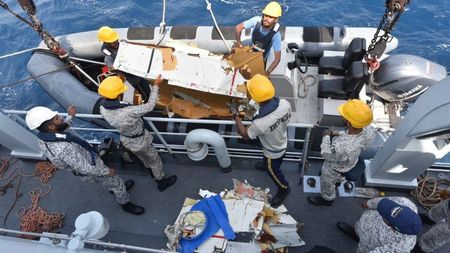
Surface debris from the freighter was collected shortly after the July 7 disaster, but the sea floor in that area sits at roughly 3,000 meters — about 9,800 feet — below the surface. Aviation experts who have experience with deepwater accidents, including the 2009 Air France 447 crash, say locating the so-called black boxes would require an expensive underwater operation that Pakistan would likely need foreign help to carry out.
Adding urgency to the situation, the locator beacons on the 27-year-old aircraft were built to transmit signals for only 30 days. Retrieving the recorders could shed light on whether a navigational system problem reported just before the crash was connected to a navigation component that family members say was swapped out prior to the flight.
Pakistan has issued no public updates on the underwater search in over a week. An industrial firm with deepwater search capabilities told Reuters it had received no inquiries from Pakistan seeking assistance from foreign companies or navies.
Yashib Rizwan, the eldest son of Captain Rizwan Idris, spoke directly to the need for continued efforts. “The search has to continue, and whatever resources can be deployed, locally and internationally, should be deployed,” he said. “For us a transparent investigation is key.”
Abdur Rafay Siddiqui, the son of engineer Muhammad Arif Siddiqui, also voiced support for bringing in international assistance if necessary. Both families have already held funeral prayers after giving up hope that the bodies would ever be found.
Pakistan’s government has not answered questions about whether it intends to seek help from other countries. K2 Airways, which lost its only aircraft in the crash, has also declined to respond to requests for comment.
What Happened in the Final Minutes
According to Pakistan’s airports authority, the pilots radioed in a navigational system problem at 9:18 p.m. local time while the plane was en route to Karachi from Sharjah in the United Arab Emirates. Ground controllers attempted to assist, but just three minutes later, radar showed the aircraft dropping rapidly and all communication was lost.
Data from Flightradar24 painted a harrowing picture: the plane fell roughly 5,000 feet in under a minute, then shot back up about 6,000 feet in 30 seconds, before entering a fatal dive from an altitude of 36,550 feet.
Ghulam Nabi, the father-in-law of co-pilot Faisal Jatoi, said the plane had spent about 10 days in Sharjah before the flight while the crew waited for a replacement part to arrive from the United States following a maintenance issue.
Yashib Rizwan, the captain’s son, confirmed that one of the plane’s two inertial reference units — devices that provide the cockpit with data on the aircraft’s position, speed, and orientation — had been replaced while the plane was in Sharjah.
John Goglia, a former member of the U.S. National Transportation Safety Board, explained the potential significance of such a malfunction. “If you have a problem with your IRU, you just can’t rely upon the instruments,” he said, noting that pilots flying at night over open water without visual cues could have serious difficulty determining the aircraft’s orientation.
Experts caution that aviation accidents almost always result from a combination of factors, and it has not been established whether the replaced component played any role in the disaster.
A similar scenario unfolded in the 2007 Adam Air crash in Indonesia, where an inertial reference system failure contributed to the accident. In that case, investigators found that the pilots became so focused on faulty instrument readings that they failed to notice the plane had banked sharply to the right, lost control, and plunged into the sea, killing all 102 people on board. Signals from the Adam Air black boxes were picked up about three weeks after the crash with help from the U.S. Navy, but pulling the recorders up from roughly 2,000 meters of water took several months and millions of dollars using a specialized remotely operated vehicle.
U.S. aviation expert Todd Curtis said on the “Flight Safety Detectives” podcast that Pakistan is unlikely to launch a comparable recovery mission, given that the K2 aircraft was an aging cargo jet rather than a modern passenger plane.